His
genius offered a footballing immortality.
Full Name : George Best
Date of Birth : 22nd May 1946
Place of Birth : Belfast
Position : Winger/Forward
Height : 5ft 8

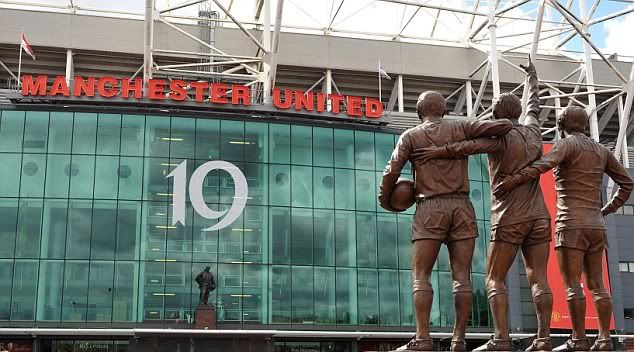
George Best with good friends Bobby Charlton
and Denis Law
The Genius from Belfast
It was obvious to Sir Matt Busby from the outset that the
skinny 16 year old from East Belfast's Cregagh Estate was something
extra-special. United's Northern Ireland scout Bob Bishop famously
sent a telegram Busby that read: "I believe I've found you a
genius." Best made his league debut for United in 1963 aged 17 and
won an international cap before he turned 18. It wasn't long before
he was a household name throughout Britain. George was perhaps the
most important member of the great United team which won the League
Championship twice in the 1960's.
By 1966, George Best superstar had arrived, especially after his
magnificent performance in United's 5-1 thrashing of Benfica in
Lisbon where he scored twice. Stepping off the plane the Portuguese
press dubbed him "El Beatle".
The only pupil in his class to pass the eleven-plus, the grammar
Best attended did not encourage football so he began truanting,
then moved to the secondary school. Best was offered a two-week
trial. His mother bought him his first pair of long trousers, but
two days into the trial he returned to Belfast complaining he was
homesick. Busby persuaded him back. Perhaps, Sir Matt would reflect
later, if his parents had accompanied him during his
apprenticeship, he would not have careered so spectacularly off the
rails. Although the manager himself acted as a father figure he
would soon wield little influence over his hedonistic young
charge.
The peak at 22
After five years of playing breathtaking football his place in
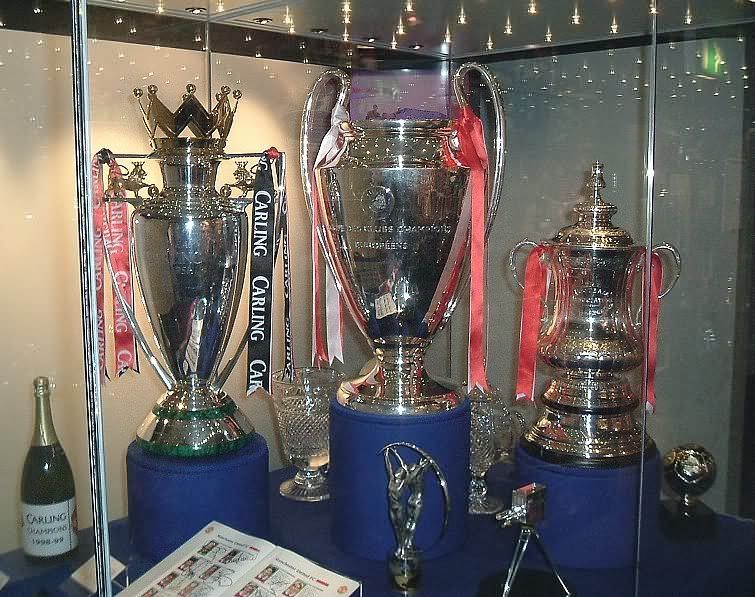
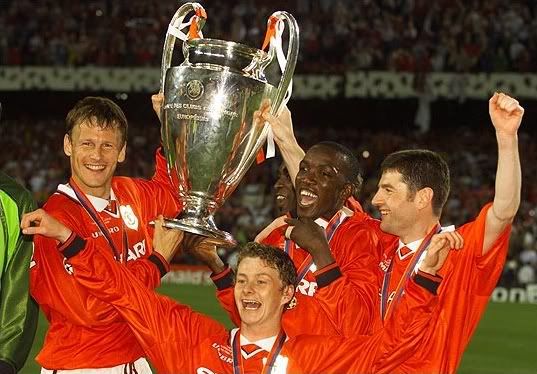
history was secured in 1968 - United became the first English team
to win the European Cup and Best scored a superb solo goal in the
final against Benfica. He later claimed that having beaten round
the Benfica keeper he wanted to take the ball up to the line stop
it, lie down on the ground and head the ball over the line. Only a
truly special sort of player would even have considered such an
outrageous act in a game of such importance.
In 1968 he was at his peak at only 22 years of age. That year he
also deservedly won both the English and European Footballer of the
Year awards. He was also the club's top scorer that year with 28
goals, and for the following four seasons. In 1970 he scored six
goals in an 8-2 win over Northampton in the FA Cup, the most goals
ever scored in a single match by any United player.
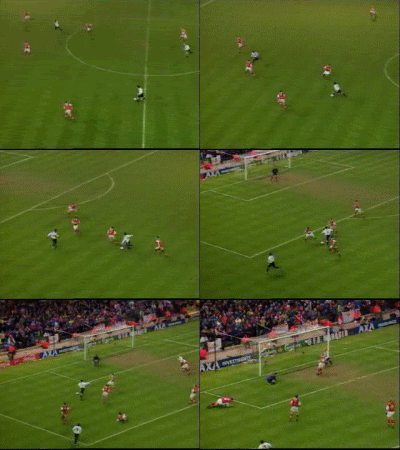
Bestie goals captured on television, such as the dazzling runs
against Sheffield United, Chelsea, West Ham and the delicate lob
against Spurs have become all-time classics. And who knows what
other gems he scored in an age before blanket television coverage,
great goals that now live on only in the memories of those lucky to
have been there at the time.
The first pop-star footballer
Nicknamed "the fifth Beatle", he was one of the most famous stars
in Britain during the 1960s. Best was the first pop-star
footballer, a personification of youth culture and the swinging
sixties. He had the good looks, the style and the girls went mad
for him with Best getting 10,000 fan letters a week. This had never
happened to a footballer before. Sadly it was this pop star image
that proved his eventual downfall, for he began to live the
lifestyle of a pop star, and not a footballer.
Best himself once said, "If I'd been ugly, you'd never have heard
of Pele". The alcohol, women and wild nights spent partying would
ultimately shorten his career and lead to severe health problems
later on. As he became a casualty of intense media attention,
George could not concentrate on football without being hounded
everywhere by paparazzi. He opened a night club and a number of
fashion boutiques which were not a success, while a string of
famous actress/model girlfriend's meant he was under incredible
media scrutiny.
At 17 Best turned professional and the rest is sporting history. At
20 he was earning £1,000 a week. By the age of 26 he had won a
European Cup winner's medal, two championship medals, European and
England Footballer of the Year and had been United's top scorer for
six seasons. After that, in his own words, there was "nowhere else
to go but down". And it was his life outside football that ensured
that was the direction he took.

Best: Known as the 5th Beatles
Best's talent was matched by his good looks. The long dark hair,
the brilliant blue eyes, the dimple, the effortless Irish charm -
all of it a magnet for women. He oozed high-octane celebrity. He
was the first footballer with pop star status and looks. His feet,
according to one commentator, were as dexterous "as a pickpocket's
fingers", his feints devastatingly deceptive, his bank account
swollen.
Everything was on a plate, and he was greedy. Clubbing, women, fast
cars, drink - in all he was insatiable. "It was spirits in those
days. I was a hairy-arsed footballer from Belfast and wine was for
poofters. So every night it was the same routine: out on the town
and stay partying until all the others had gone," he once
recalled.
His favourite haunt was Slack Alice, a Manchester nightclub he
part-owned. But he soon found himself on the wrong side of the law,
being fined for speeding in 1966, running over a woman in 1967, and
banned from driving in 1968 after ramming his Jaguar into another
car. But still he seemed untouchable.
When, in 1968, United defeated Benfica to lift the European Cup, he
got so drunk that "after the greatest day of my footballing life,
everything is a complete blank. I don't even remember going to the
official dinner". Women flocked to him. "Pulling girls had become a
sport for me and so I wanted to be the best at it
I would fly in a
girl from Australia
and after a couple of weeks when I got bored I
would send her back," he wrote in the second of his
autobiographies.

Eva Haraldsted became engaged to Best just
weeks after they met
United urged him to settle down. Even so, they were surprised when
a few weeks later he announced his engagement to a statuesque
student Eva Haraldsted, 21, whom he had met on a pre-season tour of
Denmark. "But you've only just met her," Sir Matt is said to have
spluttered. It was short-lived. Best told reporters he was too
young to marry and could not promise to be faithful. She sued for
breach of promise - he used to boast he was the last man to be sued
- and she received a £500 out-of-court settlement.
The decline
Many who knew him well believe that the seeds of this
self-destruction were sown the day he left Belfast. He was brought
up a Protestant on the religiously mixed Cregagh estate, the son of
Dickie, who worked in the shipyards, and Ann, who worked in an ice
cream factory. She was to die an alcoholic aged 58, her addiction
blamed on her cherished son's fame.
Once Sir Matt retired in 1969 it was downhill for the Ulsterman as
he became increasingly rebellious and erratic. Busby's successors,
Frank O'Farrell and Tommy Docherty lacked his fatherly influence on
Best. The United team was in decline and Best found it hard to
take. Seeing United beaten by teams they used to hammer a few years
ago was painful and his love for football slowly diminished. He
took solace in the bottle with drinking and partying taking over
his entire life. He was now frequently missing training and failing
to turn up for games.
By now, though, Best's bedroom and bar room capers were seriously
encroaching on his football. He missed training sessions, and in
1971 failed to turn up for a tie with Chelsea, instead going on a
date with the Irish actress Sinead Cusack. He missed another match
to spend a weekend with Miss Great Britain. It was behaviour Tommy
Docherty, United's new manager, was not prepared to tolerate.
Best's drunken binges dominated the headlines.
Docherty would later say: "George was a fantastic player and he
would have been an even better one if he'd been able to pass
nightclubs the way he passed the ball." Best's relationship with
United soured and in 1972 he announced his retirement. He would
make a brief comeback, only to leave again.

So, at 27, his career in top-class football was over. His success
with women, however, remained phenomenal. There were rumours that
he had slept with seven Miss Worlds, and in a later career as an
after-dinner speaker he would joke about this saying: "I used to go
missing a lot
Miss Canada, Miss United Kingdom, Miss World." He did
admit to three Miss Worlds, and the tally appears to include a Miss
United Kingdom and a Miss Scotland and Northern Ireland as
well.
Marjorie Wallace, the Miss USA who claimed the Miss World title in
1973, was stripped of it 104 days later after the beauty contest
organisers could no longer tolerate the steamy headlines. It was a
relationship that would end in more headlines when Best was
arrested at a nightclub and found himself in the dock before
Marylebone magistrates accused of stealing her mink coat, passport
and some letters. The charges were later dropped.
Susan George, the actress, and Lynsey de Paul, the singer were to
join his list too. As he said, in one of his most famous
one-liners: "I spent a lot of money on booze, birds and fast cars.
The rest I just squandered." During this time he made a living
playing for clubs in Britain and America, and by 1978 had decided
it was time to settle down. He chose as his bride Angie Macdonald
James, an Essex-born Bunnygirl who had moved to the US and was
working as an assistant to the singer Cher. She recalled that Best
arrived drunk for the wedding ceremony in Las Vegas, forgot the
ring and then spent his wedding night gambling. The marriage lasted
six years but produced his son Calum, 24.
There followed a romance with Mary Stavin, a former Miss World,
which kept him in the tabloids, especially during their explosive
break-up, and then he appeared to settle down with Mary Shatila. By
1982 Best was bankrupt, but there was always someone in the pub
honoured to buy their hero a pint.
In 1972 he announced his retirement at only 26 but was persuaded
back by Docherty. The comeback was not a success and George left
United for good on New Years Day 1974, his final game against
QPR.
Post-United Years
He then played for numerous other clubs, most notably Fulham
(76-77) with the outlandish ex Manchester City star, Rodney Marsh.
Then there was Stockport County, Hibernian and USA soccer teams
L.A. Aztecs (1976-78.) Fort Lauderdale Strikers (78-79) and San
Jose Earthquakes (80-81). Even though not as fit as in his prime,
the incredible skills were still apparent, no one could ever take
that away from him.
George finally ended his football career with Bournemouth in 1983,
although went on to play in many charity and friendly matches. In
the 1990's he established himself as a successful sports
commentator with Sky Sports and after dinner speaker. Though
playing for many clubs, it was still clear that Manchester United
were the only team that truly remained close to Best's heart - he
was a red through and through.
In 2000 Best's health reached rock bottom due to liver damage
caused by his years of alcoholism. However, in July 2002 he had a
successful liver transplant operation and made a full recovery.
Personal problems continued to hound him as he divorced for a
second time and was unable to beat the bottle.
On 1st October, 2005, George entered the Cromwell hospital with
flu-like symptoms, later suffering a kidney infection. He was
susceptible to infection because of medicines needed after the
liver transplant and his condition deteriorated sharply in the next
month when it spread to his lungs.
Ironcially his death was played out much the same way as his life,
in a blaze of media coverage. Though he fought on for far longer
than doctors ever expected, on 25th November, George Best lost his
battle for life. In Belfast, Manchester and around the world, the
whole of football was in mourning at the death of a legend.
A week later on 3rd December, the Belfast Boy came home to his
native city for the final time. 100,000 people lined the streets
and grounds of Stormont for the funeral of Northern Ireland's
greatest sporting hero.

Best married Alex Pursey when she was just
23
Throughout this time he remained with Mary Shatila then, suddenly,
she was dumped for Alex Pursey, a Virgin air hostess that he met,
predictably, at Tramp nightclub. They married when she was just 23
and he was 49. The spurned Mary vented her feelings in the tabloids
in an open letter to Best, wounding him with the words, "if there
is a perfect person for you I'd say it is your mother, which is
frightening". It was especially cutting because by then his mother
was dead.
Conclusion
There are many regrets for Best, such as ending his career early
and never displaying his phenomenal skills in the World Cup Finals.
However, when you look at the positive things he brought to British
football, the moments of sheer breath-taking excitement, the glory
of 1968, the lifestyle he led, George Best has lived more than most
of us ever will.
Let us also not forget he played for ten seasons at United - Eric
Cantona spent only five and few modern day players will have a
career as long in the red shirt. George Best's life on the surface
is the classic story of the wayward genius who had it all and
supposedly threw it all away.
However, pundits tend to overlook that it was this wild
self-destructive streak that made him the player he was. Genius
often goes hand in hand with some sort of eccentric quality, a
quality that gives that creative spark others do not possess.
Just a month before his death he said "People will remember me for
my football" and that is ultimately what will last the test of
time. George Best will live on as a football icon forever. Blessed
with unbelievable skill, he was a genius the like of which may
never come again. A player that took the game to a different level,
a level which mere footballing mortals can only gaze up at, in
wonder, awe and sheer exhilaration.

But, as he said in an interview a few weeks earlier: "I never
really learned to look ahead. I lived for the day." The interview
ended with "I'm not scared of dying". Not surprisingly the last
picture we have of George Best, lying desperately ill in hospital,
appeared, as it had so many times before, in a Sunday tabloid
newspaper.
Best wanted people to know the dangers of drink, said the story
next to a shocking picture which revealed the final toll of a
lifetime in thrall to alcohol.