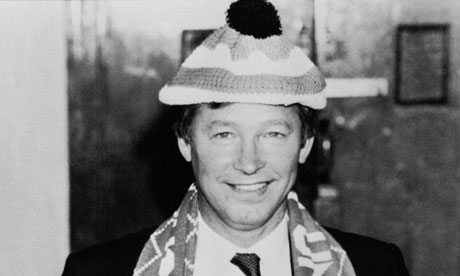
Matt Busby, Wilf McGuinness, Frank O'Farrell, Tommy
Docherty and Ron Atkinson all tried to bring the title back to Old
Trafford, but it took the appointment of Ferguson to restore the
club to their former glories. On the Sunday after Ferguson moved
from Aberdeen to Manchester United, the Observer ran two pieces on
the appointment.
Frank McGhee, a sports journalist who had followed United for 36
years, recalled the club's turbulent past and explained why no
manager had ever been able to emulate the success of Matt Busby.
McGhee argued that each of his successors had lacked the "arrogant
ego" required to dominate as dressing room and bring success to the
club. As time has told, Ferguson has no worries in that
department.
The manager Manchester United really need, have desperately
lacked and would love to have is unavailable and disqualified for
one reason. He is 76 years old. But if they can't get Sir Matt
Busby, it is obvious that they must look for someone with almost
all that marvellous man's qualities – reaching for the lot would be
asking for a bit much.
The indications are that in Alex Ferguson they may have come
fairly close to hitting the target, even though the most they can
hope for is an inner rather than a bullseye.
None of Ferguson's predecessors came anywhere near because, in
one way or another, they all lacked at least one of those qualities
and it may surprise those who don't know the man, even some of
those who think they do, that the most important is the arrogant
ego Busby so successfully concealed beneath layers of warmth,
kindness, knowledge of and love for the game that perhaps even he
didn't realise it was there.
It was there right from the day in October, 1945, he decided he
would accept the proper job as United manager "only if they would
let me have all my own way. As the manager I would want to be the
boss." Shortly afterwards, the then chairman, James Gibson, a
famous autocrat, suggested he should sign an available player from
Newcastle United. Matt said "no, he is not good for us" and when
the chairman, by then in an apoplectic rage, ordered the signing
Matt said: "I'll remind you of two things, Mr Chairman. I'm here to
manage the club and part of management is giving you advice. The
second is that I lived long before I ever saw you."
James Gibson never interfered again, nor did any other director,
particularly the one who leaned forward in the posh seats during a
match and in loud-voiced ignorance asked Matt why he wasn't
adopting different tactics. Matt caught up with him quietly in the
gents, to advise with soft menace: "Never dare say anything like
that to me when other people can hear you." He then put on the
agenda for the next board meeting the item "interference by
directors".
Has Alex Ferguson that sort of self-confidence? Ron Atkinson,
for all his front-as-big-as-Blackpool, possibly hadn't. Busby would
never have agreed to sell a player he wanted to keep and surely
Atkinson must have wanted to keep Mark Hughes.
Wilf McGuinness, the first successor, certainly didn't possess
the required self-belief. He was the lance corporal who continued
to call Busby "boss" and thereby unwittingly forfeited the respect
of the other privates in the barrack room. Two men who could have
had the job at around the same time, Jock Stein of Celtic, and Don
Revie of Leeds, would never have committed a similar error.
In fact, when Revie was asked by Jack Charlton how he wanted to
be addressed after elevation from dressing room to manager's office
he said: "From now on it's boss, ok?" Frank O'Farrell, the man who
did get the job next, was a thoroughly decent, likeable and
knowledgeable Irish Catholic, an extra qualification that
incidentally did him no harm in the eyes of a devout left-footer,
Busby. By the same token Matt would never favour a Catholic over a
Hottentot if the other guy was a better player. The only man he
required to hold a cross was his goalkeeper. Ferguson undoubtedly
fits that requirement also.
O'Farrell was, however, never in Busby's class as a manager of
men, a motivator or a communicator. "He came as a stranger and he
left as a stranger," was the caustic comment of Denis Law, one of
the quartet completed by Duncan Edwards, George Best and Bobby
Charlton who rank as Matt's all-time favourites.
Neither O'Farrell nor any other successor could match Busby in
public relations. Most significant was O'Farrell's failure to cope
with Best and, to set the record straight, Georgie never did
anything wrong at Old Trafford under Busby without being punished
and invariably apologising – before doing it again, of course.
Matt was wise and warm but never soft.
A sports reporter on the Manchester Evening News travelled just
once in Matt and Manchester United's company on a trip to London in
1950 and watched in awe as great players of that era, Johnny Carey,
Jack Rowley, Charlie Mitten, etc., walked around the manager in
wide, wary circles.
That same reporter, then on the Daily Mirror, didn't see him
again for four years. It was outside Hampden Park, with thousands
of strangers milling around, that Matt said instantly: "Frank
McGhee. How are ye son, good to see ye." He remembered with his
uncanny knack of putting names to faces and in that moment captured
an affection he has never lost. Respect, admiration and friendship
all blossomed over many years. He had to hurt many players by
dropping, selling and discarding them over those years but it
provides its own tribute that so few ever resent it.
It is unreasonable to expect any successor to have quite the
same knack or anything like the deep love for United Busby shows,
though undoubtedly Tommy Docherty will insist that he came as close
as possible to matching it. But, for all his enthusiasm, bounce and
near-genius for motivation, Tommy was, in show business terms, a
talented lightweight patter comedian in the shadow of a great star
of awesome mag-nitude. Still, at least Tommy always gave a
convincing impersonation of being willing to seek advice from Matt.
Pity he was always also destined to provide the source of his own
downfall. He did a great deal for United, then threw it all
away.
At times he provided something like the football Busby had led
Old Trafford fans to first expect and then demand. The next
manager, Dave Sexton, unfortunately, didn't – even though Matt's
hopes for him were intially the highest. "Dave could be the one
we've been waiting for," was Busby's own accolade at the time.
It must be psychologically significant that in their 15-year
search for a successor, the pendulum has swung so contrastingly.
From the tail-wagging friendly puppy of McGuinness to the sober,
serious O'Farrell. From Docherty's wisecracking ebullience to
Sexton's simmering, brooding silences. Like O'Farrell before him,
Dave's academy was the West Ham one, and for the Old Trafford
school that meant too much blackboard, not enough jungle.
Atkinson provided another contrast. As extroverted as Docherty,
he never somehow struck the same accord as Tommy with the people
who really own this club, no matter what the record in the
directory of directors niay say. The fans were never given by
Atkinson what they see as their occasional right, the championship.
Busby did it five times, came second seven times and that is what
they have been seeking so hungrily ever since. That is what is
required of Ferguson. He needs to be another Busby and maybe this
chunk of newsprint will give him some idea of what is required.
The second piece in the Observer on Sunday 8 November, 1986, was
written by Patrick Glenn, a Scottish football writer who had
tracked the young manager's career north of the border. Glenn's
experience of Ferguson showed that the manager had the competitive
desire required to handle his new job – and his final sentence
about the silence at Old Trafford has proved oddly prescient.
When Martin Edwards offered Alex Ferguson the Manchester United
job last Thursday, it was as if the Big Fisherman himself had held
out the key to the Pearly Gates. The very idea of Ferguson's
non-acceptance was absurd.
His irresistible competitiveness – at times, it borders on the
psychopathic – has long been sustained by apparently endless
energy, and to have refused the biggest club in Britain would have
seemed to Ferguson a self-betrayal deserving of hara-kiri.
Now, he can leave the ceremonial sword in its sheath and get on
with giving players, journalists, cleaners, directors, tea ladies,
secretaries and all who come and go at football grounds a mixture
of hard times, merciless ribbing, perhaps the formation of a quiz
league embracing every subject possible and, most importantly, the
unmistakable impression that here is a man who knows the most
direct route towards his destiny.
Ferguson's unshakable commitment to whatever cause he espouses
has been evident since, as a teenager, he led his fellow apprentice
toolmakers' industrial action at their factory on the south side of
Glasgow. Later, he would become chairman of the Scottish
Professional Footballers' Association.
He is an almost inconsolable loser, whether in football, his
beloved quizzes or in life itself. In his earliest days as manager
of St Mirren, still in the Scottish first division, he took his
team to Clydebank to face his closest rivals in the chase for
promotion to the premier division. It was a complete sell-out and,
when Saints went 2-0 down, Fergie could be seen leaping from the
dugout in a clear attempt at throttling the linesman nearest to
him. It was Christmas Day.
Scotland manager Andy Roxburgh swears that Ferguson has not
forgiven him his lapse almost 20 years ago during a round of 'Quiz
Ball,' a popular television game for football clubs at the time.
They were both on the Falkirk side and Roxburgh was asked which
jockey had won the previous year's Grand National.
Totally ignorant of horseracing, he became more nervous as he
heard Fergie stage-whispering and trying to throw pieces of paper
his way. Desperately, he blurted out "Lester Piggott", crediting
the world's greatest flat jockey with victory in the worki's most
famous steeplechase. From the other end of the table, he heard
Ferguson groan loudly, "Aw, Jeeesus Christ!"
On the Saturday Falkirk had a League match at Brockville and as
Roxburgh took the field– and here, he is convinced Alex had
actually used a loud hailer to organise the fans – the entire crowd
in the covered enclosure rose at once and chanted, "Les-ter
Pig-gott, Les-ter Pig-gott".
As St Mitten manager, Ferguson used a van with a loud-hailer to
tour the working class areas of Paisley, exhorting people to come
to matches. When he took over at Love Street, after just months
experience with East Stirling, crowds were down to less than 1,000.
When be left, 10,000 was commonplace, not counting matches against
Celtic and Rangers.
Nobody with his sense of urgency could accomplish what he has
without littering his trail with incident and controversy. Tales of
flying tea-sets in dressing rooms at half-time are both plentiful
and authentic. He has been knovm to batter on a referee's door
during the interval of a match with his team leading 3-0 and on the
way to clinching the league championship.
But for all the volatile aggressiveness, he is an incurable
joker. During Scotland's World Cup preparations in Santa Fe, New
Mexico, he discovered an attractive lounge with a beautiful, white
grand piano. He asked the manager about it and was told that it
played automatically. For a fee, they could arrange to make it look
as though he was playing.
The deal was done and that night Fergie took the entire backroom
staff out to dinner. When he offered to play the piano ("I'll admit
it's been some time," he said) the disbelief was obvious. But, with
every action exaggerated, it came out as pure Semprini.
Teddy Scott, Fergie's colleague at Aberdeen, couldn't recover.
"I thought I knew everything," said Teddy. "During his time with
us, he has told me everything, described in detail every daft goal
he ever scored and all the easy chances he ever missed. He never
keeps quiet, but I never knew he could play the piano."
Now he will be playing to one of the most demanding audiences in
the game and that will make him totally satisfied. Despite his
semi-love of Aberdeen FC, he was never at one with fans who, he
would say "sit on their hands". Alluding to a woeful lack of
vociferous support during a big European match one night, he said:
"There was more noise at my granny's funeral."
With him at Old Trafford, silence will be a golden rarity.
Ferguson began his career at United with a 2-0 defeat at Oxford
United and a goalless draw at newly promoted Norwich City. His
first win came at Old Trafford against QPR on November 22, 1986. In
his programme notes before that
game Ferguson wrote: "Taking over a club of the
magnitude of Manchester United is an awesome prospect. But
ultimately a football club is a football club and I shall simply
try to run things at Old Trafford in what I believe to be the right
way."
"I am not really interested in what has happened here in the
past. I don't mean any disrespect to the great achievements of
Manchester United over the years. It's simply that now there is
only one way to go, and that is forward. The aim at this club must
clearly be to win the championship."


