Source: http://www.beginnertriathlete.com/cms/article-detail.asp?articleid=486
Hard Core - Exercises to
Strengthen Your Abs For Better Performance
A strong core will allow you to keep optimal body alignment for
whatever you’re doing (swim, bike or run), and this in turn will
reduce your fatigue in the long run.
"If your core is
weak, nothing else can be strong"
By Justin Maguire
B.T.com contributor
Thought I'd capture some simple thoughts about the importance of
core work, and then share my favorite core workout dreamed up by my
evil, whip brandishing trainer...er... I mean... my wife.
Sit-ups suck!
Yes... most core work sucks when your core is out of shape. I too
used to hate doing this, but it's helped my swimming, biking and
running immeasurably. So suck it up and make this a part of your
routine (I'd recommend twice a week). Welcome to the world of a
strong core and ripped abs.
Why is core work important?
Strengthening your core will allow your body to efficiently
transfer force from the lower to the upper body and back again,
thus ensuring that any force you exert to move your body forward
isn't wasted in moving your body sideways, etc. A strong core will
allow you to keep optimal body alignment for whatever you’re doing
(swim, bike or run), and this in turn will reduce your fatigue in
the long run (good form usually takes less energy than bad
form).
The problem is that most people equate "core" with abs only. The
reality is that your core includes your upper back muscles (head
carriage), gluteals (pelvis stabilization), oblique and what you
consider "abs". My wife is the person who initially built this
little core routine for me (thx Trish! - I think!). I really like
this session because it works most of your core muscles &
challenges the body to stabilize itself throughout multiple axes of
movement, while keeping it interesting and broken into manageable
chunks.
After posting this, I was contacted by Marlon Familton at Dynamic
Sports Training. He has an excellent article (Back to the Future of Abdominal Training) on core
training. VERY good stuff in here, so give it a read. Remember...
I'm offering you a starting point for core work. Working with the
information in Marlon's document and a good trainer, feel free to
take yourself to the next level.
"Around the world"
This set should be
considered reasonably advanced. If you have not done core work
before, then you may consider doing some basic crunches before
stepping up to this workout. Before I describe each exercise
it's important to remember the following 5 things:
As with anything
new, introduce your body to these gradually. These will work your
body in a very different way than you are used to, so take it
easy!
If you aren't
breathing while doing these, then you're doing them wrong.
Go slow. Speed is
not important, and will usually lead to using momentum to cheat
your way through the exercise.
Quality over
quantity.
Do these with other
people. It's great fun, and will keep you motivated.
I call this "Around
the world" because it works all of your core muscle groups. There
are 15 different core techniques to this routine - 3 for each side
(the front goes twice). You'll start by selecting your interval.
The total number of reps you will do in this routine is based upon
the number you choose here x 15. So, if you select 25 then you will
be doing 15 X 25 = 375 reps. For beginners I'd choose 10,
intermediate 15, advanced 20-25, Elite 25-35. At the end, lay on
your stomach for 2-3 minutes and gently come up into a cobra
position to stretch your stomach muscles. Make this a part of your
workout routine twice a week, and you'll be amazed at how much
stronger you will feel come race day.
Core Set
1. Standard Crunch - Think about a string attached
to your belly button & running through your body pulling your
stomach towards the floor.

2. Knee-up
crunches - Focus on keeping the small of your back against
the floor even throughout the range of motion. SLOOOW. :)

3. Hip
lifts - Keep your legs straight and don't let them rock
back as your lift your hips. YES - I'm pushing down w/ my hands so
I could hold this forever for the camera, but you should put your
palms facing up! :) These are tough... don't speed through
them.

4. Oblique
crunches - You should feel your ribs pressing pinching
into your side. Try not to fold forward, but rather bend up trying
to get your elbow to touch your feet.

5. Side
Plank Dips - Keep your body in a straight line (one plane)
and keep the movement smooth and slow. Your hips should just touch
(but not rest on!) the ground.

6. Oblique Leg Extensions - This not only works
your obliques, but should also engage your piriformis & hip
flexor as well. Don't let your leg touch the ground, and when the
leg is fully extended your butt should be tightly squeezed rotating
your leg out ever so slightly (this is the piriformis part).

7. Supermans - Each side counts as 1/2 of a rep.
Your stomach muscles should be engaged when you lift up. Think
about your arm and leg not only being pulled up, but also out. Hold
it at the top for 2 seconds.

8. Bridged Leg Lifts - Each leg counts as 1/2 of a
rep. Keep your butt down. You don't need to lift your legs super
high.
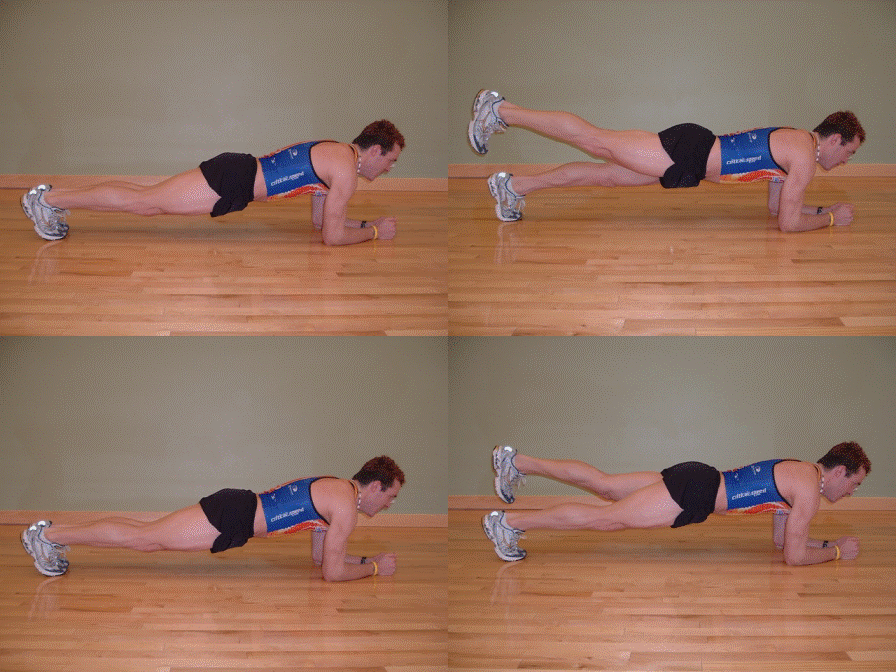
9. Pushups - Keep your head raised and looking
forward, and your body in a perfect horizontal plane. Your elbows
should bend back, not out to the side.

10, 11, 12. Repeat steps 4, 5, and 6, but do the other side.
13. Heel Touches - Each heel touch counts as
1/2 of a rep. Keep your shoulder blades off the ground, remember to
breathe, and make sure your feet are far enough away from you that
you have to really reach to touch the heel.

14. Bicycle Crunches - Each leg counts as 1/2 of a
rep. Each twist w/ leg extension should take you long enough to say
"one one thousand" to yourself, no faster. Try to keep your
shoulder blades off the ground.

15. Half Up Twists - Sit up, put your hands on top
of your knees and then lean back until your arms are straight.
Cross your arms in front of you (each hand holding an elbow) and
start twisting! Each side counts as 1/2 of a rep.


