
Japanese preschool: 12 things that stun Chinese mom
An expatriate
Chinese mother in Kyoto, Japan, expressed her shock over the
pre-school education system as well as the schooling habits of
young children there. She shared her experience and observations on
the Internet.
She wrote: "Before coming to Japan, Tiantian (her daughter)
had already gone through a year of kindergarten in Beijing, so you
could say that we are no strangers to kindergarten. But there are
some things in Japanese kindergartens that have stunned
me."
The following are 12 of her observations:
1. The ridiculous number of
bags.
2. All these bags carried by
children, while adults carry
nothing.
3. Changing clothes over and
over again
4. Wearing shorts in
winter
5. 0-Year-Old infants competing
in athletic events
6. Girls playing
soccer
7. Mixed
education
8. Education: All "Smiles" and
"Thank you"
9. The number of
activities
10. All the holidays Chinese
people don't celebrate - Japanese kindergartens
celebrate
11. Teachers'
abilities
12. Buddhist
Influences

1. The ridiculous number of
bags.
"On the first day, they explained to us that we needed to
prepare a certain number of bags of various sizes:
"A schoolbag, a blanket bag, a bag for eating utensils, a
box for eating utensils, a bag for clothes, a bag for for changing
clothes, a bag for clothes after they have been changed out of, and
a bag for shoes. Then that bag A had to be of such-and-such a
length, bag B had to be of such-and-such a width, bag C had to fit
in bag D, and E in bag F. I just couldn't believe it.
Some kindergartens even
ask mothers to make their own bags!
After
two years, we're used to it, and the kids have become very
good at putting things in their right place. I often think that the
reason that the people of Kyoto don't mind sorting their rubbish
might be because they've been taught this kind of thing from a
young age."

2. All these bags
carried by children, while adults carry
nothing.
"This is a sight that really shocked me: when dropping kids off or
picking them up, I noticed that the other Japanese adults, be they
mother, father, or grandparent, were carrying absolutely nothing,
while all those bags of different sizes (at the very least two or
three) mentioned above were carried by those little cuties. What's
more, they were running really fast!
But for us? Maybe it is out of habit, or maybe it is because it is
a cultural thing, but I carried the bags, and Tiantian carried
nothing.
A couple of days later the teacher came and had a chat with me:
"Tiantian's mother, Tina does everything herself at school ..."
Japanese people have a habit of saying only the beginning of a
sentence, and letting you work out the rest yourself.
I immediately realized that she was asking about the situation at
home, but seeing me thinking it over, the teacher continued, "...
carrying her schoolbag for example ..." After this tactful
reminder, I let Tiantian carry her own schoolbag.
When
the time came for a parents' meeting, I told everyone that in China
the custom was for parents to carry everything. It was the Japanese
mothers' turn to be dumbfounded. As one, they asked:
"Why?"
Why? Is it because we
Chinese love our children a little more?"
3. Changing clothes over and
over again
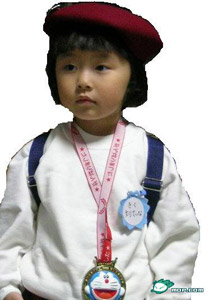
Tiantian's kindergarten has its own uniform; when she arrives she
has to take it off, and change into overalls for playtime. She has
to take off her shoes and put on white ballet shoes, when she goes
into the exercise yard she has to change her shoes again. After
their afternoon nap the kids have to change clothes again. A real
pain.
When Tiantian was in Chrysanthemum Class she used to be so slow
changing clothes, and I couldn't help but give her a hand. But I
soon noticed that all of the Japanese mothers were standing to one
side, not helping at all. I slowly saw that this business of
changing clothes educated the children in living independently.
Through things like their experiences at school, changing, sticking
their daily sticker, and hanging their handkerchiefs, these kids
start from when they are two or three years old to learn the habit
of keeping things orderly.

4. Wearing shorts in
winter
"Children in Japanese schools wear shorts in winter, no matter how
cold it is. My daughter's grandparents in Beijing were very
worried, and said that I had to talk to the teacher about it,
because Chinese children can't stand the cold.
Wouldn't
you know it, when we had just started kindergarten, practically
every day she got sick. But when I talked to the Japanese mothers
about it, their answer amazed me. "Of course! The reason we send
our kids to kindergarten is to get sick."
Seeing the
healthy energy of the children charging about like little rockets,
greeting me, it occurred to me that we shouldn't spoil our kids too
much."

5. 0-Year-Old infants competing
in athletic events
"All classes are named after flowers. Tiantian was a chrysanthemum,
then a lily, now she's one of the 'older sisters', a violet. But
the little babies who haven't reached their first birthdays are all
in the 'Peach Blossom' class.
These mo-mo (peaches), who haven't even reached
their first birthday, have not only already started going to
kindergarten, but take part in all of their major activities, like
sports competitions and performances. Seeing these
little mo-mocrying while crawling forward, I usually
feel bad for them.

6. Girls playing
soccer
"When children reach their middle year of kindergarten in Japan,
they start taking weekly 'jumping' lessons, similar to our Physical
Exercise lessons back home; when they get to their senior year,
there is a soccer competition. When they're not practicing their
drumming all day, they're practicing soccer. And they really play
too, they even have competitions with other kindergartens. Tiantian
has bruises from playing but her strength and bravery have been
brought out.
To tell the truth, when we first came to Japan, Tiantian's
performance was really shameful. Japanese kids usually start
shooting up at about three or four years old, before that they are
a lot shorter than Chinese kids. In Tiantian's class she was a
giant, but was in actual fact quite weak.
The Japanese kids would run about outside, but Tiantian? She'd get
a grain of sand in her shoe and would have to tiptoe to walk. Once
there was an excursion where they went up a mountain, and she could
only come down with two short Japanese kids supporting her. These
uncomplaining three-year-olds, who didn't have the experience of
allowing her to travel on foot up a mountain for an hour. She's
better now, last year at Shangrila, in that low oxygen environment
she walked for four hours without any problems.
7. Mixed
education
When we were
in China I saw Tiantian's kindergarten a few times. Each class
would have its classes separately, but in Japan this isn't the
case.
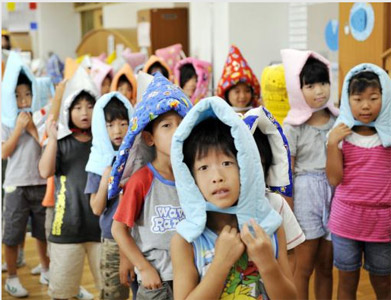
Before 9.30am, and after 3.30pm, the entire school plays together.
And in the yard big kids hold little kids, little kids chase big
kids, they carry on like crazy. They get to really experience
having 'siblings'.
For
example, in Tiantian's and the other senior year's last assembly a
few days ago, after performing their piece, they said something
that made all the parents cry.
"In today's assembly we're very happy, because the children from
lower years performed so successfully. This is our last assembly,
and when we start junior school we'll be sure to remember our
friends and our kindergarten."

8. Education: All
"Smiles" and "Thank you"
In this kindergarten, it seems like they don't care at all about
the children's intellectual education. They don't have textbooks,
just a new sketchbook every month. In the school's education plan,
there aren't any subjects like mathematics, kana, art, or music.
Don't even ask about English or the International Math Olympiad.
They don't learn roller skating or swimming.
When you ask what
they teach, you'd never guess what the answer is: "We teach the
children to be all smiles!"
In Japan,
no matter where you are, or to who you're talking to, "being all
smiles" is most important. A girl who is "all smiles" is most
beautiful.
What else do they teach? - They
teach children to "say thank you".
In everything there are things that they stress here that they
don't in China. But after three years I can see that Tiantian has
improved in things like music, art and reading, and these
improvements are from a comprehensive education.
9. The number of
activities
Looking
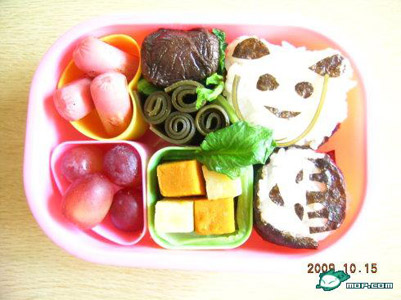
at my calendar I can see the days when I need to make lunch for
Tiantian to take to school. These are the days when she has
excursions. I can't count how many times she climbs mountains, how
many lakes she's seen, or how many animals or plants she's gone and
looked at.
Apart
from that, she's also gathered acorns, made cakes, been to sports
carnivals, performed for community events, had sleepovers,
celebrated festivals, been at assemblies, attended temples,
exhibitions ... let's just say that there have been a
lot.

10. All the holidays
Chinese people don't celebrate - Japanese kindergartens
celebrate
"This really floored me too. Like I mentioned above, Japanese
kindergartens celebrate their own traditional holidays, Girls' Day,
Boys' Day, Hungry Ghost Festival ... Not only this, they also
celebrate Renri (held on the 7th night of the
lunar new year), and Qixi.
Today
she came back, and said "Today, teacher asked how we celebrated
these holidays in China, I said I didn't know". What a disgrace!
Mommy doesn't know either."

11. Teachers'
abilities
"In one Japanese class there are ten to thirty students, but only
one teacher. In the beginning I had my doubts, if she was able to
keep her eye on all of them she'd be pretty good. Then I found out
that I had underestimated these Japanese kindergarten teachers.
With just this one teacher, thirty children's artworks, the lead
for their drumming pieces (so professional), thirty children's art,
music, reading, thirty children's birthdays, their major assemblies
and sports carnivals are all organised methodically and
thoroughly.
Look at the
teacher, she's always cool and relaxed. And she's about
50-years-old! I salute her!"

12. Buddhist
Influences
"Kyoto has probably more temples than any other city in Japan, it
has a kind of monastic ambiance. Tiantian has to go to temple every
week for instruction. In the most important festivals she has to
bow to Buddha, and there are activities on every Buddha's Birthday
and Nirvana day.
Tiantian is graduating soon, yesterday she went to Nishi Honganji
temple to make a wish. Tiantian was the class representative and
gave Buddha some flowers. I asked her what she wished, and she said
"To always trust in Buddha, to always treat others with a thankful
heart, and to always heed others' words."


