The average British carnivore eats more than 11,000 animals in
their lifetime, each requiring vast amounts of land, fuel and water
to reach the plate. It's time to think of waste as well as
taste
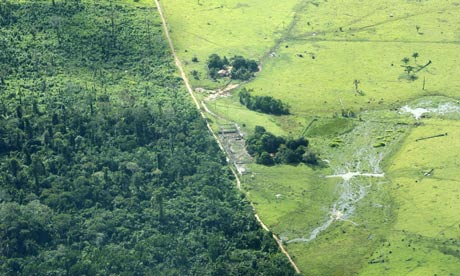 Millions
of hectares of trees have been felled for cattle ranching in the
Amazon. Photograph: Paulo Whitaker/Reuters
If we really want to reduce the human impact on the environment,
the simplest and cheapest thing anyone can do is to eat less meat.
Behind most of the joints of beef or chicken on our plates is a
phenomenally wasteful, land- and energy-hungry system of farming
that devastates forests, pollutes oceans, rivers, seas and air,
depends on oil and coal, and is significantly responsible for
climate change. The way we breed animals is now recognised by the
UN, scientists, economists and politicians as giving rise to many
interlinked human and ecological problems, but with 1 billion
people already not having enough to eat and 3 billion more mouths
to feed within 50 years, the urgency to rethink our relationship
with animals is extreme.
We humans eat about 230m tonnes of animals a year, twice as much as
we did 30 years ago. We mostly breed four species – chickens, cows,
sheep and pigs – all of which need vast amounts of food and
water, emit methane and other greenhouse gases and produce
mountains of physical waste.
But how much stress does our meat-eating put on ecological systems?
The answer is a lot but the figures are imprecise and disputed. In
2006, the UN calculated that the combined
climate change emissions of animals bred for their
meat were about 18% of the global total – more than cars,
planes and all other forms of transport put together.
The authors of the report, called Livestock's Long Shadow, did not
just count the methane from the belching, farting cattle, but the
gases released from the manures that they produce, the oil burned
taking their carcasses to markets often thousands of miles away,
the electricity needed to keep the meat cool, the gas used to cook
it, the energy needed to plough and harvest the fields that grow
the crops that the animals eat, even pumping the water that the
cattle need.
The figure was revised upward in
2009 by two World Bank scientists to more than 51%, but
attempts to fully account for meat-eating are condemned as
simplistic. Should the studies have been based on giant US factory
farms, or on more sustainable breeding in Europe? Should you
include all the knock-on emissions from clearing forests? What
about the fertiliser used to grow the crops to feed to the animals,
or the emissions from the steel needed to build the boats that
transport the cattle; or the "default" emissions – the greenhouse
gases that would be released by substitute activities to grow food
if we were to give up meat? And is it fair to count animals used
for multiple purposes, as they mostly are in developing countries,
from providing draught power to shoe leather or transport, and
which only become meat once they reach the end of their economic
lives?
It's an accounting nightmare but depending on how it's done,
livestock's contribution to climate change can be calculated as low
as 5-10% of global emissions or as high as 50%. Last year,
a Food
Climate Research Network report concluded that UK meat and
dairy consumption was responsible for 8% of the country's total
greenhouse gas emissions. But however it's counted, livestock
farming ranks as one of the three greatest sources of climate
changing emissions and one of the largest contributors to
environmental degradation.
A human population expected to grow by 3 billion, a shift in
developing countries to eating more meat, and global consumption on
track to double in 40 years point to the mother of all food crises
down the road. How much food we grow is not just limited by the
amount of available land but meat-eaters need far more space than
vegetarians. A Bangladeshi family living off rice, beans,
vegetables and fruit may live on an acre of land or less, while the
average American, who
consumes around 270 pounds of meat a year, needs 20 times
that.
Nearly 30% of the available ice-free surface area of the planet is
now used by livestock, or for growing food for those animals. One
billion people go hungry every day, but livestock now consumes the
majority of the world's crops. A Cornell University study in 1997
found that around 13m hectares of land in the US were used to grow
vegetables, rice, fruit, potatoes and beans, but 302m were used for
livestock. The problem is that farm animals are inefficient
converters of food to flesh. Broiler chickens are the best, needing
around 3.4kg to produce 1kg of flesh, but pigs need 8.4kg for that
kilo.
Other academics have calculated that if the grain fed to animals in
western countries were consumed directly by people instead of
animals, we could feed at least twice as many people – and possibly
far more – as we do now.
To make matters worse, our hunger to eat animals has led to
overstocking of fragile lands and massive soil erosion and
desertification. Overgrazing, from the downlands of southern
England to the uplands of Ethiopia and mountains of Nepal, causes
great loss of fertility, as well as flooding.
But the figures must be treated with caution. Animal manures can
revitalise the soil and millions of animals live on marginal land
that is quite unsuitable for crops.
But before we leap to conclusions and lump all livestock rearing
together, consider this: in western countries animals are bred and
reared to put on as much meat as possible in the shortest time
after which they are slaughtered. But in poorer regions, cattle –
especially in dry areas – are central to human life and culture and
often the only source of food and income for many millions of
pastoralists. The ceaseless movement of these nomadic herders over
vast areas is the backbone of many African economies and, a major
new study from the International Institute for Environment and
Development suggests, a far more ecologically efficient method of
farming than the way cattle are reared in Australia or the US.
Eat a steak or a chicken and you are effectively consuming the
water that the animal has needed to live and grow. Vegetarian
author John Robbins calculates it takes 60, 108, 168, and 229
pounds of water to produce one pound of potatoes, wheat, maize and
rice respectively. But a pound of beef needs around 9,000 litres –
or more than 20,000lbs of water. Equally, it takes nearly 1,000
litres of water to produce one litre of milk. A broiler chicken, by
contrast, is far more efficient, producing the same amount of meat
as a cow on just 1,500 litres.
Pigs are some of the thirstiest animals. An average-sized north
American pig farm with 80,000 pigs needs nearly 75m gallons of
fresh water a year. A large one, which might have one million or
more pigs, may need as much as a city.
Farming, which uses 70% of water available to humans, is already in
direct competition for water with cities. But as demand for meat
increases, so there will be less available for both crops and
drinking. Rich but water-stressed countries such as Saudi Arabia,
Libya, the Gulf states and South Africa say it makes sense to grow
food in poorer countries to conserve their water resources, and are
now buying or leasing millions of hectares of Ethiopia and
elsewhere to provide their food. Every cow fattened in Gambella
state in southern Ethiopia and exported to Abu Dhabi or Britain is
taking the pressure off water supplies back home but increasing it
elsewhere.
Global agribusiness has for 30 years turned to tropical rainforests
– not for their timber but for the land that can be used to graze
cattle or grow palm oil and soya. Millions of hectares of trees
have been felled to provide burgers for the US and more recently
animal feed for farms for Europe, China and Japan.
In its latest food report What's
Feeding Our Food? Friends of the Earth estimates that
around 6m hectares of forest land a year – an area equivalent to
Latvia or twice the size of Belgium – and a similar acreage of peat
and wetlands elsewhere, is converted to farmland a year. Of that,
it says, most goes to livestock or to grow the crops to feed the
cattle.
As soya becomes the world's major crop for chicken feed, so the
industry is driving cattle ranching deeper into the forests.
Industrial-scale agriculture now dominates the western livestock
and poultry industries, and a single farm can now generate as much
waste as a city. A cow excretes around 40kg of manure for every
kilogram of edible beef it puts on and when you have many thousands
crowded into a small area the effect can be dramatic. Their manure
and urine is funnelled into massive waste lagoons sometimes holding
as many as 40m gallons. These cesspools often break, leak or
overflow, polluting underground water supplies and rivers with
nitrogen, phosphorus and nitrates.
Tens of thousands of miles of rivers in the US, Europe and Asia are
polluted each year. A single spill of millions of gallons of waste
from a
North Carolina pig factory lagoon in 1995 killed about 10
million fish and forced the closure of 364,000 acres of coastal
wetlands to shellfishing.
The sheer quantity of animals now being raised for humans to eat
now threatens the earth's biodiversity. More than one third of the
world's 825 "ecoregions" identified by conservation group WWF are
said to be threatened by livestock and giant US group Conservation
International reckons that 23 out of 40-odd global "biodiversity
hotspots" – the places considered most valuable for life – are now
seriously affected by livestock production.
The present oil pollution disaster in the Gulf of Mexico is not the
only problem that the region faces. Most summers between
13,000-20,000 sq km of sea at the mouth of the Mississippi become a
"dead zone", caused when vast quantities of excess nutrients from
animal waste, factory farms, sewage, nitrogen compounds and
fertiliser are swept down the mighty river. This causes algal
blooms which take up all the oxygen in the water to the point where
little can live.
Nearly 400 dead zones ranging in size from one to over 70,000sq km
have now been identified, from the Scandinavian fjords to the South
China Sea. Animal farming is not the only culprit, but it is one of
the worst.
Anyone who has lived close to a large factory farm knows the smells
can be extreme. Aside from greenhouse gases such as methane and
carbon dioxide, cows and pigs produce many other polluting gases.
Global figures are unavailable but in the US, livestock and animal
feed crops are responsible for 37% of pesticide use, more than half
of all the antibiotics manufactured and a third of the nitrogen and
phosphorous in fresh water. Nearly two thirds of the manmade
ammonia – a major contributor to acid rain – is also generated by
livestock. In addition, concentrated factory farming of animals
contributes to ozone pollution.
Animal waste contains many pathogens including salmonella, E coli,
cryptosporidium, and fecal coliform, which can transfer to humans
through water run-off or manure or touch. In addition, millions of
pounds of antibiotics is added to animal feed a year to speed the
growth of cattle. But this contributes to the rise of resistant
bacteria, and so makes it harder to treat human illnesses.
The western animal farming economy is based on oil, which is why
there were food riots in 23 countries when the oil price peaked in
2008. Every link in the chain of events that brings meat to the
table demands electricity, from the production of the fertiliser
put on the land to grow the animal feed, to pumping the water they
need from the rivers or deep underground, to the fuel needed to
transport the meat in giant refrigerated ships and the supermarket
shelves. According to some studies, as much as one-third of all
fossil fuels produced in the United States now go towards animal
agriculture.
Polls suggest that 5-6% of the population eats no meat at all, with
many millions of others consciously reducing the amount of meat
they eat or only eating it occasionally. This is backed by new
government figures which show that last year we ate 5% less meat by
weight than in 2005.
But the quantities are still staggering: according to the
Vegetarian Society, the average British carnivore eats over 11,000
animals in a lifetime: 1 goose, 1 rabbit, 4 cattle, 18 pigs, 23
sheep and lambs, 28 ducks, 39 turkeys, 1,158 chickens, 3,593
shellfish and 6,182 fish.
For this, say the vegetarians, the meat eaters get increased
chances of obesity, cancers, heart diseases and other illnesses as
well as a hole in the pocket. A meat diet is generally considered
twice as expensive as a vegetarian one.
