1. Because the core
theory: marxism-leninism.
What about anti-imperialism? That was a principle of Lenin. For
people suffering under colonialism, the main attractiveness of
Leninism is anti-imperialism, not those mumbo jumbo about
anti-capitalism.
The
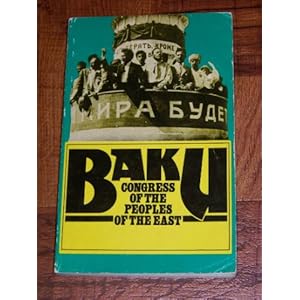
Congress of the Peoples of the East held in Baku in September, 1920
holds a special place in the history of the Communist
movement.
It was
the first attempt
to appeal to the exploited and oppressed peoples in the colonial
and semi-colonial countries to carry forward their revolutionary
struggles under the banner of Marxism and with the
support of the workers in Russia and the advanced countries of the
world.
The
summons to Baku was issued by the Second Congress of the Communist
International, which met in July and August in Moscow. In making
this call, the Second Congress made a conscious break with the
neglect of the national and colonial question by the Second
International, based as it was almost exclusively on European
parties.
It recognised both that
it was a prime duty of working class revolutionaries to support the
struggle of their colonial brothers and that the colonial
revolution could be a valuable ally in the overthrow of imperialism
in its strongholds.
Further,
in 1920 the whole
colonial and semi-colonial world was aflame,
especially in the countries bordering the Soviet republic, so that
these movements could be of direct assistance in warding off the
offensive of the imperialists, notably the British, with the aim of
establishing their power on the ruins of the Ottoman Empire. This
was the atmosphere in which the Congress met.
http://www.marxists.org/history/international/comintern/baku/foreword.htm
The heroic struggle now being waged by the people of Panama against
U.S. aggression and in defence of their national sovereignty is a
great patriotic struggle. The Chinese people stand firmly on the
side of the Panamanian people and fully support their just action
in opposing the U.S. aggressors and seeking to regain sovereignty
over the Panama Canal Zone.
U.S. imperialism is the most ferocious enemy of the people of the
entire world.
It has not only committed the grave crime of aggression against the
Panamanian people, and painstakingly and stubbornly plotted against
socialist Cuba, but has continuously been plundering and oppressing
the people of the Latin American countries and suppressing the
national-democratic revolutionary struggles there.
In Asia, U.S. imperialism has forcibly occupied China’s Taiwan,
turned the southern part of Korea and the southern part of Vietnam
into its colonies, kept Japan under its control and semi-military
occupation, sabotaged the peace, neutrality and independence of
Laos, plotted to subvert the Royal Government of Cambodia, and
committed intervention and aggression against other Asian
countries. More recently, it has decided to send a U.S. fleet to
the Indian Ocean, menacing the security of all the countries of
South-east Asia.
In Africa, U.S. imperialism is feverishly pursuing its
neocolonialist policies, seeking vigorously to take the place of
the old colonialists, to plunder and enslave the peoples of Africa,
and to undermine and stamp out the national liberation
movements.
The policies of aggression and war of U.S. imperialism also
seriously threaten the Soviet Union, China, and the other socialist
countries. Moreover, it is vigorously seeking to push its policy of
peaceful evolution’ in the socialist countries, in order to bring
about the restoration of capitalism there and disintegrate the
socialist camp.
Even toward its allies in Western Europe, North America and
Oceania, U.S. imperialism is pursuing a policy of the law of the
jungle, trying hard to trample them underfoot.
The aggressive plans of U.S. imperialism to dominate the whole
world run in a continuous line from Truman through Eisenhower and
Kennedy to Johnson.
The people of the countries in the socialist camp should unite, the
people of all the countries of Asia, Africa, and Latin America
should unite, the people of all the continents of the world should
unite, all peace-loving countries and all countries that are
subject to U.S. aggression, control, interference and bullying
should unite, and so form the broadest united front to oppose the
U.S. imperialist policies of aggression and war and to safeguard
world peace.
Riding roughshod everywhere, U.S. imperialism has placed itself in
the position of the enemy of the people the world over, and has
increasingly isolated itself The atom bombs and hydrogen bombs in
the hands of the U.S. imperialists can never cow people not willing
to be enslaved. The raging tide of the people of the world in
opposition to the U.S. aggressors is irresistible. The struggle of
the people the world over against U.S. imperialism and its running
dogs will assuredly win still greater victories.
http://www.marxists.org/reference/archive/mao/selected-works/volume-9/mswv9_11.htm
« A Personal Journey In Search Of
Fajar
Apr 10th, 2007 by s/pores
Sai Siew
Min
To
write the history of the Communist Underground or the Left-wing
movement in post-war Singapore demands more than simply filling in
the blanks of the existing dominant narrative with authentic voices
of erstwhile participants hitherto denied their right of
articulation by the hegemonic Singapore state.
It
also demands resisting the temptation to flip the dominant story
around, championing the cause of the so-called “losers” and turning
them into heroes who have arrived decades too late on the
historiographical scene in contemporary Singapore.
In
late 2006, the memoir of Fang Zhuang Bi, who Singaporeans have
come to believe, was the Number One man in the Singapore Communist
Underground was published.

Written in Chinese, Fang’s memoir provides some clues for a
historian or any student of Singapore history on the task of
reconstructing the position of the Communist movement in post-war
Singapore.
If
Fang’s memoir is anything to go by, the most critical insight that
it affords is the realization that the idea of a recoverable
authentic voice from the Communist Left is a pipe dream...
http://s-pores.com/2007/04/subaltern/

