I hope WP can form a commission to review the language policy
and make recommendations.
The current PAP rubbish policy is messing up all the cultures
and languages. This useless PAP.
Singapore 75% chinese populated still messed up. Worthless.
The problem is that the anglophile Harry Lee wants to retain his
mother tongue english as the dominant language in Singapore to
serve his narrow interests.
By 1961, the
left wing faction of the PAP split from the party to form Barisan
Socialis, an
oppositional political party under Lim’s leadership.
When the electoral battle took place
between the PAP and the Barisan Sosialis in the 1963 general
elections, Tan
Lark Sye, founder of Nantah, provided overt financial support for
all graduates of the University who were running for the Barisan
Sosialis.
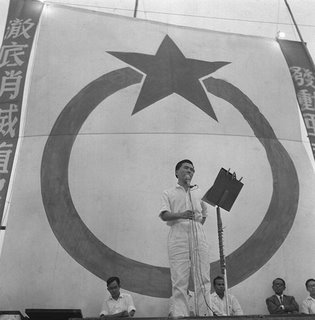
Students of the University were themselves equally participative in
electoral politics, and were reportedly seen to be going to
electoral areas in busloads to solicit support for Barisan Sosialis
candidates (Yao 2008:184).
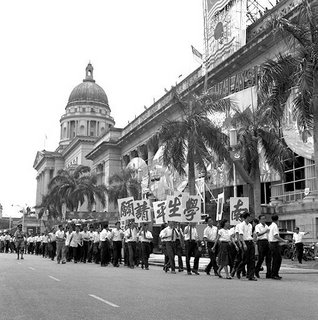
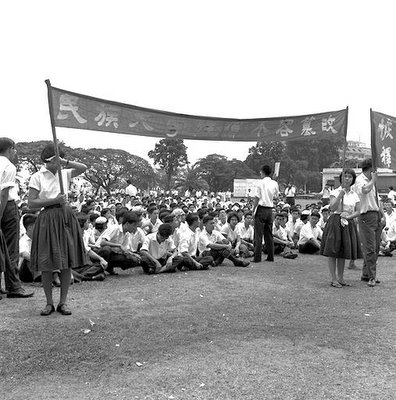
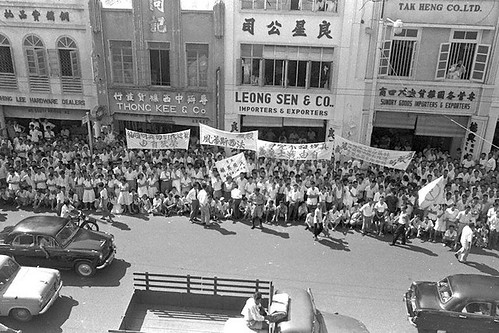
In 1965, the students of Nantah were to be galvanised into a
dramatic protest involving marches, petitions, and examination
boycotts with the release of the University Curriculum Review
Committee Report.
The report made several recommendations that were
interpreted by some members of the Chinese-educated community as a
attempt by the PAP to take control of the University and to remove
an education stream that ostensibly cultivated immense support for
its nemesis – the Barisan Sosialis
(Hong & Huang
2008:109–135).
The period from the 1950s to the 1980s, which overlapped
with the political prominence of the Chinese-educated, saw the
gradual phasing-out of Chinese-medium
education.
Key changes during this period include the teaching of English as a
second language in Chinese-medium schools in 1956; the ‘merging’ of
Nantah with the University of Singapore to become the National
University of Singapore, an English-medium University in 1980; and
the conversion of nine established Chinese-medium middle schools
into Special Assistance Plan (SAP) schools – bilingual institutions
that will offer both Chinese and English as first languages (i.e.
Special Assistance Plan (SAP) schools) in the same year.
These changes took place amidst a broader shift towards English as
the main language of instruction – by 1987, English officially
became the language of instruction for key subjects in all
secondary schools and Chinese was taught as a subject itself (Kwok
2001:500; Sai 2006:195–196).
Given the historical trajectory of Chinese-medium education in
Singapore, Kwok instructively suggests that the Chinese-educated
sector can be seen as a “continuum” of ideal types:
On
the “purer” end of the spectrum are the older generations who have
had long years of exposure to Chinese education. At the apex, this
includes Nantah graduates… On the “diluted” end of the spectrum are
the younger generations in their twenties and thirties. They have a
more mixed education in terms of exposure to both English-language
and Chinese-language universes of discourses (2001:502–503).
As Kwok adds, it is problematic to apply the term
‘Chinese-educated’ to those at the ‘diluted’ end of the spectrum
from a purist view because they are taught primarily in English
during their schooling years.
However, having received their education in SAP schools where high
teaching standards of the Chinese-language are maintained in an
environment that bear some semblance to ‘traditional’
Chinese-medium schools, those at the ‘diluted’ end continue to
operate regularly in the Chinese-language.
As such, the term ‘Chinese-educated’ may still be applied to them
(Kwok 2001:503).
In the same tone, Chinese-educated intellectuals can also be seen
along a similar continuum.
On one end, there are those from the ‘purer’ end
of the Chinese-educated who were active in the political scene
during the 1950s and the 1960s. The most illustrious amongst them
is perhaps none other than Lim
Chin Siong.
On the other end, there are those from the ‘diluted’ end of the
Chinese-educated. They are bilingual in both the English-language
and the Chinese-language, but have chosen to use the
Chinese-language in intellectual discourse.
The most visible among the ‘diluted’ end are members of The
Tangent. They are a much younger cohort than the Chinese-educated
intellectuals of the 1950s and the 1960s, and have emerged from an
English-dominant education system although many were schooled in
SAP schools.
Subsequent sections of this article will consider how the group has
constructed their roles as intellectuals in contemporary
Singapore...
http://s-pores.com/2010/12/the-tangent/