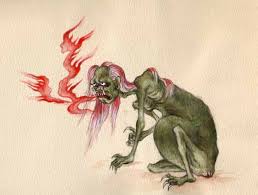
due to poor lives they were goverened and the fruitless
silent labour back in spore when they were alive.
PHRA
MALAYA
The Book of Phra Malaya is the single most important source of Thai
ideas and expectations about death and dying. It recounts the
visions of heaven and hell experienced by a medieval monk during
his meditation. It first describes his descent into hell. There, he
witnessed the hall in which Yama, the Lord of the Dead, assigned
the souls of the dead to their appropriate rebirths. There were
several options for rebirth available. A person could be reborn as
a human with any social status, with any degree of attractiveness,
as any type of animal, into any one of fourteen hells, or into any
one of nine heavens.


Judgment in the Hall
Of Yama, Lord of the Dead.
The Hell for
liars
Phra Malaya then toured
the hells, where he witnessed the various specific tortures
inflicted on those who had committed specific various types of
sins. After that, he visited a number of heavens. Both the heavens
and the hells he saw bear a strong similarity to those described in
two Buddhist classical commentaries, the Abhidhammatta Sangaha of
Acariya Anuruddha, (12th century) and the Vissudhimagga of
Buddhaghosa Acariya (14th century). These two texts were preceded
by the Vimanatthu (one of the minor anthologies of the Pali Canon),
and the Hindu scripture called the Siva Puranas(ch.5-27), both of
which also contain similar descriptions of heaven and
hell.


The
Hell For Alcoholics
The
Hell For Thieves
Phra Malaya then saw two `future' periods, the `age of Migasanni',
a sinful era dominated by violence, and the `time of Sri Ariya', a
heavenly future where, among other things, wish fulfilling trees
will grow. These trees are said to produce whatever a person
sitting under them wishes for, and grow jewels instead of fruit.
The Sanskrit word for these trees is mani trees (mani means
gem).


The Age
Of Migasanni
In the
Time of Sri Ariya.
The
book of Phra Malaya seems to have no analog in the Judeo-Christian
world. It's as though Dante's Divine Comedy were the sole source of
western concepts about death and dying, and that it's descriptions
of heaven and hell were given the status of absolute truth. To
continue the metaphor, imagine that Illustrations from Dante were
hung in large numbers of churches to augment the usual religious
instruction. Then imagine that motifs from Dante were used in comic
books, cartoons, and government education campaigns. To complete
the metaphor, imagine that the overwhelming majority of the public
had simply never been exposed to competing ideas about death and
dying. Reflecting on this hypothetical case might provide an idea
of the situation in Thailand is like with respect to the ideas
about death & dying found there.
Of course, there are differences between this scenario and the
current Thai reality. In fact, there is an alternate set of
teachings imported by the Chinese, but one which is quite similar,
being also heavily influenced by Buddhist traditions. It also has
multiple heavens and hells, and the lord of the underworld, Yama,
appears in both traditions (cf. Williams, 1976). Further,
Thailand's religious makeup is not absolutely uniform. There is a
small minority of Christians and Muslims, as well. Nevertheless,
imagining a Christian community which had no ideas about the
experience of death not found in Dante's Divine Comedy gives a
reasonably good metaphor for understanding thai concepts about
death & dying in cultural context.
After contemplating this scenario, many NDE researchers would
wonder if, in such a case, all NDEs might not manifest the same
phenomenology as Dante's Divine Comedy. Judging from the features
of the case histories presented here, it does seem possible.
Making
Merit
After the book of Phra
Malaya, the next significant factor influencing Thai expectations
of what it will be like to die come from beliefs associated with
the custom of `Making Merit' (Tham Boon). The concept of merit is
closely akin to (but not identified with) positive karma. Merit is
often spoken of as the source of good luck, as a religious
practice, and as a kind of moral currency. Any compassionate or
wise action is said to create merit, but one of the most powerful
ways to make merit (open to the laity) is by donating food, money,
or clothing to the Buddhist monks. The best way to make merit,
outside of becoming a Monk, it is commonly believed, is to fund the
construction of a Temple, or failing that, to fund the repair or
restoration of a Temple. It is also commonly held that merit can be
transferred. In the most common instance, Thai men ordain as
Buddhist monks for a time before they get married, and pray that
the merit they create be transferred to their mothers (Wells,
1975). The belief that `merit can be transferred is widespread. One
contemporary Thai Buddhist author recently began his book
(Jayamanggalo, 1996) by dedicating it to his teacher, offering the
prayer that `any merit it may generate' be dedicated to him. Both
Buddhist scriptures and Phra Malaya spoke of making merit and
dedicating it to the souls of those in hell as a way to alleviate
their suffering.


Making
Merit by Offering Food to A Monk
Making
Merit By Offering Flowers
Merit seems to grow
over time, being augmented by karmically-positive actions (boon),
but at the same time being decayed by sinful action (baap). The
types of behaviors considered to be sinful are the usual types
found in all important religions. Killing, gambling, theft,
adultery, etc.. A caption found in a poster the author purchased in
a Bangkok religious supply shop reads `Yama judges man and beast
according to boon and baap'. The accompanying illustration shows
Yama seated next to a scale whose arms are each hung with signs
reading boon and baap. The implication is clear: merit and sin
offset one another. One goes to heaven or hell according to the
balance showed by the scales. How much merit a person has, is less
important than whether or not it outweighs one's burden of sin. The
reviews of karma that occur in our collection of Thai NDEs are
confined to examinations of single sins. In four cases (4, 6, 8,
&10), this is done by accountants, reading from books. It's
almost as though the accountants were looking at only the balance
due, while the Western panoramic Life Review covers the
transactions. If the balance hangs heavily enough in a person's
favor, they can be reborn in the realms of the gods.


Yama sends a Yamatoot to collect a soul whose time has come. The
illustration shows Yama's accountant and the scales of Karma, with
signs reading 'sin' and 'merit.'
Marriage 'works' in the time of Sri Ariya.
Circumstances of
rebirth, apparently, are subject to interpretation. Case #10
includes an account of a Yamatoot whose positive and negative
karmas each created separate effects, whereas case #6 includes an
account of the effect of a negative karma being canceled out by a
positive one. Although most Thai Buddhists will agree that there
are laws governing karma and it's effects, there is neither
agreement nor finality concerning the specific operations which are
performed when these laws are brought into action. This lack of
lucidity in the teachings allows a wide latitude in understanding
how karma operates. We suggest that individual psychodynamics
manifest in the specific operation of karma as it appears in any
given Thai NDE. The most popular concept of karma in South East
Asia is the formula "Do good; receive good. Do bad; Receive bad".
So long as this rule is preserved,If an individual having an NDE in
Southeast Asia confabulate any `laws of karma' so as to explicate
their their feelings about their life. If so, then the karmic
review might be an example of a Life Review.
COMMENTS
One of the most
interesting cases of the effects of karma manifesting in an NDE is
in case #8, the case of `Kodien'. In this case, the Chinese
merit-making practices Kodien (a Chinese-Thai) followed are
rejected in favor of the Thai ones. Kodien was a Chinese person
raised Thailand. His NDE seems to reveal that he was actually more
drawn to the Thai ways of creating merit than to those of his own
subculture. That an NDE of a person torn between two cultures
should exhibit features of both suggests that it is not culture
that determines NDE phenomenology, but rather that people's NDEs
reveal what their expectations are concerning what death will be
like, even when these expectations are held subconsciously, or are
influenced by more than one culture. Atwater (1994) has found that
NDEs which manifest visions of the classical western hell are much
more likely to occur in the Southeast part of he U.S., the
so-called `Bible belt', where the literal veracity of the Bible is
often taken for granted. Christianity teaches that the only options
are those of heaven and hell. For a person guided by this belief,
we suggest, the choice of which they will enter happens according
to the expectations created by their own feelings regarding their
behaviors during their lives. Thai NDEs, with their frequent
visions of hell, seem to confirm this interpretation.
The case of Kodien seems to rule out culture per se as the
determinative factor in shaping NDE phenomenology. The fact that
Thai (and Indian) NDEs do not follow the typical, Western,
progression reflected by the Ring Scale seems to rule out the
possibility that there is any such thing as an ideal or normal NDE
scenario, except within a particular cultural context.
NDEs manifested within certain, special, groups have been studied
that reveal typical variations. Pediatric NDEs (Morse, 1985), and
those of pre-literate cultures, as well as those of India
(Pasricha, 1986), Africa (Morse, 1992) have all been looked at, and
patterns have been discerned in each group. However, the most
common approach to discussing their typical features has been to
compare them to the typical Western NDE; to the pattern shown in
the Ring Scale. We would suggest that the near-constant comparisons
with the most frequently reported types of NDEs tends to blind
researchers to the features of NDEs which are absent in these NDEs.
Tunnels are rare, if not absent. The panoramic Life Review appears
to be absent. Instead, our collection shows people reviewing just a
few karmically-significant incidents. Perhaps they symbolize
behavioral tendencies, the results of which are then experienced as
determinative of their rebirths. These incidents are read out to
them from a book. There is no Being of Light in these Thai NDEs,
although The Buddha does appear in a symbolic form, in case #6.
Yama is present during this truncated Life Review, as is the Being
of Light during Western life reviews, but Yama is anything but a
being of light. In popular Thai depictions, he is shown as a
wrathful being, and is most often remembered for his power to
condemn one to hell. Some of the functions of Angels and guides are
also filled by Yamatoots. They guide, lead tours of hell, and are
even seen to grant requests made by the experient.
The most common first phase of Western NDEs is an Out-of-Body
Experience (an OBE). An equally common first phase of Thai NDEs is
a visitation by a messenger of some kind, most often a Yamatoot,
one of the servants of Yama (all ten cases). The mythology of Yama
and his servants was imported from India along with much of the
Hindu/Vedic pantheon, and it can still be found in contemporary
Indian NDEs (Pasricha, 1986). Phenomenologically, the appearance of
a herald of death and an OBE could not be more disparate.
Interestingly, OBEs in Thai NDEs tend to immediately precede
meetings with Yamatoots. Their functions could be the same: to
convey the news that one has died.
The OBE appears to rely on a specific neurological function. The
neuroseurgeon Wilder Penfield accidentally induced an OBE while
stimulating the surface of one of his patient's brain with
electrodes (Penfield, 1955). The OBE occurs in many contexts
outside of NDEs. It has also been reported in meditation
experiences, fever delirium, shamanic `journeys', temporal lobe
epilepsy, dissasociative disorders, and it can even occur
spontaneously. The autoscopic OBE (AOBE) is not subject to
confabulation. During an AOBE, one still perceives the physical
world, so it can not be validated in culture-specific ways. A
person having an OBE will still perceive their surroundings. There
are few reports, if any, of a person having an OBE while
simultaneously seeing the being of light. Perhaps the recognition
that one has died is easier if one experiences what one has been
taught will occur at death. Thus, while an OBE may well be found in
NDEs of all cultures, not all cultures recognize OBEs as a herald
of death. Indeed, one of our cases (#10) a monk experiencing an NDE
initially mistakes his NDE OBE for one appearing in his meditation.
So, some cultures seem to have anthropomorphic harbingers that
inform the person of their deaths independently of OBEs. Yamatoots,
the Grim Reaper, and Angels all have appeared as harbingers of
death.
It has been found (Horowtiz, 1970) that hallucinatory phenomena are
facilitated by Altered States of Consciousness (ASCs). We might
speculate that the ASC that occurs in conjunction with OBEs can
also facilitate the confabulation of imagery which conveys that
death has begun. If this were the case, then Yamatoots and OBEs
each have the same function; to make the person aware that they are
dead.
This notion might also help to explain why tunnels, common in
Western NDEs, and having a known neurological basis (Blackmore,
1993) are also largely absent in Thai NDEs. Tunnels might symbolize
moving from one ASC to another. Roads, or the act of walking, might
symbolize the same thing in Thai and some Indian NDEs. Indeed, most
of our collection features one or the other. One of our cases does
feature a tunnel, (#10), but it does not occur at the beginning of
the experience, as it most often would in Western NDEs.
The Light seems to be absent in Thai NDEs. So is the profound
positive affect found in so many Western NDEs. The most common
affect in our collection is negative. Unlike the negative affect in
so many Western NDEs (cf. Greyson & Bush, 1992), that found in
Thai NDEs (in all but case #11) has two recognizable causes. The
first is fear of `going'. The second is horror and fear of hell. It
is worth noting that although half of our collection include seeing
hell (cases 2,6,7,9,10) and being forced to witness horrific
tortures, not one includes the NDEer having been subjected to these
torments themselves. The positive affects that occur in our
collection are those of pleasantness, comfort, a sense of beauty,
happiness, and case #6 speaks of his feeling that those who he saw
living in heaven were happy without mentioning his own feelings
about being there. It's also worth noting that we have one case in
which someone saw only heaven, without also having seen hell. All
these cases include both positive and negative affects. At least
one similar case in the west has already been noted in the
literature (Irwin, 1988).
Dead friends and relatives do appear, but in contrast to Western
NDEs, these dead friends do not greet the dying person. Instead, in
three of the four cases where the motif occurs in our collection of
Thai NDEs, they seem to inform the dying person of the rules
governing the afterlife (Cases #7, 8, 9).
The way in which Thai NDEers experience their own resuscitations
seems to have unique features. As in India, Thai NDEs (cases
1,2,4,6,& 8) often include the person being told that they are
the wrong person, and being ordered back to normal consciousness.
In contrast , Western NDEs often end with the person choosing to
`go back'. Westerners might also find themselves spontaneously
returning to their bodies, as also happens in Thai NDEs. Perhaps,
where Westerners might choose to revive, Thais and Indians are
forced to revive. The Thai and Indian cultures do not reward
independence and individuality the way Westerners do. Instead,
these cultures encourage dependence on one's family, village,
traditional religion etc. The idea that one has a choice about
living or dying does not fit well in a culture where,
traditionally, one cannot choose one's spouse, work, religion, or
where to live. Let your parents arrange your marriage. Follow in
your father's footsteps. Live by your parents, if not with them.
Worship in the same place, and in the same way as the rest of your
family. If the course of crucial life changes are imposed on
someone, will they not be more likely to confabulate being forced
to revive than choosing to revive? One case (# 8) ends with the
NDEer being physically pushed into reviving.
Another theme in the return to life in Thai NDEs occur in cases
5,6, &11. In these three cases, the NDE ends with the person
falling, and regaining consciousness as they hit the floor or
ground.
Tentative
conclusion
The conclusion we can offer is that, while the most common
phenomenologies found in Western NDEs are either absent or rare in
Thai NDEs, there are meaningful correlations that can be drawn.
Typical phases appear in both, and with some typical ordering. The
possibility arises that the same psychological processes are
occurring in both types of NDEs, and that the only significant
differences are in terms of their phenomenologies. It may that NDEs
of all cultures share common patterns, but that these patterns are
obscured by the many different confabulated phenomena through which
they manifest. These confabulations, it appears, are highly
individualized. The Thai cases support the idea that NDEs are
postmortem confabulations occurring within specific cultural
contexts.
MORE
GRAPHICS:


The Hell For Sexual
Offenders.
Hungry Ghosts Plead
with Phra Malaya asking for him to petition their living relatives
to make merit for them.
The Hell For Those Who
Butcher Animals.
Malaya's Sermon to The
Gods.