Sunday, 15 June 2008, 11:06 pm | 548 views
Leong Sze Hian
 I am somewhat puzzled by
the statistics on university admissions.
Surely,
what is more important is the number of applicants, rather than the
number of applications, since many may apply to all three
universities.
What is the
break-down of the applicants for Singaporeans, permanent residents
(PRs) and foreigners?
Since 20 per cent of the three universities’ total offering of
14,700 places this year is reserved for foreigners, does it mean
that the places for Singaporeans and PRs is 11,760?
Therefore,
what Singaporeans may like to know is what percentage of
Singaporeans and PRs who apply, will be offered places?
This may be
a more meaningful figure than saying that “25 per cent of the
graduating cohort would be offered places, compared to 23 per cent
last year”.
The
Ministry of Education said in July last year that the actual number
of foreign students admitted was 4,218.
Since the
three local universities provided 14,685 places last year, dividing
4,218 by 14,685 gives a foreign students enrolment of 28.7 per
cent.
So, was the
foreign students admitted last year 20 or 28.7 per cent of the
total intake?
What was
the first-year intake percentage of Singaporeans after adjusting
for PRs?
What is the
break-down of the percentage of Singaporean and PR polytechnic
graduate applicants, and foreigner applicants, who are
admitted?
Is the
admission success rate of Singaporean polytechnic graduates lower
than foreigners?
So, I think
in order to clear up the confusion on university admissions, what
Singaporeans may really want to know is what is the actual
percentage of Singaporeans, PRs, and foreigners admitted, instead
of the number of applications, applicants or the number offered
places ?
References:
Charlene
Sng’s letter “Uni entry still hard for most poly graduates” (ST,
May 26)
Khoo
Lih-Han’s letter “Govt should subsidise private courses” (ST, May
16)
Patrick
Sio’s letter “Universities should be clearer about entry criteria”
(ST, May 16)
“Smaller
cohort, but universities getting more applications” (ST, May
14)
“University
education: Economics of choice” (ST, May 17).
Employment: Who
actually get jobs?
I
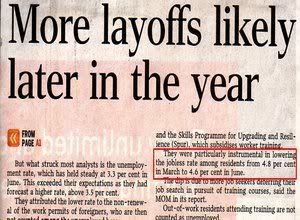
refer to the articles “More jobs created, but number of jobless
still up” (ST, May 1) and “Jobs for Singaporeans: WP challenged to
act on its words” (ST, May 2).
I
would like to point out the following worrying employment trends
:-
Another quarter of record
employment growth – employment grew by 68,400 in the first quarter,
but the seasonally adjusted resident (Singaporeans and PRs)
unemployment rate increased from 2.4 per cent in the last quarter
of 2007 to 2.9 per cent this quarter. This increase of 0.5 per cent
is higher than the 0.3 per cent overall unemployment rate increase,
from 1.7 in December to 2.0 in March.
Despite employment growing
by 68,400, the number of seasonally adjusted unemployed residents
grew to 54,400.
In
2006, 52 per cent of jobs created went to residents, of which 37
per cent went to citizens.
In
2007, the percentage of jobs created that went to residents
declined to 38 per cent. Of this, what percentage went to
Singaporeans ?
Has this trend of
declining jobs for citizens persisted in the first quarter of 2008
? What is the percentage of jobs to residents, and to citizens, for
the first quarter ?
A
record 46,900 became PRs, in the first nine months of 2007, and
7,300 became citizens in the first half of 2007. Has this trend
persisted since 1 October 2007
for new PRs,
and 1
July 2007 for new citizens, to the
quarter ended 31 March 2008
?
How many of the new jobs
for residents, went to such new residents ?
Labour stakeholders like
NTUC should analyse the cause of the above worrying trends for
Singaporean workers, explore what can be done to reverse or slow
down the trend, and how to mitigate the effect and implications on
citizens?
In
this connection, according to the Department of Statistics’ Monthly
Digest of Statistics April 2008, the ratio of job seekers placed in
employment to job seekers attended to at Career Link Centres, has
declined from 29 per cent in 2006, to 28 and 24 per cent in 2007
and March 2008, respectively.
Also, the total population
in Singapore is growing at it’s fastest rate since 1990, at 4.3 per
cent, compared to the resident (citizens and PRs) population
growing at only 1.6 per cent since 1990.
GST increase
statistics
I
refer to the article “An exclusive club to help the needy” (Today,
May 24).
The
North-West Community Development Council is asking companies and
individuals to donate $100 or more each month towards the
North-West Food Aid Fund, because demand for food packages from the
needy has more than doubled since December, as inflation hit
another 26-year high, at 7.5 per cent in April.
There have
also been media reports of hospitals raising funds to help needy
patients pay for their medical fees.
Since the
reason given for raising the Goods and Services Tax (GST) by
another two per cent, was to help the poor, aren’t the CDCs and
hospitals getting more money to help the poor?
In this
connection, I understand that GST collections after the two per
cent increase is estimated to be $ 1.9 billion, which is more than
the initial estimate of about $1.5 billion because of a booming
economy.
Moreover,
in addition, I understand that co-operatives in Singapore
have had
healthy surpluses, of which up to 20 per cent are contributed to
the Central Co-operative Fund under the Ministry of Community
Development, Youth and Sports (MCYS).
Some of
these funds are also available to help the needy.
What are the statistics on
how the increased GST collections have been used to help the poor,
on a comparative basis, before and after the GST hike?