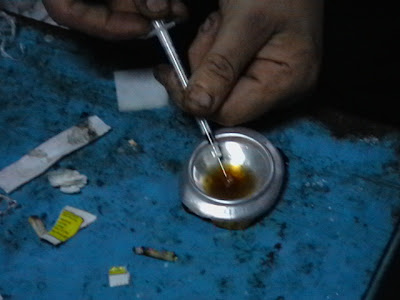
Hi here is a little culture shock to me that u can get a
free needle for
drugs injection by dialing a no. in almost everywhere in oz.
This is good that it can reduce AIDS by sharing needles.
but ....i dunt know wat to say.read on....
FOOT PATROL MOBILE NEEDLE EXCHANGE
[email protected]@@@@@@@@@@@@@
I am not saying SG is perfect.But there are many over estimate
Oz
situation.Homeless is just one of the too many problems in
Oz,among
drugs,organised crimes,guns,corruptions etc etc.
1.There is no point to show so many photos of SG homeless.We can
see.right?
I think SG MCYS shall look into this
problem,together with
various CDC,Community Development Councils and NGO's etc.
2.Look at the problems in Oz.
U can find that there are many Homeless centers in big cities
to small
town.I dunt know why.Is The demand so high down under?
Homeless is not a stand alone problem,like in SG.

@@@@@@@@@@@@@@@
http://www.homelessnessaustralia.org.au/site/experiencing.php
http://www.aihw.gov.au/publications/aus/bulletin71/aus-114-10773.pdf
@@@@@@@@@@@@@
I give u examples of good services for Homeless in Oz.
Crisis Help Network: Melbourne Homeless
Service
http://www.melbourne.homeless.org.au/
Just arrived in Melbourne and Homeless? press this link
for information
 Street Rights
Travelers
Aid Society of Victoria
Regional public transport information
Homelessness Statistics Melbourne
Drug & Alcohol Help Melbourne
3.There is no Heaven in the Earth ,yet.
Anyplace which is slightest further away from Hell is a
Heaven.
Here is a cultural shock that in a highly policed state
such as Singapore, the number of arrests has not seen any effective
reduction in drug abuse - but an increase.
More drug arrests in 2007 due to heroin, Subutex
abuse
By Jermyn Chow
CLOSE to 80 per cent more drug addicts
were arrested last year, no thanks largely to heroin and
Subutex abusers.
Out of the 2,166 drug abusers who were picked up in 2007,
two-thirds were hooked on heroin and Subutex - mostly repeat
abusers who are above 30.
But Singapore's drug enforcement agency, the Central Narcotics
Bureau, said it is only to be expected as 2007 was the first full
year that Subutex users were caught, after the drug was outlawed in
August 2006.
The majority of Subutex abusers are Malays - about 1000.
One area of concern is the 670 heroin abusers caught, swelling six
times more from the 116 arrested the year before.
CNB's deputy director Vijakumar Sethuraj attributed the increase to
the 'rational choice' addicts made after Subutex was re-classified
as a controlled drug, hence making it more expensive than
heroin.
CNB said that the price of an 8mg Subutex tablet now costs about
$120, as compared to $40, before the clampdown two years ago.
The average street price of heroin, on the other hand, goes to up
$50 per straw.
Traffickers, synthetic drug abusers also up
More drug traffickers were also arrested last year.
The number of illicit traders, mostly from neighbouring Johor and
Batam swelled to 769, up by about 30 per cent.
But CNB cautioned that the supply is not driven by demand in
Singapore, as drug pushers just want to 'flood the market'.
There were also slightly more users of the synthetic drug users
last year.
The number of people using synthetic drugs such as Erimin-5,
ketamine, Ecstasy and Ice increased by about 3 per cent, making up
about 30 per cent of all drug abusers.
http://www.straitstimes.com/Latest%2...ry_196470.html
Nearly 2,200 drug abusers were arrested in
2007, a 78 percent increase from
2006 when 1,218 were arrested, the TV Channel
NewsAsia reported on Tuesday. The TV channel NewsAsia
quoted the Central Narcotics Bureau ( CNB) as
saying that most of those arrested were subutex abusers, followed by heroin abusers, said the
report. The Bureau also pointed out
that most of the druggers, or 77
percent, were repeat abusers, while the proportion of
first time drug abusers arrested decreased from 39 percent of the
total abusers in 2006 to 23 percent in 2007. This decline was described by the Bureau as a
"well contained drug situation".
Source: Daily News / 16 January 2008 /
http://www.dailynews.lk/2008/01/17/wld05.asp
What could possibly be the cause of such increase in
arrests ?
If Singapore is such a small country, with a small
population compared with other neighboring countries, surely the
problems should have long been resolved.
What possibly could be the reasons behind this
continued blight ?
A Big-time Burmese Drug
Trafficker’s Singaporean Connection
Friday, 29 February 2008
In an action that
Burma watchers view as long overdue, the United States earlier this
week slapped financial sanctions on wealthy Burmese businessman Lo
Hsing Han, his US-educated son, Steven Law and Law’s wife, Cecilia
Ng, a Singaporean businesswoman.
At least 10 Singaporean
companies owned by Law’s wife have been targeted by the sanctions.
Among other things, the sanctions point up the often-unhealthy way
the Singaporean government chooses to ignore relationships between
its financial community and unsavory Burmese businessmen. Because
of the ties to Lo’s main corporate vehicle, Asia World Co. Ltd, the
story also illustrates graphically the narco-state that Burma’s
rulers have visited upon the world
stage.
Asia World is targeted
by sanctions also. And, included among the Singaporean companies
owned by Ng is Golden Aaron Pte Ltd, which has been linked to the
Chinese state-controlled oil and gas giant, China National Offshore
Oil Corporation (CNOOC). Under the sanctions, any bank accounts and
financial assets the individuals or their companies hold in the
United States are frozen and Americans are forbidden from doing
business with them.
Asia World is considered to be
Burma’s biggest and most diversified conglomerate. Lo is
chairman and Steven Law is the company’s managing director. The
story of the connection between the Singapore Government and the Lo
and Law family was first reported by Australia's SBS Dateline in a
report called "Singapore Sling." In a 1997 article, the US
magazine The Nation also described the web of
connections between Asia World and the Singapore government, which
“is directly connected to key business ventures of drug kingpin Lo”
through a series of investments in the Myanmar Fund, including some
by the Government of Singapore Investment Corporation
(GIC).
In a letter to the magazine the
Singapore embassy in the US said that GIC was a passive investor in
the Myanmar Fund and was not involved in investment decisions, and
that the Myanmar Fund had been wound up.
Asia World is involved
in industrial investment, development, construction and
transportation. It imports and distributes goods into Burma and
owns a supermarket chain. It was recently involved in
road construction from Pyin Oo Lwin in
Shan State to the Chinese border, the
renovation of Rangoon’s international airport and the construction
of a deep water seaport at Ahlone near Rangoon. It was also
one of two main contractors for the construction of the new capitol
at Naypyidaw. In 2001 the company’s authorized capitol was
given at about US$40 million.
Rangoon’s port, which
handles 40 percent of Burma’s container traffic, is also run by
Asia World which also operates a cargo and shipping business from
the port. This and Lo’s ownership of Burma’s largest bus
company has led some to speculate about whether he is using the
facilities for continued drug trafficking.
Lo and Steven Law were
refused visas to travel to the US as long ago as 1996 for suspected
drug trafficking activities. The property interests of Golden
Aaron are now reportedly blocked.
These moves follow
sanctions earlier this month against the business empire of Burmese
tycoon Tay Za and 33 other Burmese generals and business people and
11 companies which have had their assets frozen and were denied
travel to the US. This is the latest in an ongoing series of
financial sanctions aimed at hurting Burma’s ruling State Peace and
Development Council through its business contacts.
“Unless the ruling junta
in Burma halts the violent suppression of its peoples, we will
continue to target those like Steven Law who sustain and who profit
corruptly because of that support,” said Stuart Levy, Treasury
Department Under-Secretary for Terrorism and Financial
Intelligence.
According to the
Treasury Department, “In addition to their support for the Burmese
regime, Steven Law and Lo Hsing Han have a history of involvement
in illicit activities. Lo, known as the ‘Godfather of
Heroin,’ has been one of the world’s key heroin traffickers dating
back to the early 1970s. Law joined his father’s drug empire
in the 1990s and has since become one of the wealthiest individuals
in Burma.”
The saga of how Lo and
his son acquired their fortune and the outward trappings of
respectability has many twists and turns including several brushes
with death. Lo, 70 or 73 years old depending on the source, began
in the drug trade in 1960 when he organized a
local militia in the Kokang area of Shan State. The
government turned a blind eye to Lo’s drug trafficking in exchange
for his assistance in fighting Shan insurgents. He was dubbed
the “King of Opium” by US authorities in the 1970s.
His fortunes then
changed. Thai police arrested Lo in 1973 and deported him back to
Burma, where he was found guilty of rebellion and sentenced to
death. However, he was given amnesty in 1980, and he moved
back to Shan State where he built his headquarters at Salween
Village near Nampawng southwest of Lashio. He immediately
reestablished himself with a new militia and resumed his role in
the drug trade.
The wisdom behind
granting Lo amnesty was borne out when Lt General Khin Nyunt used
him as a go-between in 1989 in arranging ceasefires with Kokang and
Wa insurgents who had recently mutinied against their Burmese
Communist Party leaders. In exchange, according to a memo
from the Thai Office of Narcotics Control Board in 1993, Khin Nyunt
gave Lo the right “to smuggle heroin from the Kokang Group to
Tachilek [on the border with Thailand] without interception.”
By 1994 he controlled what was regarded as the most heavily armed
drug trafficking organization in Southeast Asia.
Lo also gained
unfettered access to the Burmese economy for his part in the
ceasefire deals. This was further enhanced when in the early
1990s, with the Burmese economy on the brink of collapse, the
generals turned to traffickers to invest their money in legal and
semi-legal businesses. A “whitening” tax of 40 percent, later
reduced to 25 percent, was levied on funds repatriated from bank
accounts in Bangkok and Singapore. It was also at this time,
on June 5, 1992, that Lo set up Asia World.
Law enforcement
officials say indications are that since the mid-1990s Lo has
stepped back from direct involvement in the drug trade, although he
does reportedly maintain contacts, and that has not stopped western
law enforcement agencies from trying to find evidence of his
continued role, so far without success.
Lo’s business empire,
international observers believe, is built on the profits from his
drug trafficking activities. These businesses and his money
have proved invaluable to the junta.
Lo has maintained strong
relations with Burma’s ruling generals. At Steven Law and
Cecilia Ng’s 1996 wedding, among the guests was then-Hotels and
Tourism Minister Lt General Kyaw Ba as well as three other generals
and four cabinet ministers. Lo also
organized the catering for the extravagant wedding party thrown for
the daughter of Burma’s Senior General Than Shwe in 2006.
Despite Lo’s relations with Khin Nyunt, he was notably unaffected
when the general was placed under house arrest in 2004.
Lo also has been
described by government figures as the most prominent partner for
foreigners wishing to invest in Burma, with a massive amount of the
joint venture investment done through Asia World. For
example, an agreement to import cooking oil from companies
controlled by Malaysian billionaire Robert Kuok reportedly has
grown into very lucrative real estate and construction deals,
including the construction of the Trader’s Hotel in Rangoon, in
which Asia World holds shares.
Another joint venture
was with Sinmardev International Pte Ltd of Singapore. Headed
by Albert Hong, Sinmardev was a consortium of Singaporean and other
companies that built a US$207 million industrial park and port on
the outskirts of Rangoon. Asia World contracted for part of
the construction and holds shares in the project along with the
members of the junta and several international
investors.
Steven Law, who also
goes by Tun Myint Naing, is the managing director of Golden Aaron,
which has now been linked to CNOOC. The link was spotted by
David Webb, a business commentator and non-executive director of
the Hong Kong Stock Exchange. The
relationship goes back to an October 2004 production-sharing
contract between Myanmar Oil and Gas Enterprise and a business
group formed by CNOOC Myanmar, Golden Aaron and China Huanqui
Contracting and Engineering Corp to explore for oil and gas in
Kyaukphyu township of Rakhine State.
According to the
official New Light of Myanmar newspaper, the signing ceremony was
attended by CNOOC chairman Fu Chengyu and Golden Aaron director
Chua Chay Jin.
CNOOC’s 2004 annual
report listed itself as the operator of a joint venture with Golden
Aaron and China Global Engineering Corp. through which it owns five
exploration licenses covering 73,152 square kilometers. The
licenses will run out on March 12, 2008 unless they are
renewed. The gas deposits are part of the controversial Shwe
gas project which is to include a gas pipeline through Burma to
China. Human rights organizations have frequently cited
abuses related to the project and have called for its
cancellation.
The US sanctions may
also have an effect on Singapore. The island republic has
long been accused of being a shopping and financial center for
Burmese generals and narcotics traffickers. Former US
Assistant Secretary of State for the Bureau of International
Narcotics and Law Enforcement Affairs, Robert Gelbard, said in
1997, “since 1998 over half of [the investments from] Singapore
have been tied to the family of narco-trafficker Lo Hsing
Han.”
Singaporean banks have
been repeatedly accused of being used for money laundering by Burmese narcotics
traffickers. Although Singapore does have what are considered
by the Asia/Pacific Group on Money Laundering effective anti-money
laundering mechanisms, the fact that figures such as Lo and Law are
able to continue to do business there and keep banks accounts has
prompted much speculation. In a recent step to detect money
laundering, the Singaporean police announced that after 1 November
2007, anyone carrying or transferring more than $20,650 would be
required to submit a report to the immigration
authorities.
Whether or not the money
is from drug profits, it is being used to finance investment in
Burma that the US and international observers claim prop up the
regime. While US financial sanctions are not aimed directly
at Singapore or its banks, the hint is there that by dealing with
individuals and firms on the sanctions list, the banks risk bad
publicity.
Although the Money
Authority of Singapore is unlikely to advise banks to cut ties with
Burmese firms as a result of the US sanctions, some analysts
believe Singaporean banks are taking steps to restrict their links
to Burmese companies. The refusal of Singaporean banks to
deal with Burmese tycoon Tay Za’s Air Bagan airline is seen as a
possible example of this. In addition, in late October 2007
the Irrawaddy magazine reported that bank transfers between United
Overseas Bank of Singapore and Burma had been suspended
temporarily. The risks to their banking relationships with
the US may be forcing Singaporean banks to re-evaluate doing
business with Burmese firms
http://www.asiasentinel.com/index.php?option=com_content&task=view&id=1076&Itemid=168


