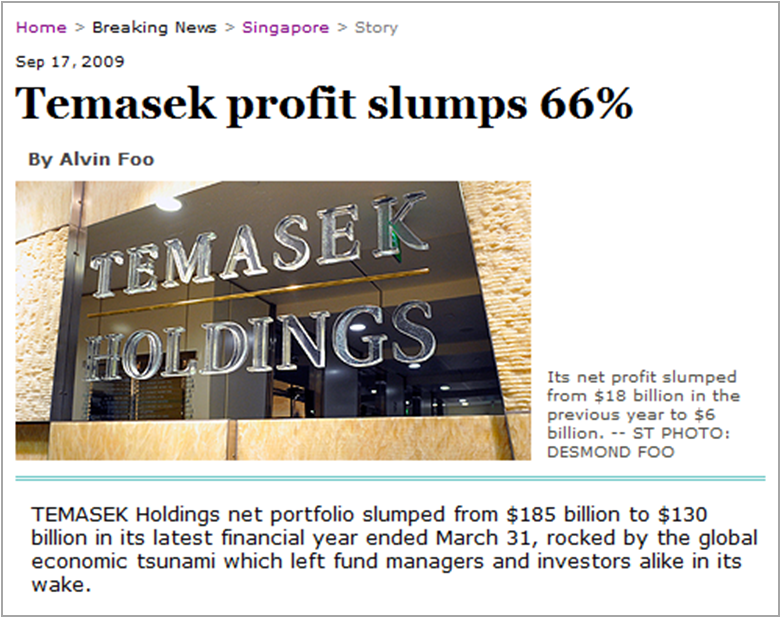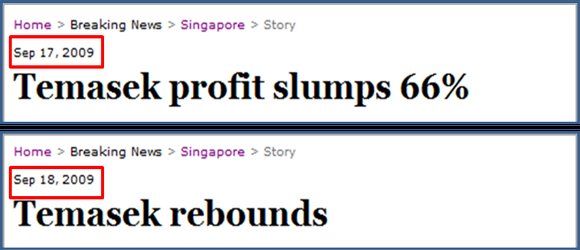
Sept 17 2009 :
Temasek Profit Slumps 66%
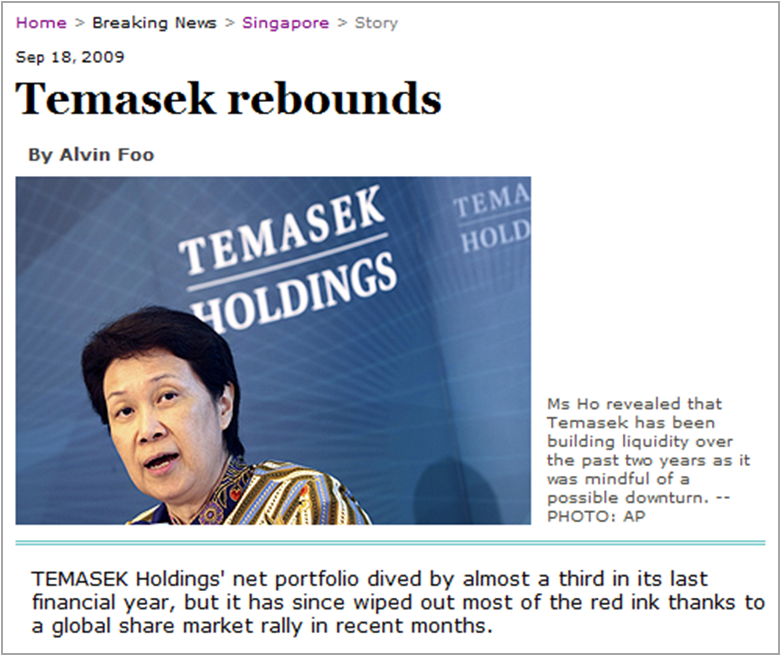
Sept 18, 2009 :
Temasek Rebounds
SOURCE:
http://theonlinecitizen.com/2009/09/analysing-temasek-holdings-review-does-portfolio-value-mean-anything/
Gangasudhan
Temasek Holdings released its annual report on
17th September 2009 which was duly highlighted in the
best possible light with a bold header of ‘Temasek
Rebounds’ (Straits Times, September 18).
Unfortunately,
Temasek Review 2009 seems to have more questions than answers
(not necessarily a surprise), some which would serve the interests
of the fundamental shareholders to be answered – and we are not
talking about the Ministry of Finance which is its sole
shareholder.
The focus in the report has again predominately been the
Portfolio Value which refers to the market value of the various
assets under its charge. These include local heavyweights such as
Singtel, Standard Chartered, DBS Group and CapitaLand, as well as
other overseas entities based in China, India, US and even Brazil.
This Portfolio Value has risen steadily over the years from $90
billion in 2004 to $185 billion in 2008 (and in between consecutive
years too) before spectacularly dropping by $55 billion in 2009 to
$130 billion.
The information from the press and Temasek Holdings contrasts
this single drop in portfolio value against previous years’ stellar
values and puts the blame of poor performance squarely on the
global financial crisis which has taken the world by
(thunder)storm.
Value vs Wealth
However, the Temasek Review 2009 (pages 21 and 22) also reveals
another figure which is termed ‘Wealth Added’ and reports this
value as a ‘negative $68 billion’ (a positive way of saying the
‘Wealth Deducted’ was $68.1 billion) which certainly does not tally
with the reported drop of $55 billion in Portfolio Value. The
description of the Wealth Added component according to the Temasek
Review 2009 includes various components such as operating cost and
capital charges, among others.
However, this component conveniently includes any capital
injections (whose exact amount would be hidden here) and thus the
Portfolio Value of $130 billion which is overemphasised by the
parties concerned could very well be lower had the capital
injection (if any) not been included in estimating this value.
Illustration
Although this may be creative accounting at its best, the
implications of not knowing these figures are rather significant.
Without knowing whether there was a capital injection and if so,
how much, we are left to speculate on the actual loss of the
Portfolio Value. Using the figures available in Temasek Review
2009, we can estimate that the ‘true’ Portfolio Value
could have been as low as $116.9 billion ($185 –
$68.1 billion) as contrasted against the reported $130 billion.
Interestingly, the Wealth Added for 2008 was also a negative
value ($6.3 billion) which seems to suggest that any growth in
Portfolio Value (for any year’s performance) may not necessarily
translate into ‘wealth’. Thus, there is a need to relook the wisdom
of using Portfolio Value as a measure of success or performance
instead of Wealth Added.
Illustration
Imagine buying your home for $200,000 and boasting about the
current market value of $300,000 (implying a profit of $100,000
should you sell). However, if you were to actually sell your home
and the various levies, loan interest charges, fees and CPF account
reimbursements are then deducted, the net returns may very well be
just a few thousand dollars. In this example, the Portfolio
Value would be the buying and selling prices of the home
and the Wealth Added would be the actual money that you get
in your pocket. As can be seen through this example, the
price of your home (i.e. Portfolio Value) is hardly anything more
than a bragging right and the net returns that you (can) get (i.e.
Wealth Added) is what really matters.
Rephrasing 101
This year’s annual report also included the new term ‘retraced
its value’ (Temasek Review 2009, page 8 & 18). A rose by any
other name may still be a rose but it is apparent that the Temasek
Review still holds positive spin above all else. Not content with
just one creative adjective, it goes on to add ‘retracted its
value’ (Temasek Review 2009, page 6) to further reinforce the
implied notion that the drop in value is not a drop in value.
A retracing or retraction of value seems to imply that it was a
mere reversal or a rewind to 3 years earlier (2006), but notably,
operating costs are NOT at these levels – in fact they are 3 times
more in 2009 (Temasek Review 2009, page 28). Also, if the drop in
Portfolio Value symbolises a return to 2006, then logic would
dictate that salaries paid in 2006 and 2007 should be recovered in
tandem. Thus, a play on semantics is not always a good idea,
especially on the back of such a catastrophic financial
performance.
Illustration
What if you had to take a pay cut that amounts to 3 years’
increment? Could you go around to your creditors and tell them,
“Sorry my salary retraced by 3 years.” Would that change anything
in the eyes of these creditors?
Signs of desperation
Finally, the Straits Times’ Alvin Foo was more than happy to pen
down,
“The portfolio sank from a peak of $185 billion on March 31
last year to $130 billion on March 31 this year, according
to its annual report, which was out on Thursday. It also showed
that the portfolio had rebounded to $172 billion as at July
31.” Temasek
Rebounds (18 September 2009)
However, the reporter failed to realise that the annual report
(Temasek Review 2009) made no reference to the ‘magic’ $172 billion
and, in fact, this figure appears only in the
CEO’s Opening Remarks (page 2). It is therefore very erroneous
to suggest that the annual report reports such a figure as the
auditors (whose sign off dates 16th July 2009) could not
and have not verified this figure to be true, accurate or reliable.
It is also quite amusing that Temasek Holdings which prides itself
in ensuring that it is always quoted properly has allowed the
misrepresentation to exist without corrections – and it is hard not
to speculate that the reason is due to the positive inclination of
said misrepresentation.
Nevertheless, the discussion on Temasek Holdings’
(non-)performance should revolve around the substantiated facts
($130 billion) instead of an unverified number ($172 billion) which
was mentioned in a single sentence involving a mere 16 words out of
1,786 that the speech comprised.
Illustration
If a child takes an exam and is unable to answer a question
but later on gets the answer, is he or she able to go back and
include this information and improve his final score? Here, the
‘exam’ for Temasek Holdings ended on 31st March 2009 and
it is thus meaningless to talk about any issue after the
fact.
At the end of reviewing Temasek Review 2009, we would urge
Temasek Holdings to;
a) issue a correction to the
misrepresentation by Straits Times attributing the reported July
2009 Portfolio Value to its annual report
b) reveal its monthly Portfolio Value for at
least the last 3 years for an adequate comparison of the July
figure of $172 billion (which incidentally is featured prominently
on the homepage of its
website)
c) disclose the exact components
(especially any capital injection) and their accompanying figures
involved that resulted in the Wealth Added figure of negative $68.1
billion
These are the critical factors that enable the ultimate
shareholders (citizens of Singapore) to assess and understand the
actual performance of Temasek Holdings in the financial year ended
31st March 2009, and the speculative performance in the
four months thereafter.
************************************************************************
Temasek Trivia
Temasek Holdings has been reporting an annual report since
2004 and TOC made an attempt to secure these reports online. While
the reports for 2004 and 2005 were nowhere to be found, the 2006 to
2009 issues were (eventually) located on the Temasek Holdings
website. Quizzically, each Temasek Review is placed on a different
URL as follows:
2006
http://www.temasekholdings.com.sg/2006review/files/Temasek%20Review%202006.pdf
2007
http://www.temasek.com.sg/pdf/Temasek%20Review%202007_Full.pdf
2008
http://www.temasekholdings.com.sg/temasekreview/2008/pdf/TR2008%2018-08-08%20Bookmarked.pdf
2009
http://review.temasek.com.sg/wp-content/uploads/pdf/temasek-review-2009-colour.pdf
The link on the Media Centre webpage of Temasek Holdings’
website meanwhile links directly to Temasek Review 2009 and offers
no other access to the previous annual reports. This begs the
conclusion that the IT department employed by Temasek Holdings to
manage its online annual report files and website is rather
incompetent and sloppy or that the organisation is being
purposefully vague about keeping its previous annual reports
accessible.