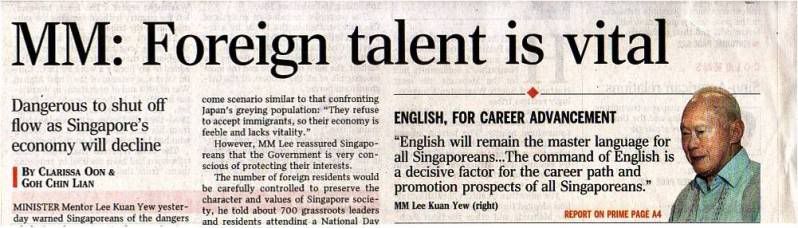
Population control revisited
 30 years later, the same man who was responsible for
the “Stop At Two” policy in the 70s, is now telling us that the
government “accept only immigrants who increase the average level
of competence of Singaporeans” – and doing so to the tune
of 1.68 million foreigners presently on our tiny island, in a
population of 3.2 million Singaporeans.
This is in response to Singapore’s birth rate problem – it
continues to fall, despite government incentives to induce
Singaporeans to have children.
Besides MM Lee’s dubious record in population control,
the same danger of our Parliamentarians silently tagging
along and thus giving support to such policies, as similarly
happened in the 70s and 80s, may see history repeat itself
– 30 years hence, with future generations living the consequences
of this present policy.
Calls from some quarters for the government to re-look
its policy on foreigners have been met with dismissive remarks by
government ministers. “Just zeroing in on foreign workers
alone is not the total solution,” Manpower Minister Gan Kim Yong
said in August. He also termed such calls “simplistic”.
What concerns Singaporeans are not just jobs or economic
prosperity but also the social consequences of having so many
foreigners in our midst. This has led to some Singaporeans
wondering if the government knows what is happening on the ground,
where physical and personal space is now harder to come
by, even in the heartlands. This may potentially result in
social friction among the various groups, something which the Prime
Minister spoke about in his National Day message recently.
The government’s preoccupation seems to be the economy
and how foreigners can contribute to this. It has
said little about the social consequences,
although it has set up the National Integration Council “to drive
social integration efforts across the private, people and public
sectors”. The success of the council’s effort is left to be
seen.
In the meantime, the government has been urging Singaporeans to
“embrace and accept” these foreigners, as MM Lee said on 14 August.
He also urged Singaporeans to “treat new citizens as equals”.
(AsiaOne)
According to the New Population Secretariat website, the
number of PRs in 2008 was 79,167, upped from 63,627 the previous
year.
The number of new citizens hit a record high of 20,513
in 2008, upped from 17,334 in 2007.
We seem to be in a hurry to bring in foreigners at an
alarming rate.
But perhaps all is not lost. The lone voice in Parliament
calling for a re-look of the policy has come from the ruling
party’s own Member of Parliament, Mrs Josephine Teo. But even so,
she is only concerned about the falling productivity level of
Singaporean workers. Her argument is that a more targeted approach
to the employment of foreigners will help up the productivity level
of Singaporeans.
But given how the government seems to feel that the
policy is the right one, and ministers have defended it to the
hilt, it does not appear that any changes will be
forthcoming.
The man and his ideas are not always right
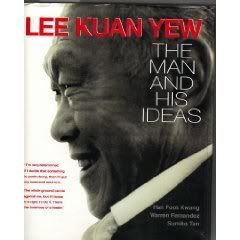 Lee Kuan Yew’s attempt at population control in the
70s and 80s has resulted in a population unable and unwilling to
replace itself.
Will our current policy at population control by the same
government result in a worse fate for Singaporeans in the
future?
Blogger
Lucky Tan says it best
here:
The real reason for the large percentage of imported
labor, more than almost anywhere else in the world, is to keep
wages down so that rent, utilities, transport and other costs can
go up. It would have been alright if we did it like Dubai
where the indigenous population sits on top of the economic food
chain while foreigners do all the work. The problem is a
large number of Singaporeans are at the bottom of the food
chain….crushed.
Anyone who’s had a track record in population control as Lee
Kuan Yew has would be seen as a failure. Yet, we are providing
front page coverage to MM Lee’s latest thinking on the topic.
MM Lee may have been instrumental in building Singapore.
But neither he nor his government is always right – as history
has proved.
http://sgblogs.com/entry/what-will-tonight/357513
Great materials and clear observations made with your posts -
with the exception of the statement:-
"MM Lee may have been instrumental in building
Singapore."
He is not instrumental in building Singapore to what it is
today.
Without the other Founding Fathers of Singapore - Toh Chin Chye,
Goh Keng Swee, S. Rajaratnam, Lim Kim San, E.W.Barker - LKY would
have been struggling out at sea after getting
Singapore kicked out of Malaysia.
During the critical period after Singapore was kicked out of
Malaysia, LKY was lost, demoralised, shattered, and had sleepless
nights while recuperating at a government villa at Changi
Point - (next to the Changi Swimming Club). [See my post on
previous page for more details]
The days after Singapore was cut out from being part
of Malaysia, LKY was a changed person - reading the text of his
speeches from the 1950s till his last speech at the
Malaysian Federal Parliament in Kuala Lumpur clearly had LKY
clamouring for the Freedoms and Human Rights enshrined in the
Constitutions of then Malaysia and Singapore.
Yet, immediately after 9 August 1965 - Singapore was
subjected the Machiavellian Ways of a despot determined to mobilise
Singaporeans to wreak his personal vengeance onto
the Malaysian politicians.
From his own political disappointments, LKY suppressed
his democratic idealism, and penalised Singaporeans from
having those democratic values that he had so eloquently propounded
first to the British Colonial Government then the Malaysian.
Singapore's entry into Malaysia was LKY's own wilfull ambitions
that were pushed by him against better advise from
Singaporeans who were more familiar with the political
mentality of the Malay Politicians in Malaya.
Singapore's merger with Malaysia was an outcome of LKY's
personal ambitions and scheme to gain independence as part of a
bigger country, when the British Colonial Office and many
Singaporeans were hesistant with this marriage of
convenience.
The British Colonial Office was reluctant to accept this
proposal unless LKY could get Tunku Abdul Rahman to accept his
proposal for Singapore to merge as a state within
the Federation of MALAYA so as to gain independence
as a single entity.
Tunku had balked at Singapore entry into the Federation of
MALAYA with a large Chinese population that will increase the
Chinese population even more.
To placate Tunku's fears, LKY proposed to the British Colonial
Government that British North Borneo and Sarawak must be added
to form the a larger Federation of MALAYSIA - as the
native ethnic groups of these two states will negate the
effects of a largely Singapore Chinese population in an
enlarged Federation.
The addition of Sarawak and British North Borneo (now known
as Sabah) to form a larger Federation of Malaysia was totally
unexpected by Tunku Abdul Rahman, and it sparked the natural
instincts of a politician in the Tunku, even as it stirred the
wrath of the Indonesian President Sukarno.
On all accounts, LKY was proven wrong by events in History - as
during the struggles which Singapore had with the Federal
Government and the UMNO politicians, the peoples in Sarawak and
Sabah were similarly disenchanted with Malaysia too.
The politicians in Sabah and Sarawak had proposed joining
Singapore to separate from the Federation of Malaysia, and form a
Federation of "3-S" with LKY heading the "3-S" States out of
Malaysia.
Fortunately for the folks in Sabah and Sarawak, LKY declined
their proposal.