An introduction to the political thoughts of Kenneth Jeyaretnam – graduated with a double First
Class Honors - from Cambridge University, UK - in
Economics.
Thursday, 30 July 2009, 11:22 am | 2,934 views
Kenneth Jeyaretnam
Investment in our only natural resource, our people,
could potentially have had a much higher internal rate of return,
in the form of a more highly educated workforce, than that achieved
by Temasek or GIC on their overseas investments.
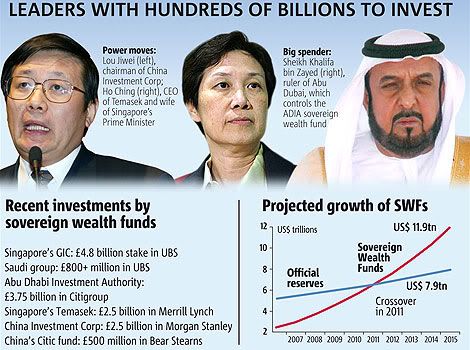
Sovereign
Wealth Funds (SWFs) are not a new idea. According to Wikipedia, the
termSovereign Wealth Fund was first used by
Andrew Rozanov in an article entitled, ‘Who holds the wealth of
nations?’ in the Central Banking Journal of May 2005. A SWF may be
broadly defined as a state-owned investment fund composed of
financial assets such as stocks, bonds, property, precious metals
or other financial instruments.
Theoretically one can distinguish two types of SWFs. The first, and
the oldest form of SWF, is one set up to manage revenues from an
exhaustible resource such as oil, or one which derives its assets
from government budget surpluses. An example of one based on
resources, and arguably the first SWF was the Kuwait Investment
Authority, a commodity SWF created in 1953 from oil revenues before
Kuwait even gained independence from Great Britain. A more recent
example is the Norwegian SWF which was set up primarily to ensure
that the wealth represented by Norway’s oil reserves was not
squandered on current consumption but turned into financial assets
which would benefit future generations.
Temasek could be said to be an example of the first type of SWF.
It was set up in 1974 to hold stakes in the various
government-controlled companies, such as DBS, SIA and Singapore
Technologies, that had previously been held by the Ministry of
Finance. The Temasek Holdings website states that, “Our investments
are funded through dividends we receive from our portfolio
companies, our divestment proceeds, commercial borrowings, a maiden
Yankee bond issue in 2005 and occasional asset injections from our
shareholder, the Minister for Finance (Incorporated).”
The second type of SWF is one set up to manage a country’s excess
foreign exchange reserves. GIC is probably an example of this type
of SWF since it was set up in 1981 with the explicit objective of
managing our foreign exchange reserves for long-term capital
appreciation. I say probably, as there is very little transparency,
so it is not clear whether it is also funded by capital injections
from the Ministry of Finance in the same manner as Temasek. However
a significant portion of its funding may come indirectly from the
CPF which invests primarily in debt issued by MOF. No information
is available on the current level of assets. The website states
only that the investment portfolio is in excess of US$100 billion.
However various estimates have put the level of assets at between
US$250 and US$330 billion.
Singaporeans need to be asking, particularly in the light of the
recent investment losses, why Singapore even has not one, but two,
SWFs. Singapore does not meet the criteria for the first type of
SWF since we do not need to manage a windfall from any natural
resources. If Singapore had expanded its domestic investment and
consumption over the last 30 years it would have had smaller
current account surpluses and thus smaller foreign exchange
reserves needing management. MAS already has sufficient foreign
exchange reserves necessary to manage the Singapore dollar.
No second SWF was needed to fulfil this function.
Again without transparency we have no breakdown of how much
government saving in the form of surpluses has contributed to both
Temasek and GIC’s growth over the years. But we do know that the
cumulative budget surplus over the last thirty years has been
considerable.
Where have these oft lauded budget surpluses come from in the first
place. Well we all know how to save money. We cut back on
expenditures. When a country cuts back on the absolute basics such
as free education for its children then it creates a budget
surplus. Let’s make no mistake here. No other First World Nation
only has compulsory education up to the end of Primary school and
even that only for a very short day and that minimal compulsory
education not even free (although heavily subsidised). I am not
advocating a welfare state but to put it bluntly, Singaporeans have
helped to pay for our enormous overseas investments by forgoing
free universal education to secondary level, a national health
insurance system and other elements of a social safety net which
are characteristic of most countries at Singapore’s level of
development
The budget surplus, having been taken from the pockets of
Singaporeans, then represents money that not only could have, but
should have, been returned to the citizens of Singapore in the form
of lower taxes, fees and charges. It could have also been used to
finance much higher domestic investment in education or in health
and welfare. Their website states that Temasek has achieved an
annualized return of 18% since inception though that is based on
the March 2008 asset figure of S$185 billion rather than on the
current valuation of S$145 billion announced by CEO Ho Ching
yesterday. Investment in our only natural resource, our people,
could potentially have had a much higher internal rate of return,
in the form of a more highly educated workforce, than that achieved
by Temasek or GIC on their overseas investments.
Instead of the Government investing our money to pick winners
through an industrial strategy there could have been greater
incentives for investment and R&D in the private sector which
might have led to faster productivity growth and higher levels of
real incomes. And even if GIC has not been funded directly by the
MOF, the growth of our foreign exchange reserves has come about
through chronic external surpluses which represent domestic
under-consumption and under-investment.
As a final ignominy, CEO Ho Ching announced on July 29th at the
Institute of Policy Studies that Temasek was thinking of allowing
Singaporeans to co-invest alongside Temasek sometime in the next
ten years. How kind of her. I thought we had already invested as
outlined above. The only positive side of this news is that
it would presumably force Temasek to be much more transparent about
its investment process and corporate governance. In any case any
personal financial adviser (and I am not one) would not advise an
investment in a company without sufficient transparency that
required due diligence.
As we all know, calls on the government for accountability and
transparency in its sovereign wealth funds is not new.
However; I would go one step further! Many of you know that I
gave a speech at the Foreign Correspondents Association lunch on
the 2 July 2009. In answer to a question put to me after the lunch
I went on record as saying that Singaporeans should be given a
direct stake in our SWFs, either through their privatization and
the issuance of shares to Singapore citizens or through the
explicit linkage of part of the value of these assets to the
welfare of Singaporeans, as is done in Norway through the Pension
Fund.
To counter one possible objection that our national “crown jewels”
could end up being bought by foreigners the government could retain
a golden share which would prevent this happening to Temasek’s
portfolio of domestic GLCs. Longer term there is no reason for
Singapore to continue to run large budget surpluses over the course
of an economic cycle.
In conclusion whilst I will not let up on calling on our government
for greater transparency and accountability into how it manages our
money, I would urge it also to look at credible new proposals such
as mine, rather than confining itself to the limited steps outlined
by CEO Ho Ching in her speech.