The full thread shall be--
Paul
Krugman:SG economic
growth,like Soviet Union,"achieved purely through mobilization of
resources".
Now i know why USA falls.
When the Noble prize winner falls into this standard,it is no
suprise
that USA falls from heaven.
I wont say too much .Ten thousand words cant express my
anger
to this article.BTW,i cant write too long in English!!
This article is not just a insult to Singapore,as well as to the
economists.
2.So,facts
speaks volume.
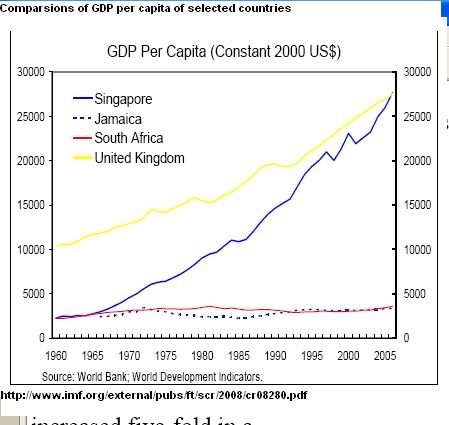
In the first image below,
u can see SG,through many politically incorrect measures,catch
up
the former Colony Master UK!!
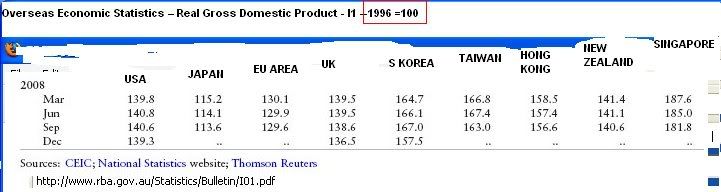
In the second image,u can see SG grew faster than
a no. of G8 countries,after Krugman 's prediction in 1994.
BTW,Australia grew abt 55% in the same period fr 1996
to end 2008.
3.Do u agree with
Krugman?
And yet there are surprising
similarities. The newly industrializing countries of Asia, like the
Soviet Union of the 1950s, have achieved rapid growth in large part
through an astonishing mobilization of resources. Once one accounts
for the role of rapidly growing inputs in these countries' growth,
one finds little left to explain, Asian growth, like that of the
Soviet Union in its high-growth era, seems to be driven by
extraordinary growth in inputs like labor and capital rather than
by gains in efficiency.
Consider, in particular, the
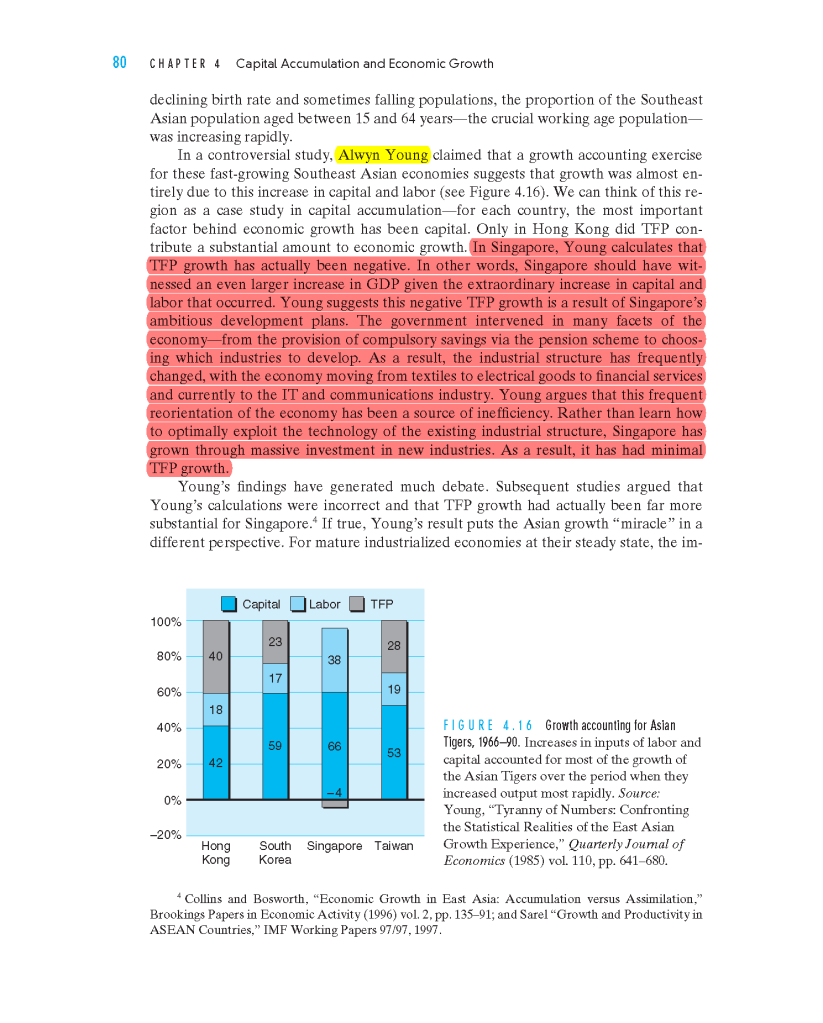
case of Singapore. Between 1966 and 1990, the Singaporean economy
grew a remarkable 8.5 percent per annum, three times as fast as the
United States; per capita income grew at a 6.6 percent rate,
roughly doubling every decade. This achievement seems to be a kind
of economic miracle. But the miracle turns out to have been based
on perspiration rather than inspiration: Singapore grew through a
mobilization of resources that would have done Stalin proud. The
employed share of the population surged from 27 to 51 percent. The
educational standards of that work force were dramatically
upgraded: while in 1966 more than half the workers had no formal
education at all, by 1990 two-thirds had completed secondary
education. Above all, the country had made an awesome investment in
physical capital: investment as a share of output rose from 11 to
more than 40 percent.
Even without going through
the formal exercise of growth accounting, these numbers should make
it obvious that Singapore's growth has been based largely on
one-time changes in behavior that cannot be repeated. Over the past
generation the percentage of people employed has almost doubled; it
cannot double again. A half-educated work force has been replaced
by one in which the bulk of workers has high school diplomas; it is
unlikely that a generation from now most Singaporeans will have
Ph.D's. And an investment share of 40 percent is amazingly high by
any standard; a share of 7O percent would be ridiculous. So one can
immediately conclude that Singapore is unlikely to achieve future
growth rates comparable to those of the past.
But it is only when one
actually does the quantitative accounting that the astonishing
result emerges: all of Singapore's growth can be explained by
increases in measured inputs. There is no sign at all of increased
efficiency. In this sense, the growth of Lee Kuan Yew's Singapore
is an economic twin of the growth of Stalin's Soviet Union growth
achieved purely through mobilization of resources. Of course,
Singapore today is far more prosperous than the U.S.S.R. ever
was--even at its peak in the Brezhnev years--because Singapore is
closer to, though still below, the efficiency of Western economies.
The point, however, is that Singapore's economy has always been
relatively efficient; it just used to be starved of capital and
educated workers.
Singapore's case is
admittedly, the most extreme. Other rapidly growing East
Asian economics have not increased their labor force participation
as much, made such dramatic improvements in educational levels, or
raised investment rates quite as far. Nonetheless, the basic
conclusion is the same: there is startlingly little evidence of
improvements in efficiency. Kim and Lau conclude of the four Asian
"tigers" that "the hypothesis that there has been no technical
progress during the postwar period cannot be rejected for the four
East Asian newly industrialized countries." Young, more poetically,
notes that once one allows for their rapid growth of inputs, the
productivity performance of the "Tigers" falls "from the heights of
Olympus to the plains of Thessaly.
This conclusion runs so
counter to conventional wisdom that it is extremely difficult for
the economists who have reached it to get a hearing. As early as
1982 a Harvard graduate student, Yuan Tsao.) found little evidence
of efficiency growth in her dissertation on Singapore, but her work
was, as Young puts it, "ignored or dismissed as unbelievable." When
Kim and Lau presented their work at a 1992 conference in Taipei, it
received a more respectful hearing, but had little immediate impact
But when Young tried to make the case for input-driven Asian growth
at the 1993 meetings of the European Economic Association, he was
met with a stone wall of disbelief.
references-
this article first appeared in Foreign
Affairs 1994.
-
mmm