North Korea: “Sanity” at the Brink
by Michael Parenti
June 20, 2009
Nations that chart a self-defining course, seeking to use their
land, labor, natural resources, and markets as they see fit, free
from the smothering embrace of the US corporate global order,
frequently become a target of defamation. Their leaders often have
their moral sanity called into question by US officials and US
media, as has been the case at one time or another with Castro,
Noriega, Ortega, Qaddafi, Aristide, Milosevic, Saddam Hussein, Hugo
Chavez, and others.
So it comes as no surprise that the rulers of the Democratic
People's Republic of Korea (DPRK or North Korea) have been
routinely described as mentally unbalanced by our policymakers and
pundits. Senior Defense Department officials refer to the DPRK as a
country "not of this planet," led by "dysfunctional" autocrats. One
government official, quoted in the New York Times, wondered aloud
"if they are really totally crazy." The New Yorker magazine called
them "balmy," and late-night TV host David Letterman got into the
act by labeling Kim Jong-il a "madman maniac."
To be sure, there are things about the DPRK that one might wonder
about, including its dynastic leadership system, its highly
dictatorial one-party rule, and the chaos that seems implanted in
the heart of its "planned" economy.
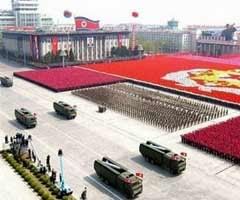
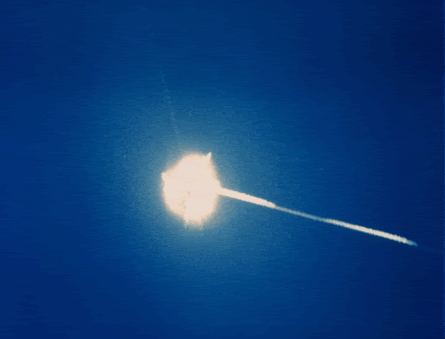
But in its much advertised effort to become a nuclear power, North
Korea is actually displaying more sanity than first meets the eye.
The Pyongyang leadership
seems to know something about US global policy that our own
policymakers and pundits have overlooked. In a word, the United
States has never attacked or invaded any nation that has a nuclear
arsenal.
The countries directly
battered by US military actions in recent decades (Grenada, Panama,
Iraq, Libya, Somalia, Yugoslavia, Afghanistan, then again Iraq),
along with numerous other states that have been threatened at one
time or another for being "anti-American" or "anti-West" (Iran,
Cuba, South Yemen, Venezuela, Syria, North Korea, and others) have
one thing in common: not one of them has wielded a nuclear
deterrence--until now.
Let us provide a little background. Put aside the entire Korean War
(1950-53) in which US aerial power destroyed most of the DPRK's
infrastructure and tens of thousands of its civilians. Consider
more recent events. In the jingoist tide that followed the
September 11, 2001 attacks on the World Trade Center and the
Pentagon, President George W. Bush claimed the right to initiate
any military action against any "terrorist" nation, organization,
or individual of his choosing.
Such a claim to arbitrary power--in violation of international
law, the UN charter, and the US Constitution--transformed the
president into something of an absolute monarch who could exercise
life and death power over any quarter of the Earth. Needless to
say, numerous nations--the DPRK among them--were considerably
discomforted by the US president's elevation to King of the
Planet.
It was only in 2008 that President Bush finally removed North Korea
from a list of states that allegedly sponsor terrorism. But there
remains another more devilishly disquieting hit list that Pyongyang
recalls. In December 2001, two months after 9/11, Vice President
Dick Cheney referred chillingly to "forty or fifty countries" that
might need military disciplining. A month later in his 2002 State
of the Union message, President Bush pruned the list down to three
especially dangerous culprits: Iraq, Iran, and North Korea, who, he
said, composed an "axis of evil."
It was a curious lumping together of three nations that had little
in common. In Iraq the leadership was secular, in Iran it was a
near Islamic theocracy. And far from being allies, the two
countries were serious enemies. Meanwhile the DPRK, had no
historical, cultural, or geographical links to either Iraq or Iran.
But it could witness what was happening.
The first to get hit was Iraq, nation #1 on the short list of
accused evil doers. Before the 2003 US invasion, Iraq had the
highest standard of living in the Middle East. But years of war,
sanctions, and occupation reduced the country to shambles, its
infrastructure shattered and much of its population drenched in
blood and misery.
Were it not that Iraq has proven to be such a costly venture, the
United States long ago would have been moving against Iran, #2 on
the axis-of-evil hit list. As we might expect, Iranian president
Mahmoud Amadinijad has been diagnosed in the US media as
"dangerously unstable."
The Pentagon has announced that thousands of key sites in Iran
have been mapped and targeted for aerial attack. All sorts of
threats have been directed against Tehran for having pursued an
enriched uranium program--which every nation in the world has a
right to do. And on a recent Sunday TV program, Secretary of State
Hillary Clinton warned that the United States might undertake a
"first strike" against Iran to prevent its nuclear weapons
development.
Rather than passively await
its fate sitting in Washington's crosshairs, nation #3 on the US
hit list is trying to pack a deterrence. The
DPRK's attempt at self-defense is characterized in US official
circles and US media as wild aggression. Secretary Clinton warned
that the United States would not be "blackmailed by North Korea."
Defense Secretary Robert Gates fulminated, "We will not stand idly
by as North Korea builds the capability to wreak destruction on any
target in Asia--or on us." The DPRK's nuclear program, Gates warns,
is a "harbinger of a dark future."
President Obama condemned North Korea's "belligerent provocative
behavior" as posing a "grave threat." In June 2009, the UN Security
Council unanimously passed a US-sponsored resolution ratcheting up
the financial, trade, and military sanctions against the DPRK, a
nation already hard hit by sanctions. In response to the Security
Council's action, Kim Jong-il's government announced it would no
longer "even think about giving up its nuclear weapons" and would
enlarge its efforts to produce more of them.
In his earlier Cairo speech Obama stated, "No single nation should
pick and choose which nation holds nuclear weapons." But that is
exactly what the United States is trying to do in regard to a
benighted North Korea--and Iran. Physicist and political writer
Manuel Garcia, Jr., observes that Washington's policy "is to
encourage other nations to abide by the terms of the Nuclear
Non-Proliferation Treaty--and renounce nuclear weapons--while
exempting itself." Others must disarm so that Washington may more
easily rule over them, Garcia concludes.
US leaders still refuse to give any guarantee that they will not
try to topple Pyongyang's communist government. There is talk of
putting the DPRK back on the list of state sponsors of terrorism,
though Secretary Clinton admits that evidence is wanting to support
such a designation.
From its lonely and precarious perch the North cannot help feeling
vulnerable. Consider the intimidating military threat it faces. The
DPRK's outdated and ill-equipped army is no match for the
conventional forces of the United States, South Korea, and
Japan.
The United States maintains a large attack base in South Korea.
As Paul Sack reminds us in a recent correspondence to the New York
Times, at least once a year the US military conducts joint
exercises with South Korean forces, practicing a land invasion of
the DPRK. The US Air Force maintains a "nuclear umbrella" over
South Korea with nuclear arsenals in Okinawa, Guam, and Hawaii.
Japan not only says it can produce nuclear bombs within a year, it
seems increasingly willing to do so. And the newly installed
leadership in South Korea is showing itself to be anything but
friendly toward Pyongyang.
The DPRK's nuclear arsenal is a two-edged sword. It can deter
attack or invite attack. It may cause US officials to think twice
before cinching a tighter knot around the North, or it may cause
them to move aggressively toward a confrontation that no one really
wants.
After years of encirclement
and repeated rebuffs from Washington, years of threat, isolation,
and demonization, the Pyongyang leaders are convinced that the best
way to resist superpower attack and domination is by developing a
nuclear arsenal. It does not really sound so
crazy. As already mentioned, the United States does not invade
countries that are armed with long-range nuclear missiles (at least
not thus far).
Having been pushed to the brink for so long, the North Koreans are
now taking a gamble, upping the ante, pursuing an arguably "sane"
deterrence policy in the otherwise insane world
configured by an overweening and voracious
empire.
http://www.globalresearch.ca/index.php?context=va&aid=14033
http://www.lewrockwell.com/vance/vance174.html