Temasek makes money with its investments in Merril Lynch.
Calling others stupid will not change this fact. You
lose.  .
Of course, you wished very hard that Temasek would lose money on
Merril Lynch because you are "Anti". However, being unable to
accept the fact that Temasek eventually made some money out from
Merril Lynch and even tried to "condemn" this investments makes you
a lousy loser. .
Hahaha.......(ROTFLMAO)
Did I call you stupid? If not, then why do you feel
insulted? Guilty conscious? 
First of all I don't deny that Temasek "might"
possibly make money from the purchase of Merrill Lynch. But you
have to understand the facts of the case, instead of being in
constant denial and subvening on blind faith regarding
Temasek's investment decisions.
1) Temasek acquired Merrill Lynch in December 2007, when the
share price was trading at USD 52 per share, the price sold to
Temasek was USD 48, which was a discount, already a gain for
Temasek.
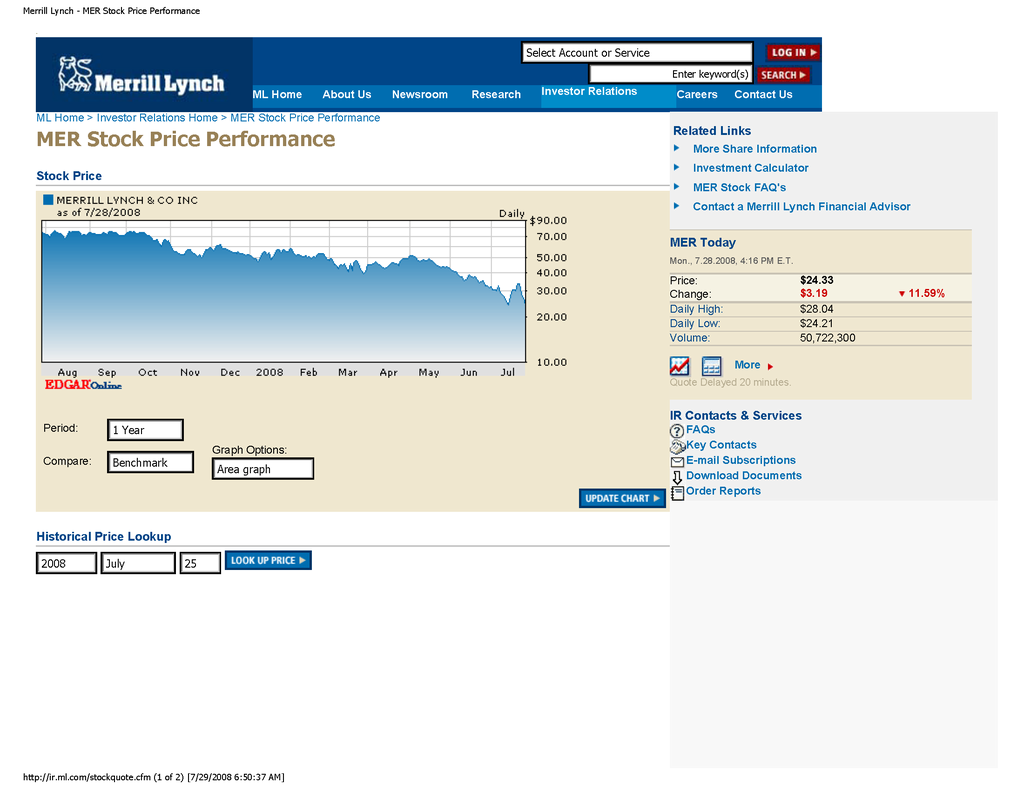
2) In a matter of 6 months the share price
plummeted to half price around USD 25. Due to liquidity
constraints the bank was force to seek extra cash. There are
various ways of raising cash.
a) They could have used bonds to get cash, I don't know why they
didn't use this avenue of raising cash. It would have denied
Temasek from gaining the USD 23, that they overpaid for the shares
in December 2007, because the clause in the share purchase
agreement only if only new equity shares were issued within a year,
Merill Lynch will have to make good the difference of the USD 48
and the new share issue price. Perhaps they foresaw the difficulty
of raising finance through the debt (bond) maket because of the
financial statements exposure to subprime.
b) The other way to get finance is to issue new share capital,
to which current equity stareholders will buy, else they lose
shareholding in Merill Lynch. The new share issue was at USD 22.50
when Merrill Lynch was trading at USD 25, it was the same scenario
as in December 2007, it was given a discount for the new share
issues.
i) One thing you have to ask yourself is, was it really a profit
for Temasek. Why would any company issue shares at USD 22.50 when
the share is currently trading in stock exchange for USD 25? The
only reason why anybody would do that is because they fear that the
new share issues will not be bought up by the public, therefore
they need to give a discount to ensure that the new share issue is
a success.
ii) The so called "profit" of USD 2.50 for Temasek was the
same as the discount given to Temasek when they purchased the
Merrill Lynch shares in December 2007. They received USD 4.00
discount for the share purchase in December 2007, which is close to
double the current discount of USD 2.50. The "profit" is not in the
form of cash, it is paid out in new shares, so Temasek received
more bad shares. 
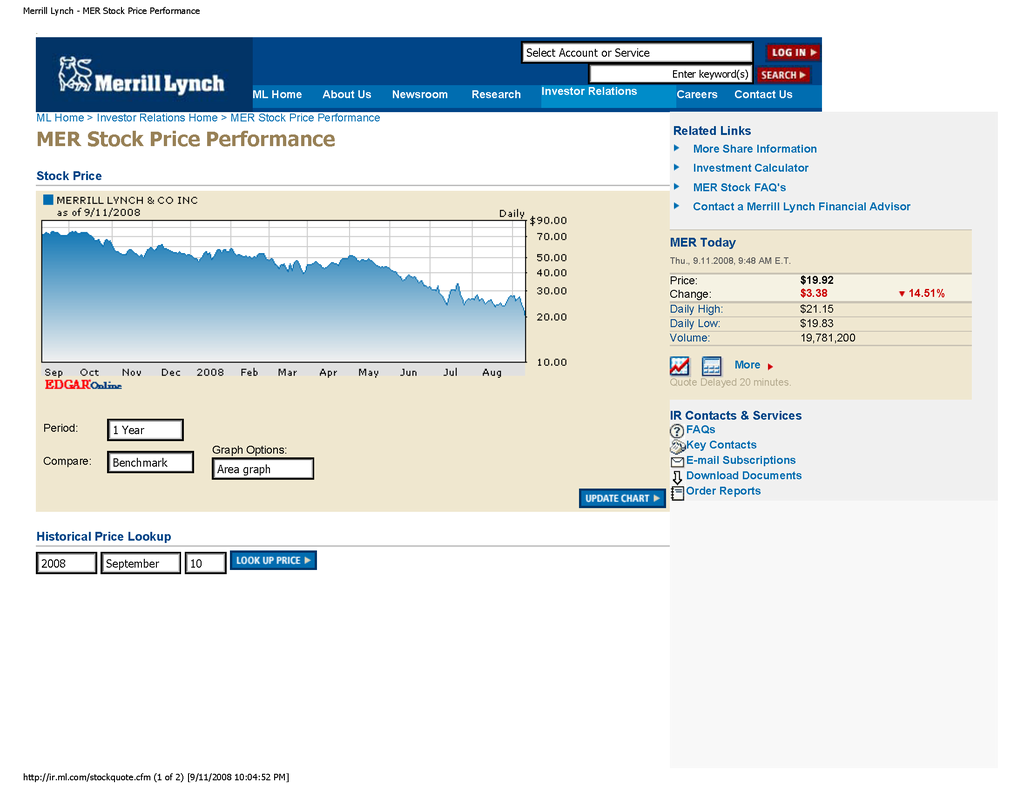
3) Afew months after the new share issue, the company's share
dipped to a new low of USD 16.50, this is a loss USD 6 from the new
share issue price of USD 22.50. During this period, Merrill Lynch
was also a candidate for bankruptcy like AIG, Lehman Brothers and
Bear Stearns. Then appeared a White Knight (Bank of America) which
offered to buy the Merrill Lynch for USD 29, when the share price
in the stock exchange was trading at USD 17. In any takeover, the
share price of the target company will always rise because a higher
share price entices current shareholder to sell their shares. But
the "profit" "if" Bank of America goes ahead with the deal in early
2009 is not going to be paid in cash, but in equity shares in Bank
of America, most likely these shares will have conditions attached
to them like Merrill Lynch, which forbids them to sell the shares
within a certain period.
The appearance of a White Knight was pure luck, Merrill Lynch
could have winded up like Lehman Brothers or Bear Stearns. They did
make a so call "profit" (barring any unforseen circumstances
arising in early 2009) out of Merrill Lynch, but was it investment
or gambling? Investment requires knowledge and intelligence,
judging from Temasek's past acquisition of other companies, they
haven't been very good in this category, they always overpay for
their investments.