Lim Chin
Siong vs Lee Kuan Yew: The true and shocking
history
It will forever change how you see Lee Kuan Yew and
the PAP
Lim Chin Siong
Introduction
Schools teach our children that Lee Kuan Yew heroically delivered
Singapore from the evil clutches of the communists and gave us what
we have today.
Whether such an assertion is historically accurate or not, the
Government seems intent to seal this version in the annals of
Singapore. When filmmaker, Mr Martyn See, released Zahari's 17
Years in which Mr Said Zahari talked about his 17-year detention,
the Government promptly banned it.
It, it stated, "will not allow people who had posed a security
threat to the country in the past to exploit the use of films to
purvey a false and distorted portrayal of their past actions and
detention by the government."
Top-secret documents held by
the British Government, now declassified, reveal some jaw-dropping
facts about Lee Kuan Yew and how he came to
power.
When Lim Chin Siong, another of Lee Kuan Yew's prisoners, died in
1996, the PAP was equally anxious to make sure that Lim's portrayal
as a revolutionary communist remained etched in the minds of the
people.
 In response to a tribute that the SDP had written about
Lim, the PAP through then MP Dr Ow Chin Hock, said that the Barisan
Sosialis (Socilaist Front), of which Lim was its leader, fought the
Government in 1966 "on the streets, according to the teachings of
Mao Zedong in the Cultural Revolution."
It was a bald-faced lie. Lim was already in prison under ISA
detention in 1966 and could not have led his party in
anything.
This, it seems, was not the only untruth that the PAP has been
telling us.
For example, Dr Ow pointed out that Lim was not fighting for a
democratic Singapore (the cheek) but a communist one. Lim would
have turned Singapore into "Mao's China or Ho Chi Minh's Vietnam",
the PAP insisted.
Besides, it was the Internal Security Council (ISC) under the
command of the British and not the PAP Government, who ordered the
arrest and detention of Lim and colleagues.
 This was because there were only three PAP representatives
on the ISC and they were "outnumbered" by the other four members on
the Council, three British and one Malaysian.
Nothing could be more untrue.
Top-secret documents held by the British Government, now
declassified, reveal some jaw-dropping facts about Lee Kuan Yew and
how he came to power.
Two history scholars studied these papers and presented their
findings in the book Comet In Our Sky (available at Select Books at
the Tanglin Shopping Centre).
The first is Tim Harper who teaches Southeast Asian history and the
history of the British empire at the University of Cambridge in
London.
The second is Greg Poulgrain, a professor at Griffiths University
in Australia who has been researching Southeast Asian history for
more than 20 years.
This SDP feature presents a summary of Dr Harper's and Dr
Poulgrain's chapters. It contains some shocking archival
material.
It also attempts to answer questions like who were people like Lim
Chin Siong and Said Zahari? Did they really pose a security threat
to the country? Were they communists hell-bent on undermining
constitutional/democratic means of governance in Singapore? Was it
really the ISC that was responsible for their arrest and
imprisonment? Most important, is the PAP's version of history based
on fact?
Remember, this narration is not the SDP's rendition of events past.
It is a collective summary of the research done by two
historians.
To ensure that this present essay remains faithful to Professors
Harper's and Poulgrain's works, quotes from the historians'
chapters are used liberally.
Still, don't take our word for it. Get a copy of Comet In Our Sky
and read for yourself the real history of the PAP and Barisan
Sosialis.
Why bother?
But why is this important? Why should Lim Chin Siong, a man who
died more than ten years ago and who led a party which is now
defunct, be relevant to the world in which we now live?
Hard, historical facts are the greatest antidote to fear
mongering by the state and to the use of national security as a
bogey to suppress freedom and democracy.
Lim Chin Siong (right) and Lee Kuan Yew
First, because those events are part of our history, and history
defines who we are as a people and, more important, shapes the way
we plan our future.
The textbooks that the Ministry of Education writes for our kids
are not history but rather fables, starring Mr Lee Kuan Yew. We
have a duty to teach our youths the truth.
Also, what happened in the 1950s and 60s continue to be relevant
because many of Lim's colleagues are still alive and the sacrifices
they made for the independence of Singapore have been all but
erased. Their stories must be told and their honour restored.
Third, and perhaps most important, not only is the PAP's cloroxed
account used to mentally condition (brainwash, if you prefer) our
children, it continues to be used as a weapon to intimidate and
silence voices of dissent.
If Lee Kuan Yew can manipulate the security apparatus for his own
political ends in the 1950s and 60 as you will note from Dr
Harper's and Dr Poulgrain's revelations, what does that say about
the present use of the ISD to detain other Singaporeans?
More ominously, what if the PAP feels sufficiently threatened
politically and resorts to concocting another conspiracy to detain
without trial more Singaporeans and opposition politicians like it
did to a group of professionals in 1987?
Hard, historical facts are the greatest antidote to fear mongering
by the state and to the use of national security as a bogey to
suppress freedom and democracy.
Knowledgeable citizens with a keen sense of history are the best
protection against acts of repression in the future.
So if you are a discerning Singaporean unwilling to let the
authorities tell you what to think and how to think it, if you are
one of those who don't want your mind raped, then introduce
yourself to this four-part Special Feature and take part in the
forum discussion.
http://yoursdp.org/index.php/perspective/
Lim Chin
Siong vs Lee Kuan Yew: The true and shocking history
Part I: Our man
08 Jul 07
"The men who led Singapore to self-government and
independence were swift to produce an authorized version of their
struggle…,” historian T N Harper observes, "it began with Lee Kuan
Yew's dramatic broadcasts as Prime Minister on Radio Malaya in
1961. The plot and the moral of this story are clear: by the
political resolve and tactical acumen of its leaders, the fragile
city-state weathers the perils of a volatile age and emerges into
an era of stability and prosperity."
However, much to the discomfort of the Minister Mentor who hitherto
has had a relatively free reign in portraying "the period as one in
which Lim Chin Siong and the left were outmanoeuvred by the
tactically more astute Lee Kuan Yew," Harper cautions that
"authoritative new archival research sheds new light on the high
politics of the period."
In other words, Lee's bravado with which he presently speaks covers
up much that took place during those years.
In truth, Lim Chin Siong's fate was sealed right from the very
beginning by the power of the British colonialists – and not Lee
Kuan's political prowess.
At that time British authorities were already devising ways on how
to stop Lim's ascent in Singapore's politics. Southeast Asia
historian, Greg Poulgrain, writes that "In the Public Record Office
in London are some of the observations and stratagems pursued by
both the Colonial and Foreign Office – revealed now more than
thirty years after the events – on how to deal with this rising
star, Lim Siong Chin."
With Singaporeans becoming more educated and the advent of the
Internet, events surrounding the heroics of Lee and his PAP during
the period of independence and merger with Malaya "no longer looks
so unilinear and uncontested."
The emergence of Lim Chin Siong
Harper recounts the "meteoric" rise of Lim Chin Siong as a student
and trade union leader in the early 1950s who was at the heart of
the anti-colonial politics that had erupted all over Asia following
World War II.
By unifying the labour movement and galvanizing the overwhelmingly
Chinese-speaking electorate through his formidable oratorical
skills (he once told his massive audience: "Saya masuk
first gear, lu jangan gostan!" – "When I go into the first
gear, don't you go into reverse!"), Lim captured the attention of
the masses.
And Lee Kuan Yew's too. This led to an association between the two
men and the subsequent formation of the PAP. The anglophile Lee
(Harry, as he once wanted to be called) saw the power of his
younger Chinese-educated comrade.
Even within the PAP, "Lim eclipsed Lee Kuan Yew and other leaders
in the popular following he commanded..."
But in his memoirs, The Singapore Story, published in 1998
Lee Kuan Yew condescendingly described Lim as "modest, humble and
well-behaved, with a dedication to his cause that won my reluctant
admiration and respect."
The truth is that Lee didn't have much of a choice. Lim Chin Siong
was at the front, back and center of a political movement that
commanded national attention. From all accounts, Lee would have
been marginalized if his parasitic instincts had not been so
acute.
Popular as he was locally, Lim Chin Siong did not confine his
politics to within Singapore. Despite British efforts to isolate
the island from anti-imperial movements that engulfed much of
Empire, Lim would draw inspiration from liberation movements
elsewhere in Africa and Asia.
His speeches in the early 1960s repeatedly made reference to events
in the colonial world as well as to South Africa, Korea, and
Turkey. This sense of internationalism had a "deep resonance" in
Singapore.
The colonial government countered by censoring imported reading
material. "This," writes Harper, "would continue, even intensify,
after self-government as the PAP government increasingly saw itself
as pitted against what Lee Kuan Yew was to term the
‘anti-colonialism' of global liberation movements."
In other words, Lee was not the hero who led the fight for
Singapore's freedom. This might come as a shock to some but as
declassified documents reveal, it was Lim Chin Siong who insisted
that Singaporeans' freedom and independence were not for
compromise.
It was also "what really caused the British authorities to consider
[Lim] such a threat."
The talks collapse…
When David Marshall became the chief minister after his Labour
Front won the elections in 1955, he organised a delegation to
London the following year to negotiate independence from the
British. Marshall included both Lim Chin Siong and Lee Kuan Yew in
his team.
The chief minister fought hard, some say too hard, to wrest power
from the British in the internal affairs of Singapore. He opposed
Britain's power to appoint the police chief who in turn had power
over the Special Branch, as it was then known. It was the Special
Branch that gave the authorities the power of detention without
trial.
The idea of retaining the power of internal security whilst
granting self-government, Marshall accused the British, was like
serving "Christmas pudding and arsenic sauce."
Lim Chin Siong supported the chief minister on this and demanded a
constitution that transferred power to the local government with
only defence and foreign relations left in British hands.
The British refused the demand and the talks collapsed. Marshall
returned to Singapore frustrated and, amidst condemnation by Lee
Kuan Yew, resigned as chief minister.
...Lim Chin Siong is detained…
Lim Yew Hock took over the position and led another visit to London
the following year, which again included Lee Kuan Yew. But this
time, Marshall and Lim Chin Siong were not part of the negotiating
team.
More accurately, Lim Chin Siong could not go because Lim Yew Hock,
as chief minister, had placed him under arrest, ostensibly for
instigating a riot.
The episode began when Chief Minister Lim closed down a Chinese
women's group and a musical association. A week later, he banned
the Chinese Middle School Union which provoked further unhappiness
with the locals.
Undeterred he arrested Chinese student leaders and shut down more
organizations and schools, including the Chinese High School and
the Chung Cheng High School. Given the already tense situation
between the Chinese-speaking people and the colonial authorities,
this was a highly provocative act.
At that time any Singaporean leader worth his salt could not have
sat by idly. And so Lim Chin Siong came to the fore and spoke up
for the students. The late Devan Nair, former Singapore president,
joined in.
A 12-day stay-in was organised at one of the schools and Lim Chin
Siong was scheduled to speak at a nearby park one evening.
It wasn't long before the police appeared and ringed the crowd.
Suddenly a mob started throwing stones at the police who then
charged with batons and tear-gas.
Violence erupted and spread, with police stations being attacked
and cars burned. By the end of the chaos 2,346 people were arrested
and more than a dozen Singaporeans were killed.
The blame was squarely pinned on Lim Chin Siong who was
arrested.
But did Lim Chin Siong really cause the mayhem? Who was the "mob"
that started attacking the police?
At that time, Chief Minister Lim made no bones that the Lim Chin
Siong was the front man for the communists who had started the
violence. Lim was arrested by the Special Branch the following
day.
Lim vehemently denied this accusation and countered that the chief
minister was a colonial stooge. As declassified documents now
reveal, Lim Chin Siong was largely right.
Entitled Extract from a note of a meeting between Secretary of
State and Singapore Chief Minister, 12 December 1956, the
archival note recorded that it was Chief Minister Lim who "had
provoked the riots and this had enabled the detention of Lim Chin
Siong."
Poulgrain even documents that full-scale military assistance was
requested by prior arrangement. Singapore Governor, William Goode,
acknowledged that the colonial government was not beyond employing
the tactic of provoking a riot and then using the outcome to
"achieve a desired political result."
Indeed, Poulgrain noted that "[Public Record Office] documents show
these were the tactics of provocation that were employed in the
1956 riots that led to Lim Chin Siong's arrest."
A few weeks after Lim Chin Siong was behind bars, Lim Yew Hock
visited London in December 1956 and was "warmly congratulated on
the outcome by Alan Lennox-Boyd, Secretary of State for the
Colonies."
And yet, in his memoirs, the Minister Mentor concludes that the
Malayan Communist Party "in charge of Lim Chin Siong" were behind
the whole affair and that Lim Yew Hock had purged Singapore of the
communist ringleaders.
…and the talks are resurrected
And so in the 1957 with Lim Chin Siong under detention, Lim Yew
Hock led the delegation to London. But during the negotiations, it
was Lee who "played a crucial role in sweeping away the earlier
obstacles to agreement on internal security by resurrecting the
proposal for an Internal Security Council (ISC)."
The ISC was structured in a way that Britain and Malaya outweighed
Singapore in the outfit. Why was the PAP supportive of such an
arrangement?
Historian Simon Ball said it best: "Lee wanted an elected
government but not one that could be blamed for suppressing its own
citizens."
Even more damning was an archival "Top Secret" document that
recorded: "Lee was confidentially said that he values the [Internal
Security] Council as a potential ‘scape-goat' for unpopular
measures he will wish to take against subversive activities."
But the PAP continues the charade. Recall what Dr Ow Chin Hock
wrote in his letter in 1996 about the arrest of Lim Chin Siong and
other Barisan leaders: "The [ISC] had a British chairman, two
British members, one Malaysian members and three Singaporean
members. Together these four non-Singaporeans outnumbered the three
Singaporeans on the council."
In any event, unlike the one led by David Marshall, the
negotiations in 1957 had little spine and gave away too much of
Singaporeans' rights. As a result, both sides expeditiously reached
an agreement for self-government, an agreement that Marshall called
"tiga suku busok merdeka" (three-quarters rotten
independence).
But self-government was not the only subject being discussed. On
the side, the British also wanted to introduce a clause that would
bar ex-detainees, or subversives as the authorities called them,
from standing for elections.
Lee supported such a move – one that he would surely have known
would cripple party comrade Lim Chin Siong's political
career.
In his memoirs, however, Lee Kuan Yew wrote: "I objected to [the
introduction of the clause] saying that ‘the condition is
disturbing both because it is a departure from the democratic
practice and because there is no guarantee that the government in
power will not use this procedure to prevent not only the communist
but also democratic opponents of their policy from standing for
elections'."
A declassified British memo contradicts this: "Lee Kuan Yew was
secretly a party with Lim Yew Hock in urging the Colonial Secretary
to impose the ‘subversives ban'."
Perhaps this is not surprising as the British had noted that the
"present leadership of the PAP is obsessed with the need to
persuade the politically unsophisticated masses that the PAP is ‘on
their side' and this involves demonstrating that the PAP is not a
friend of the foreigner…"
And this is perhaps the reason why Lee told Britain's Secretary of
State, Alan Lennox-Boyd: "I will have to denounce [the clause]. You
will have to take responsibility."
London to the rescue…again
A few months after Lee returned from the constitutional talks in
London in March 1957, the PAP conducted elections of its executive
council. Lim Chin Siong was still under detention and could not
challenge Lee for the party's leadership.
Lim's supporters, however, outnumbered Lee's rightwing faction and
were elected to the executive council of the PAP.
The British, through Lim Yew Hock who was by then "viewed as an
altogether more compliant tool of the security apparatus," ordered
the arrest of Lim Chin Siong's supporters, thereby securing Lee
Kuan Yew's continued control of the party.
Harper records, that despite Lee's protests against the crackdown
of his party's leftwing, "not all were convinced of his innocence
in the matter."
In his 1998 memoirs, Lee Kuan Yew describes the fateful detention
of the PAP's leftwing leaders by giving much prominence to Lim Yew
Hock's decision while adroitly playing down the role of the
British.
After the talks in 1957, and given the stubbornness of Marshall and
Lim in the 1956 talks, the British were persuaded that Lee was
their man.
Another set of talks were arranged in May 1958 and thereafter
"there was an unspoken assumption that the PAP would govern after
the 1959 elections."
Writer T J S George repeated this observation that "repeated
[British] intervention to ensure Lee Kuan Yew's political survival
confirmed the feeling that Lee was by now Britain's chosen man for
Singapore."
Poulgrain recounted his own experience with British intelligence
officers who were operating in Singapore in the early 1960s. One
told him about a group of officers who were listening in on Lee
Kuan Yew making a speech, railing against British
imperialism.
"The diatribe," Poulgrain writes, "brought only a jocular response
from this group, one of whom openly commented that Lee was going a
‘bit over the top' considering that he was actually ‘working with
us.'"
The historian states plainly that Lee Kuan Yew personified the
essential long-term interests of the United Kingdom in
Singapore.
Lee himself played up this position when he told the British
government that the PAP was really London's "best ally."
The British agreed. Secret documents now show that London's
assessment was that Lim Chin Siong was increasingly bringing
pressure to bear on Her Majesty's Government and "unless
forestalled by Lee, may well be able to make the pressure
decisive."
Lee was grateful. He indicated that "he and his other reputed
moderates in the PAP regard the continued presence of the British
in Singapore as an assurance for themselves."
From then on, despite the British concerns of Lee's "totalitarian
streak that rides roughshod over all opposition or criticism",
Lee's PAP and London "became locked closer together."
Part II: Get him!
In the next instalment read how an emboldened Lee Kuan Yew, with
British backing, officially breaks with Lim Chin Siong. To be
posted tomorrow. You won't want to miss this.
Preview:
In his memoirs, Lee wrote that "Lim Chin Siong wanted to eliminate
the Internal Security Council because he knew that…if it ordered
the arrest and detention of the communist leaders, the Singapore
government could not be held responsible and be stigmatized a
colonial stooge."
What the Minister Mentor did not say, but what Harper reveals in
his chapter, is shockingly contradictory: "In mid-1961, therefore,
to seek a way out, Lee suggested to the British that his government
should order the release of all [the remaining] detainees, but then
have that order countermanded in the ISC by Britain and
Malaya."
Such a craven act was even rebuffed by the British. The acting
Commissioner, Philip Moore, stated that the British should not be
"party to a device for deliberate
misrepresentation of responsibility for continuing detentions in
order to help the PAP government remain in power." (emphasis
added)
http://singaporedemocrat.org/article
Part II: Get him!
9 Jul 07
After securing control of the PAP with the aid of
the British, Lee Kuan Yew was still left with the problem of the
detained Lim Chin Siong and his supporters.
This was a source of embarrassment for him. Seeing this, Lee
announced that he would secure the release of his party comrades
before taking office if the PAP won the elections in 1959.
Behind the scenes, Lee negotiated and secured the private agreement
of then British Prime Minister Harold Macmillan that the prisoners
would be released by promising that he (Lee) would "move against
them if they departed from the party line."
In return for promising to secure their release, Lee had secured
Lim Chin Siong's and other detainees' pledges of allegiance to the
party's manifesto.
Following PAP's victory in the 1959 election, Lim and six other
detainees, were released.
Question: If Lim Chin Siong had really been the one who started the
riots in 1956, shouldn't he have been charged and imprisoned,
rather then released?
In truth the PAP and the British themselves were playing fast and
loose with the law. The affair confirmed suspicions that all the
backroom dealings was for political ends, not national
security.
In any event, Lee assigned Lim – who, if not for all the
machinations, would have been the leader of the PAP and prime
minister – the post of political secretary in the ministry of
finance, the Siberia of politics at that time.
In the meantime, detentions without trial continued under the new
Lee government and the ISC continued to be used as a front for the
PAP's acts.
An indecent proposal
Fed-up with Lee's autocratic style and the delay of releasing the
remaining detainees, PAP MP and mayor Ong Eng Guan denounced the
government for its dictatorial methods and moved a motion in the
Legislative Assembly to abolish the ISC.
Harper wrote that because of the secrecy under which the ISC
operated "not all members of Lee's cabinet were aware that the
Singapore government had not pressed for the releases since early
1960."
In his memoirs, Lee wrote that "Lim Chin Siong wanted to eliminate
the Internal Security Council because he knew that…if it ordered
the arrest and detention of the communist leaders, the Singapore
government could not be held responsible and be stigmatized a
colonial stooge."
What the Minister Mentor did not say, but what Harper reveals in
his chapter, is shockingly contradictory: "In mid-1961, therefore,
to seek a way out, Lee suggested to the British that his government
should order the release of all [the remaining] detainees, but then
have that order countermanded in the ISC by Britain and
Malaya."
Such a craven act was even rebuffed by the British. The acting
Commissioner, Philip Moore, stated that the British should not be
"party to a device for deliberate
misrepresentation of responsibility for continuing detentions in
order to help the PAP government remain in power." (emphasis
added)
Moore suggested that the best solution would be "to release all the
detainees forthwith." Lee, however, "was unwilling to present the
left with such a victory."
In a most damning indictment, Moore said that Lee "has lived a lie
about the detainees for too long, giving the Party the impression
that he was pressing for their release while, in fact, agreeing in
the ISC that they should remain in detention."
And if one thought that Lee Kuan Yew could not sink any lower, he
did. He turned to his saviours and warned that should he lose in an
upcoming by-election, he would call for a general election, which
he fully expected to lose.
This was because he was facing defections in the Legislative
Assembly on his refusal to release the remaining detainees. And
should he lose the elections, he warned the colonial masters, David
Marshall, Ong Eng Guan and Lim Chin Siong would form the next
government.
This, he calculated, would be so distasteful to the British that it
would rally them to his side.
He presented the scheme at a dinner with Commissioner Lord Selkirk,
Philip Moore (Selkirk's deputy), and Goh Keng Swee: Lee would order
the release of the prisoners, the British would stop it through the
ISC, and he would then announce a referendum on merger with Malaya
(the story behind merger is explained below).
This would provoke opposition from his party mates as well as Lim's
supporters whom he would then banish to Malaya.
A 1961 memo between the then Commission in Singapore and the
Colonial Office in London revealed that Lee calculated that this
move "would force Lim Chin Siong to reveal his hand completely and
resort to direct action, in which event the Singapore Government
would relinquish power and allow the British or the Federation to
take over Singapore."
In short, Lee was willing to sacrifice the efforts to secure the
independence of Singapore to achieve his own political ends!
As it turned out, Selkirk wanted to have nothing to do with the
"unsavoury" proposal.
Merger – on one condition
At about this time, Malaya's Prime Minister Tunku Abdul Rahman
revived the idea of a federation of Malaysia consisting of the
Borneo territories (now Sarawak, Sabah, and Brunei), Malaya (now
peninsular Malaysia), and Singapore.
In exchange for territorial concessions in Borneo, the Tunku as the
head of the federation would allow Britain to maintain a strategic
presence in Singapore.
The proposal was put forward because the Tunku was having problems
of his own with the left in Malaya. This was not helped by the
strength of Lim Chin Siong's left in Singapore. Kuala Lumpur saw
the necessity of crippling Lim's support and wanted Lee to be its
hit-man.
For the British, the idea of a Malaysian federation was an
acceptable compromise because it allowed London to maintain
influence in the region while relinquishing its colony which it was
going to lose anyway given the irresistible anti-colonial sentiment
fanning the globe at that time.
As for Lee Kuan Yew, the idea was heaven sent. Harper documents
that Lee saw the Tunku's concept of a "Malaysia" as crucial to his
own political survival because of the growing strength of the
left.
The left's strength was amply demonstrated when Lee's rightwing
faction lost two by-elections in quick succession – the first to
Ong Eng Guan in April 1961 (Hong Lim) and the second three months
later to David Marshall (Anson).
Lee was rattled. Then PAP chairman, Toh Chin Chye, recalled: "He
was quite shocked. He drew me aside after the results were
announced and asked me what to do. I said, 'Hang on!'"
Toh also revealed that Lee had written to him that "the trade
unions, the Middle Road crowd wanted him to resign" and that they
wanted him to replace Lee as the prime minister.
Toh did not recommend Lee's resignation. But the reason he gave was
that it "would divide the government and it would appear to the
people of Singapore that we were being unsteady," hardly a ringing
endorsement of Lee's leadership.
These developments precipitated an open split between Lee and Lim
Chin Siong. Lim's group suspected – correctly – that Lee was up to
no good in his pursuit of merger with Malaysia and they openly
called for the abolition of the ISC.
In July 1961, legislative assemblymen, parliamentary/organising
secretaries, and members of the PAP split from the party and formed
the Barisan Sosialis. Lee's party was shaved to bare bones.
At the time, Harper writes, "there was an immense political
momentum, a sense that the future lay with the Barisan
Sosialis."
Even then, Lim Chin Siong never wavered in his commitment to
governing Singapore in a democratic way when he wrote in a press
statement that "any constitutional arrangement must not mean a
setback for the people in terms of freedom and democracy."
This contrasts with the PAP's demonisation of Lim as a front for
the communist out to destroy the democratic way.
Closing in on Lim
Meanwhile In Malaya the Tunku insisted that Lee re-arrest Lim Chin
Siong before he would allow Singapore into the federation.
One of the reasons was because if the detention was conducted after
merger, the Kuala Lumpur government would be responsible for it and
it would be seen as cracking down on the Chinese in Singapore,
increasing communal tensions.
As for Lee's part, he saw the detention of Lim as his trump card
and wanted to secure the merger first before he moved against the
Barisan leader; Abdul Rahman would have no incentive to proceed
with merger once the threat of Lim was removed.
But the Tunku was firm: No detention of Lim, no merger. Lee knew he
had to act.
And so a two-part plan was hatched to bait Lim and colleagues: "In
the first phase, the Barisan would be harassed by the police and
the government. This was designed to provoke it into
unconstitutional action, which would initiate a second phase of
detentions, restrictions and other actions to be sanctioned by the
ISC."
Lim's opposition of allowing the British to retain powers of
detention during the constitutional talks in 1956 rang truer than
ever and Marshall's colourful description of "Christmas pudding and
arsenic sauce" were beginning to sound very apt.
The diabolical scheme was vehemently opposed by the British
Commission in Singapore. Lord Selkirk told his superiors in London
that "in fact I believe that both of them (Abdul Rahman and Lee
Kuan Yew) wish to arrest the effective political opposition and
blame us for doing so."
In the months leading up to Lim's arrest, Selkirk wrote to his
superiors in London again, imploring them not to cooperate with
Lee:
"Lee is probably very much attracted to the idea of destroying his
political opponents. It should be remembered that there is behind
all this a very personal aspect…he claims he wishes to put back in
detention the very people who were released at his insistence –
people who are intimate acquaintances, who have served in his
government, and with whom there is a strong sense of political
rivalry which transcends ideological differences."
Contrast this to what Lee wrote in his memoirs in 1998: "Lim Chin
Siong…knew that if he went beyond certain limits, [the ISC] would
act…"
Lim need not have gone "beyond certain limits" as declassified
documents now reveal, Lee was determined to put him in prison,
communist or not, limits or no.
More shamefully, Lee will not admit that he was the one who had
pushed for Lim's detention.
Selkirk's deputy, Philip Moore, reviewed intelligence reports and
concluded that there were no security reasons to detain Lim Chin
Siong: "Lim is working very much on his own and that his primary
objective is not the Communist millennium but to obtain control of
the constitutional government of Singapore."
But London was determined not to allow democratic scruples from
getting in the way of its strategic presence in Southeast Asia. It
acquiesced to Lee's plan.
Part III: The end of Lim Chin Siong
The next instalment will examine the treatment of
Lim Chin Siong in Lee Kuan Yew's hands. More evidence of Lim's
persecution.
http://singaporedemocrat.org/article
Part III: The end of Lim Chin Siong
9 Jul 07
In February 1963 the ISC, under the direction of Lee,
ordered Operation Coldstore where 113 opposition leaders, trade
unionists, journalists, and student leaders who supported the left
were arrested. Top of the list was, of course, Lim Chin
Siong.
Historian Matthew Jones recorded that the arrests "primarily
reflected the imperative felt by the decision-makers in London to
respond to the needs and demands of the nationalist elites."
Not for the first time, the British had come to the rescue of Lee
Kuan Yew.
Behind bars, torture and psychological abuse were meted out in
liberal doses. Amnesty International documented much of this in a
report in 1981.
The state of Lim Chin Siong under detention makes for sordid
reading. According to (the late) Dennis Bloodworth, Lim came close
to taking his own life while in detention. He had gone into
depression. In 1965, when he was at the Singapore General Hospital
Lim tried to hang himself from a pipe in the toilet. He was rescued
just in time. After he recovered he was sent back to prison.
Four years later, he penned a letter to his former
comrade-turned-arch-enemy and capitulated, saying that he had
"finally come to the conclusion to give up politics for good" and
repudiated the "international communist movement."
Even then, Lee banished Lim to London in 1969 and allowed him to
return to Singapore only ten years later.
What kind of treatment Lim received at the hands of his foes that
turned him from a spirited and charismatic national leader who
walked tall among his people into a forlorn political non-entity,
Singaporeans can only imagine.
For Lim is not talking, he passed away in February 1996, forever
carrying his secrets with him to his grave.
It was not Britain's finest hour. Far from the honest-broker that
everyone had expected Britain to be, the UK Government had actively
engineered Lim's downfall and Lee Kuan Yew's capture of the prime
ministership.
As it is, the historic account is hardly a heroic tale of the PAP's
courageous triumph over the Barisan, as official accounts would
have us believe.
Instead, declassified documents now show that it was a sad tale of
private dealings and cowardly machinations for the attainment of
power.
At his funeral which overflowed with his former Barisan comrades
and supporters, eulogies recounting Lim's selfless dedication to a
free and democratic Singapore were read. As his casket was pushed
into the furnace, a thunderous and defiant applause
resounded.
Referendum: To merger or to merge?
After having fulfilled his promise to Tunku Abdul
Rahman to arrest Lim Chin Siong before merger, Lee set his sights
on taking Singapore into Malaysia. He called for a referendum to
obtain the people's mandate for the move, a decision that Britain
and the Tunku objected to.
A referendum was hardly necessary as Lim and other Barisan leaders
were behind bars. One suspects that a vote was needed to give the
PAP the mandate to move in this direction.
Indeed Lee, with not little false bravado, wrote in his memoirs: "I
remained determined that there should be referendum."
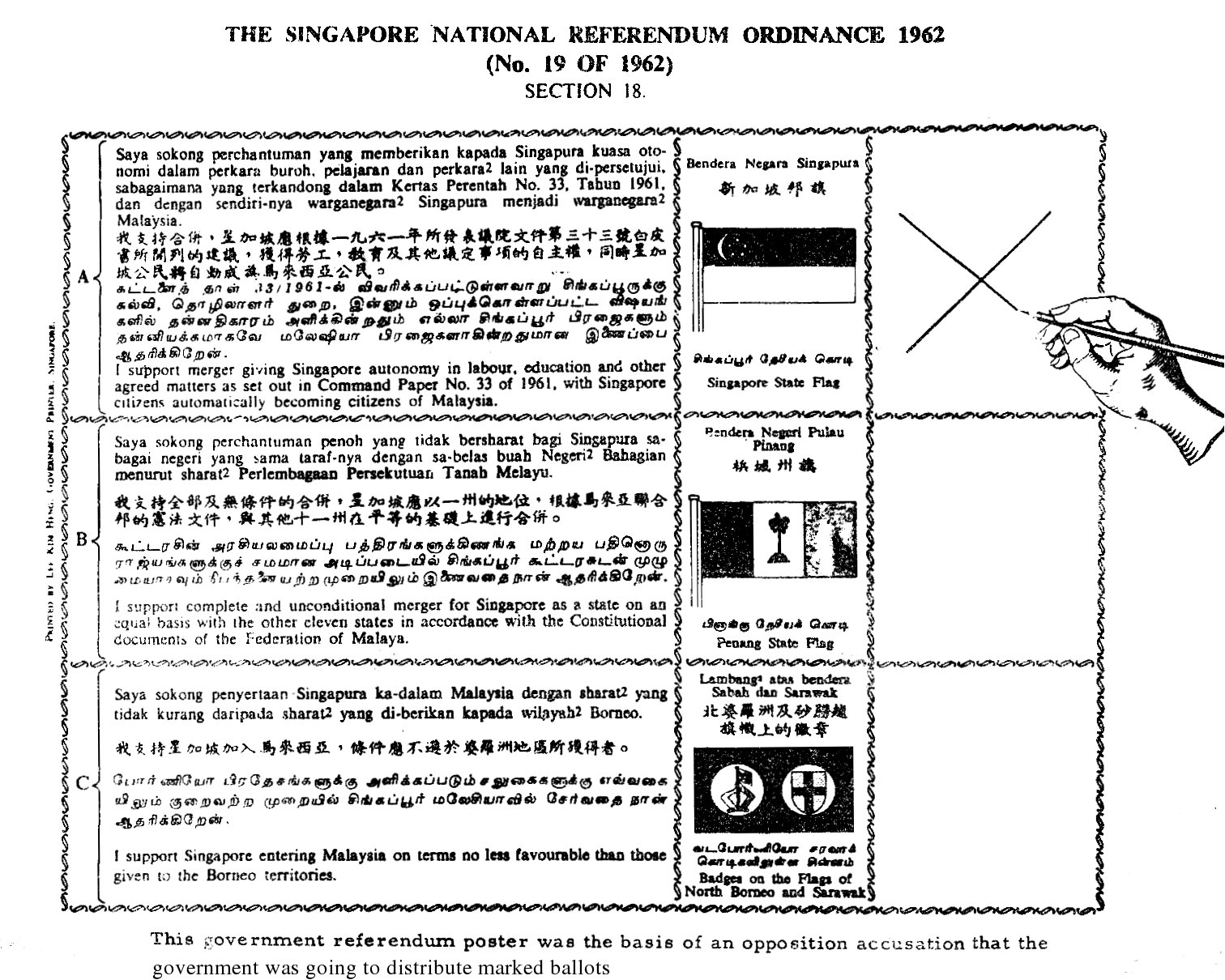
Democratic? Hardly. Instead of asking Singaporeans to vote for
‘yes' or ‘no' to merger, Lee proposed a ballot that allowed the
people to vote only for merger under three options:
Do you want merger?
A. in accordance with the white paper, or
B. on the basis of Singapore as a constituent state of the
Federation of Malaya, or
C. on terms no less favourable than those given to the three Borneo
territories?
And so after the referendum in September 1962, Singapore moved one
step closer to becoming a part of an independent Malaysia.
Regrettable but necessary?
Lee Kuan Yew, would have us believe as he wrote in
his memoirs, that the use of detention without trial was "most
regrettable but, from my personal knowledge of the communists,
absolutely necessary."
Harper dismisses this argument: "It was…inadmissible to argue, as
Lee Kuan Yew did, that the exercise of these powers was
‘regrettable', but dictated by historical necessity."
The truth is that "through this adversity…the Barisan Sosialis
still adhered to constitutional tactics."
Indeed, in the entire campaign to cripple the opposition, Lee Kuan
Yew and his rightwing PAP faction has repeatedly resorted to using
desperate measures of detention without trial, brazenly accusing
his opponents of being a front for the communists.
Harper makes it even more explicit:
"After 1959, Lee Kuan Yew had urged the necessity of defeating the
radical left through open democratic argument, whilst trying to
provoke them into extra-legal action. The left, however, had not
been deflected from constitutional struggle. Therefore, from
mid-1962 at least, Lee concluded that this confrontation could only
be resolved by resort to special powers that lay beyond the
democratic process. This merely exposed the extent to which the
crisis, as the British argued, a political one, and not a security
one."
The last chapter
Lim Chin Siong's fight for Singapore may have come
to a close, but another one is just beginning – the fight for
history to be written the way it should be.
Declassified secret papers are beginning to provide a glimpse into
what really took place during the 1950s and 60s, especially in the
behind-the-scenes dealings.
Beginning with Comet In Our Sky more will be revealed. But
as Harper tells us "many files remain closed and many files that
have been released have had key documents ‘retained' by the
original government department." These include key documents on Lim
Chin Siong's detention in Operation Coldstore in 1963.
As the real story emerges, the Singapore Democrats will play our
part to urge this process along – in cyberspace – thus ensuring
that the memory of Lim Chin Siong and what he and his Barisan
colleagues did for Singapore will forever remain with us.
This is crucial as our past is still our present. Lim had argued
that arbitrary powers of detention without trial, in whoever's
hands be they white or yellow, will continue to make Singapore
unfree and our struggle for independence elusive.
"The people ask for fundamental democratic rights," he argued, "but
what have they got? They have only got freedom of firecrackers
after seven o'clock in the evening. The people ask for bread and
they have been given stones instead."
More than half a century later, can any Singaporeans say with hand
on heart that Lim Chin Siong was not right?
Part IV (final): What they teach in
school
Read what they're teaching our children in school. To be posted
tomorrow.
http://singaporedemocrat.org/articlelim