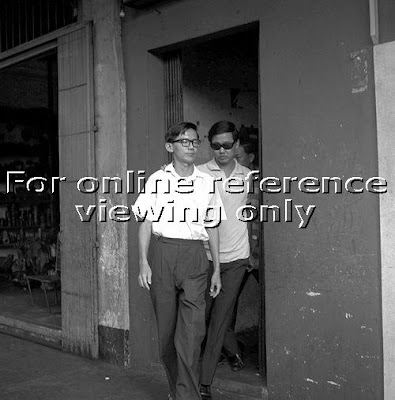
In 1989, James Gomez ( then a 2nd year NUS
undergraduate) was President of the NUS Philosophy Society and
editor of the society?s magazine ? PHILOTIN. He & Susan Chua
interviewed Chia Thye Poh about his views on politics and the
Internal Security Act while Chia was confined in Sentosa.
Monday, 02 January 1989

by James Gomez & Susan Chua (PHILOTIN)
Chia Thye Poh, a
political detainee for twenty-three years, was released
conditionally on the 17th of May 1989. He now lives on the island
of Sentosa. As a figure who evokes much interest, political or
otherwise, an interview with him seems only appropriate in line
with this issue's emphasis on political philosophy.
As such, here we
have for you, a first hand, and exclusive insight into the life and
ideals of the man himself. Chia Thye Poh, as a primary school
student, had a taste of studying both in a Chinese as well as an
English school.
His secondary education was
obtained in Chinese High School. In 1958, he
entered Nanyang University, majoring in physics. He was also
vice-chairman of the university's Student Union. After graduation,
he became a council member of the Guild of Graduates.
Mr Chia then became a
teacher. He taught in Chung Cheng High School for a short period
before he went back to Nanyang University as a graduate assistant
in the Physics Department. During this period, he was preparing to
further his studies abroad.
However,
Operation Cold Store (Feb. 1963) and the subsequent Sept. 1963
general elections drastically changed the course of his
life.
He stood for elections and
won a seat under the banner of Barisan Socialis in the Jurong
constituency. (At present, Barisan Socialis is
integrated into the Worker?s Party).
The following
interview with Mr Chia was carried out at his residence in Sentosa.
The aim of the interview is to bring across a more distinct picture
of Mr Chia?s ideals and aspirations.
Question: When
did your political awakening begin and how did it begin?
Answer: My
political awakening began when I was in Chinese High School. At
that time, there was a strong anti-colonial movement in Asia and
Africa. In Singapore, people were struggling for independence. And
in Chinese schools, there was a feeling that Chinese education was
discriminated against. There were incidents that Chinese school
teachers were arrested and Chinese schools ordered to close down.
These events raised the political consciousness of majority of
students and I was one of them. We opposed the colonial education
policy and later, became active in the struggle for
independence.
Q: What was/is
your ideology? Has your years in detention altered your
ideology?
A: My ideology:
to struggle for a fair, just and democratic society (freedom of
speech, freedom of the press and more parliamentary representation
for the people). When I was a parliamentarian, my close contact
with the people, especially the lower income group, had
strengthened my ideal. My ideal has not been
dampened after nearly 23 years under detention. In fact, prison
life can only make a person more determined to fight against
oppression and for a fair, just and democratic
society.
Q: What are your
current views regarding the running of Singapore?
A: Under the PAP rule, there is
no genuine parliamentary democracy. In essence, it has been
practising a one-party rule. It seems to want to
remain as the sole, dominant party, with other small parties acting
as marginal opposition and ?sparring partners? for new PAP MPs. The
opposition parties will never be allowed to grow strong. Before
past elections, potential opposition candidates had been arrested;
so were some of the elected opposition MPs who were arrested after
the elections. The GPC (Government Parliamentary Committee)
feedback unit and introduction of non-elected MPs are merely
improvements on the one-party rule. There is always the danger of
one-party rule slipping into one-man rule, and worse still, into
dynastic rule. The PAP government does not
like critical newspapers or publications, and is intolerant towards
sharp criticisms. They seem elitist and arrogant, regarding
themselves as the best and the most suitable to rule Singapore. And
they rule it with iron-handed policies.
Q: What do you
think of the opposition parties in Singapore?
A: If the PAP
itself laments the difficulties of getting good candidates for
elections, one can imagine how much harder it is for the opposition
parties to do the same. Opposition parties candidates
risk not only loss of jobs, but also personal
freedom. However, despite all difficulties,
including little access to the media, the opposition parties had
scored 37% of the popular votes in the last general election. To
withstand the continual onslaught of the powerful PAP machinery and
to make further headway, the opposition parties will need more
co-ordinated efforts. They need to build up their branch
organisations, so that, through their own network, party programmes
and policies can be brought across to the people.
Q: What kind of
change would you like to see in Singapore?
A: The last
election shows that the people want more opposition members in the
Parliament (37% popular votes went to opposition parties). However,
there is only one opposition MP in the 81 seat Parliament. The
discrepancies are too obvious and cry for correction. (In the 1963
election, Barisan Socialis gained 33% of the popular votes, and
there were 13 members in the 51 seat parliament). There should be
proportionate representation of opposition voices in Parliament, so
that there can be a real check and balance system. Basic human
rights should be respected, the ISA (Internal Security Act) should
be abolished. There should be freedom of speech and freedom of the
press so that the people can have better access to information and
can voice their feelings without fear.
Q: Do you feel
that it is not essential to have the ISA?
A: In 1955, when
there was still a jungle warfare in Johor and the other states of
Malaya, the PAP congress had adopted a resolution, calling for the
abolition of Emergency Regulations. Yet, since its coming to power,
it has never hesitated in using the ISA to arrest, detain and crush
its opponents. The PAP government has openly stated that the ISA,
periodical arrests and secret police are the mainstays for the
security of the state. But, for a long time past, the situation in
Singapore has been peaceful. And with other stringent laws well in
place, the government is in fact more than amply equipped to deal
with any security problem. The ISA is a powerful weapon,
but it is a remnant of the colonial rule. It tramples upon the
basic human rights and hinders the progress of
democracy.
Q: What are your
reasons for not leaving Singapore? If you could go into exile
elsewhere at present, would you? If not, why not?
A: In 1985, when
the Home Affairs Minister said that the government allowed me to
emigrate, my reply was that as I had been detained for nearly 20
years, the government should release me unconditionally, and not
try to drive me out of my country. My stand on the issue has not
changed and I have no intention of going into exile someplace else.
My main concern is to achieve complete freedom. Whether a political
prisoner should go into exile depends on whether he can contribute
to the people's cause. It is the people?s struggle inside the
country that can determine the course of events. And it is
important for me to be close to the people and share their weal and
woe.
Q: How is your
life in Sentosa? Is it relatively comfortable?
A: My life in Sentosa is like an
indefinite internal exile after 23 years under detention without
trial. I am now under the restrictions of four
conditions and am put under close surveillance in the island.
Sentosa is a tiny island of 3.5 sq. km and a tourist resort with no
residence. Thus, there are no provisions like shops for residential
living. Most of my daily necessities have to be brought in by my
family members. When I want to go to the mainland for medical
check-up or a haircut, I have to apply for written permit from the
ISD (Internal Security Department) and travel under escort.
Sentosa, to me, is just like another prison. The scenery is good,
but freedom is scarce.
Q: Do you see
yourself being released unconditionally to the mainland?
A: I have never
lost hope during me years under detention. I am confident that no
matter how much difficulties I face, and how long it will take, the
government will have to release me unconditionally one day. My
struggle for personal freedom is not an isolated one. It is the
people?s struggle for democracy. My partial release onto Sentosa is
the result of collective effort. I hope that with continued support
from the people, I can one day gain my complete freedom.
Taken from the
newsletter of the Philosophy Society, The Philotin. Issue No.2,
August 1989.
http://www.jamesgomeznews.com/article