The politics of judicial institutions in
Singapore
BY Francis T. Seow, former solicitor general of
Singapore.
This is the text of a lecture given in Sydney, Australia in early
1997.
IN the past decade Singapore, along with the other newly
industrialising countries of Asia, has been touted as an
alternative model of economic development. Its high standard of
living, measured in economic terms, and freedom from foreign debt,
among other aspects, has been envied by less fortunate nations.
More recently, features of Singapore society have been cited with
approval by overseas commentators -- its law and order regime,
compulsory savings, maintenance of parents legislation to compel
children to look after their aged parents, to name a few. While
these may be desirable, the manner of their implementation depends
on certain anti-democratic and authoritarian structures and
institutions. Today, I intend to look at one of these - the
judicial institutions.
I was astounded when my attention was first drawn to an
October 1993 Straits Times banner-headlines,
Singapore's legal system rated best in world: Full confidence
that justice will be fast and fair. It was, the newspaper
crowed, "the most authoritative report on competitiveness of
selected developed and developing economies."
The survey was purportedly carried out worldwide among
18,000 business executives, who had expressed "full confidence in
the ability of Singapore's judicial system to mete out justice in
society." Out of 37 named countries, Singapore scored top place,
Australia shared seventh place with Ireland, Malaysia fifteenth
place, while the United States scored seventeenth place, and the
United Kingdom, a sad and distant nineteenth place. The authority
for this conclusion was the 1993 World Competitiveness Report,
published by the Geneva-based World Economic Forum. This was the
first time Singapore had scored top marks. Hence, the delirious
headlines. As it seemed probable the World Economic Forum (WEF)
knew something, which I did not, I wrote to it.
I inquired the criteria used, and of the 18,000 persons
purportedly surveyed, how many have had personal experience with
Singapore's judicial system? And, if so, in what capacity and over
what matter? Were they represented by any local and/or foreign
lawyers? Whether the survey included any English QCs, especially
those who had appeared before the Singapore courts?... Any American
lawyers or academics who had observed legal proceedings in
Singapore? And whether the survey included newspapermen.
WEF explained that "... three criteria ... [had] been used
to assess the ranking of the countries for ‘Justice and
Security.’"
The three criteria were:
(1) serious crime: number of murders, violent crimes or armed
robberies reported per 100,000 inhabitants;
(2) security, and
(3) justice.
Of the three criteria, the third is germane to our
discussion. I found its methodology flawed. Respondents were simply
asked a bald question whether they had or had not full confidence
in the fair administration of justice in Singapore -- Answer: Yes
or No. No Singapore lawyers or litigants were apparently surveyed.
How could these international business executives, ensconced in
their air-conditioned executive suites, with little or no personal
experience of Singapore's legal system, possibly give valued
conclusions on the administration of justice in
Singapore?
True picture:
NOW to draw aside the curtain, to show you
the true picture. Some history is needed to show how the legal
system was systematically undermined by the prime minister after
the People’s Action Party (PAP), came into power in June 1959. The
senior crown counsel, Ahmad Ibrahim, was promoted over the
solicitor general, A.V. Winslow, to the top office of attorney
general. Ahmad Ibrahim was a Muslim, and his presence was useful to
the prime minister, whose political objectives included merger with
Malaya. A.V. Winslow, on the other hand, was a Ceylon Tamil, the
first Singaporean in the colonial legal service to reach its
topmost rung. The prime minister, however, saw him as too closely
tied to the old colonial administration, and therefore politically
unreliable. Several years later, Winslow was elevated to the high
court bench but, significantly, was never assigned to try sensitive
cases.
Meanwhile, Ahmad Ibrahim -- who had become a political
liability but whose tenure of office was protected under the
constitution -- was sent overseas as ambassador to the United Arab
Republic. This lateral promotion is reminiscent of the practice of
Chinese emperors getting rid of awkward officials by sending them
out to govern the far-flung provinces.
Another significant move was the designation of Justice
Wee Chong Jin -- a relatively recent recruit from the bar -- as
chief justice over the more experienced acting incumbent. Like
Winslow, he was also identified with the old order. Wee's political
acuity and industry had recommended themselves to the prime
minister, who once again ignored the claims of seniority and
experience to further his political agenda.
Sudden transfer:
THE sudden transfer in 1986 of senior
district judge, Michael Khoo -- one of the ablest judges to grace
the subordinate court bench -- to the attorney general's chambers
following his acquittal of Joshua Benjamin Jeyaretnam, an opposition MP, and,
more significantly, the prime minister's political bêtre noire, (Among the many
colourful epithets were: "hustler", "skunk", "mangy dog",
"charlatan", and "political riff-raff". Hansard, Parliamentary
debates, March 19, 1986, cols. 688-689, 720.) on all
politically-inspired charges, save one, of financial impropriety,
engendered much controversy. From being the respected head of the
subordinate judiciary, Khoo overnight became a mere digit within
the attorney general's chambers.
The prosecution appealed the acquittal. The chief justice
allowed the appeal with the unusual instruction for it to
be retried before another district judge. Jeyaretnam's application
for the retrial to be heard before a high court judge to enable him
to appeal to the Judicial Committee of the Privy Council --
Singapore’s ultimate court of appeal in London -- was refused. At
the re-trial, he was predictably found guilty, and convicted. His
appeal against the conviction and sentence was heard by Justice Lai
Kew Chai, who dismissed his appeal, and varied the sentence to
month’s imprisonment, plus a fine, which was high enough to
disqualify him from sitting in parliament.
Meanwhile, Jeyaretnam alleged in parliament that Khoo's
transfer had caused "public disquiet," implying that it had been
motivated by political considerations, which he expanded to include
both the chief justice and the attorney general, as being
"beholden" to the prime minister for having extended their
respective appointments beyond their legal retirement age. In a
rancorous parliamentary debate, it emerged that Khoo's transfer was
not a "routine departmental transfer," as claimed by the prime
minister. In the result, Jeyaretnam was expelled from parliament,
and disbarred from law practice.
Jeyaretnam appealed the disbarment to the privy council,
which, in allowing the appeal, roundly castigated the chief justice
and the Singapore courts for their legal reasoning. It was a
telling indictment of Singapore’s courts. The privy council held
that two innocent persons had suffered a grievous injustice --
fined, imprisoned and publicly disgraced for offences of which they
were not guilty.
This was the same privy council, which the prime minister
had earlier praised as the acme of Singapore's judicial
independence, when he cautioned future PAP governments against
interfering with its status in the judicial
infrastructure:
"I can only express the hope that faith in the
judicial system will never be diminished, and I am sure it will
not, so long as we allow
a review of the judicial processes that takes place here in some
other tribunal where obviously undue influence cannot be brought to
bear. As long as governments are wise enough to leave alone the
rights of appeal to some superior body outside Singapore, then
there must be a higher degree of confidence in the integrity of our
judicial process. This is most important. (Author's
underlining)" Lee Kuan Yew in parliament, March 15,
1967.
This sentiment was also echoed by the minister for
law, S. Jayakumar, who -- in a blunt reference to Jeyaretnam's
series of legal failures, dismissed his remarks as the "jaundiced
view of a person who has not had satisfaction in the courts as he
would have liked" -- asked: "How many countries are there in the
world that he can refer to where there are appeals to the privy
council in criminal and civil cases ... other than Singapore? That
is the litmus test of our judicial system's
independence."
The judgment of the privy council reflected severely on
the integrity of the Singapore judiciary -- and was seen by many as
solemn confirmation of their own unspoken misgivings about its
independence. Any other government -- to use an Americanism --
would have rolled with the punch but this was a government whose
sensitivity to criticism was proverbial. As long as the privy
council handed down judgments supportive of the prime minister and
his government, its status at the apex of Singapore’s judicial
infrastructure was inviolable. With that crucial decision, the
privy council sealed its own doom. The minister for law, ignoring
his previous rhetoric, moved in parliament for the abolition of
appeals to the Privy Council decrying it as being "interventionist"
and "out of touch" with local conditions -- a decrial questionable
both in law and in taste.
Asked about the abolition of the privy council, Goh Chok
Tong -- who had succeeded to the premiership in 1990 -- responded
that, in allowing Jeyaretnam's appeal against his disbarment, the
privy council had "gone outside its prescribed role" and was
"playing politics." It was a disgraceful statement, as well as
wilful contempt of Singapore's own superior court, but as Juvenal
-- the Roman satirist -- once said: Quis custodiet ipsos custodes?
(Who will guard the guards themselves?) Implicit in Goh's
contemptible statement was that the PAP government could no longer
afford the hard political currency of a free and independent court.
The Jeyaretnam case is unsurpassed for the pathetic attempts by the
Singapore courts to stretch the law to fit the facts. It highlights
the grotesque contortions the politically corrupt judiciary went
through to rid a political irritant to the prime minister and his
government. It demonstrates the misuse of the law in advancing the
agenda and interests of the ruling political party.
Government spin:
THE Singapore government often puts a spin on the
Jeyaretnam judgment claiming that the privy council had no
jurisdiction over the convictions insinuating that it was out of
line in making that statement, as the ‘party most affected --
Singapore’s public prosecutor -- was not heard on the matter.’ That
is only half of the truth. What it failed to disclose is that the
public prosecutor was asked whether he wished to be heard. But the
public prosecutor chose not to appear. An obiter dicta -- and, more
especially that of the privy council -- would normally have been
sufficient to propel a government to correct an obvious injustice
-- but this was no ordinary case.
To counter public perception that the judiciary was
inclined towards the executive, the chief justice was perforce to
publicly address this matter:
It is our responsibility to let there be no shadow
of doubt whatsoever that we are committed to these two principles
-- the total commitment of the judiciary in Singapore to dispensing
justice according to law, and to upholding the independence of the
judiciary -- and to dispel as forcefully as lies within our power
any attempt from any quarter to cast doubt that these two
principles are being adhered to here.
There was, alas, a vast chasm separating the precept
from the practice.
The attorney general also sought to show that the
administration of justice was impartial by stressing the
supervisory jurisdiction of the courts, thus:
[The] impartial and unbiased administration of the
law in all matters, particularly in respect of those matters
requiring strict observance of the rules of natural justice, and in
respect of matters where the exercise of administrative discretion
has been challenged, is the cornerstone upon which our system of
justice has been constructed. Those charged with the functions of
the government, in all their wide diversity, know full well that
ultimately there can be recourse to these courts to correct
irregularities and injustices in governmental administration.
As in all countries where
the rule of law prevails, it is [the] exercise of the court's
supervisory jurisdiction that provides one of the most important
safeguards against the arbitrary exercise of power.
[Author's underlining]
In stressing the supervisory powers of the courts as the
capstone of democracy, the attorney general overlooked the
egregious fact that he had argued in habeas corpus applications
that orders of detention under the Internal Security Act, Cap. 143
-- a law which allows preventive detention on grounds of national
security -- were not justiciable. Notwithstanding the
inconsistencies and contradictions in the official statements, he
argued the court could "not look behind the orders," and "inquire
into the reasons why and wherefore a detention order is made. This
is an executive act." The court for its part willingly abdicated
its judicial responsibility in favour of officialdom rather than
the cause of justice.
The attorney general later drafted the amending
legislation depriving the courts of their supervisory jurisdiction,
which was -- in his own words -- "one of the most important
safeguards against the exercise of arbitrary power." But there was
not a squeak of protest from the complaisant judiciary or the legal
profession. In the result, applications against administrative
actions, like habeas
corpus, are now largely legal history.
Judicial accommodation:
ANOTHER instance of judicial accommodation may be seen in
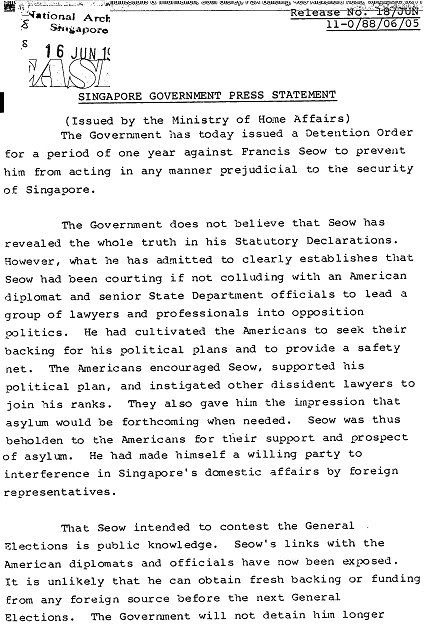
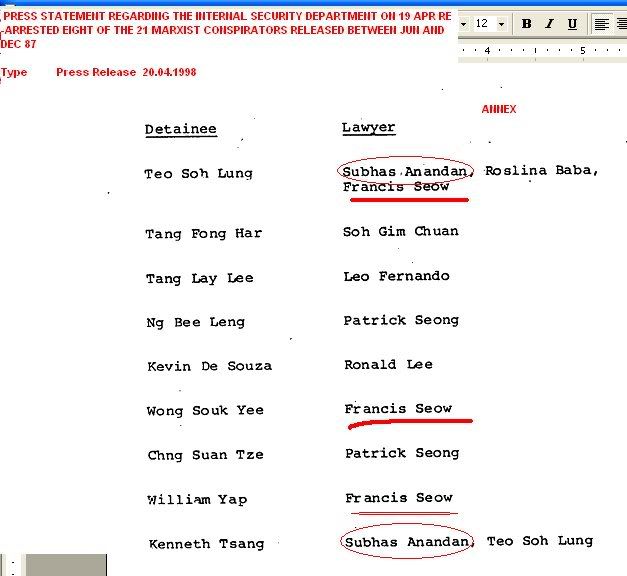
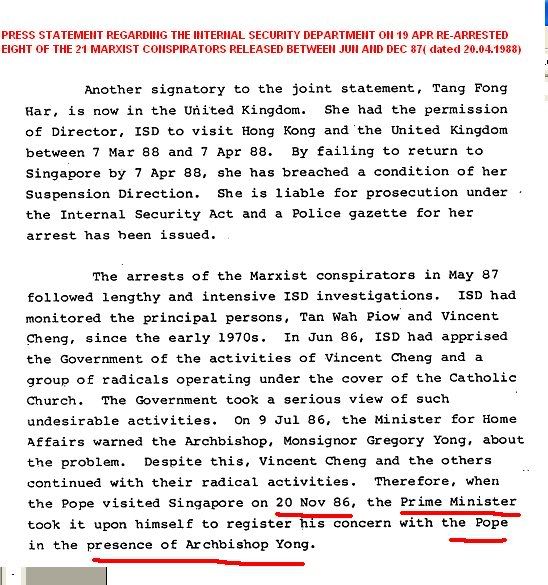
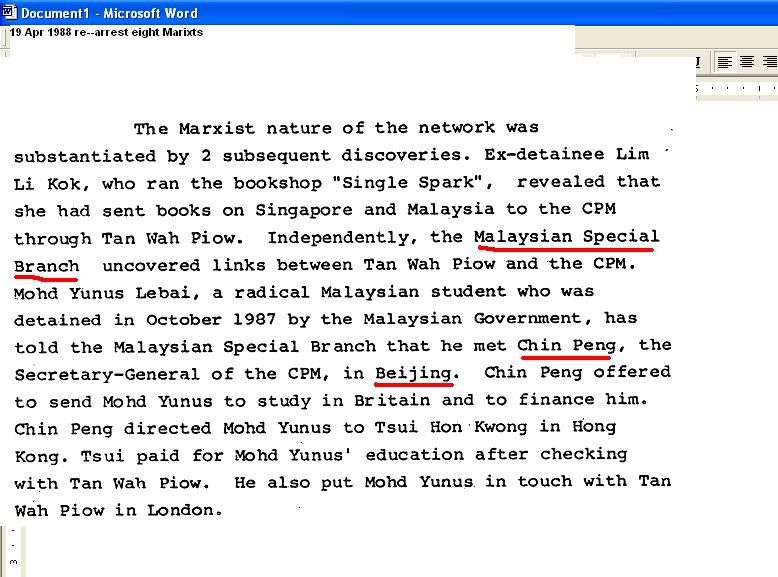
this case. In 1987, twenty-two young Roman Catholic and social
activists were arrested under the Internal Security Act (ISA),
accused of being Marxists involved in a dangerous conspiracy to
subvert the PAP government through violence, and replace it with a
Marxist state. They were released only after they had made the
ritualistic television confessions. But eight of them were
re-arrested when they disclosed those confessions had been coerced
out of them. In the ensuing habeas corpus proceedings, the
court of appeal had perforce to allow the appeal, but it did so on
technical rather than on substantive grounds, thus enabling the
government to hurriedly amend the constitution and the relevant
laws, and order their re-arrest.
Another egregious example of judicial accommodation is the
case of Re Dow Jones
Publishing Company (Asia) Inc Application, where the court
of appeal deliberately delayed giving its decision, which had the
effect of denying the appellant the opportunity of pursuing its
appeal to the Privy Council. Queen’s Counsel for the appellant flew
down specially from England to plead with the court to rule on its
application, and give its decision later, but in neither one nor
the other would the court be hurried. In the result, the appellant
lost its right to appeal to the Privy Council. The appellant
desperately tried to petition the privy council for special leave
to appeal, which said:
Their lordships understand the petitioner's sense of
grievance that, after the appeal from the judgment of Sinnathuray,
J., had been argued and at a time when it was known that the
[Judicial Committee of the Privy Council Amendment] Act of 1989
would shortly come into operation, the court of appeal in Singapore
did not accede to an invitation to give their decision promptly, if
necessary giving their reasons later, which would have enabled the
petitioner to take advantage of the transitional provisions in the
Act of 1989. ...
Those gentle words of reproach spoke volumes for a free
and independent judiciary.
Consequential role:
THE judiciary -- a bulwark between citizen
and state -- plays a consequential role in the affairs of a nation,
and often sets the ultimate seal of legitimacy on controversial
policies and actions of the state by its decisions. Governments,
therefore, try to ensure those persons, who are called upon to make
these weighty decisions, understand the purpose of controverted
legislative acts and policies. The PAP government is no exception.
It also tries to ensure that judicial aspirants are screened for
loyalty and political correctness. Although the PAP government
recognizes the role of the judiciary in the body politic, it no
longer sees it as a check on the balance of power in the
traditional sense but rather as an important instrument for the
prolongation of its political longevity.
High court judges are appointed from within the legal and
judicial service and among qualified members of the bar by the
president on the advice of the prime minister after consultation
with the chief justice. Judges hold their appointment until the age
of 65 years and thereafter at the will of the president. For many
years, retiring high court judges have had their appointments
extended on contract for short periods at a time and, in some
cases, from month to month. Judicial commissioners are employed on
time contract. Some do, indeed, make the grade to the high court
bench. Needless to say, judges on contract, renewable at the will
of the prime minister, is not conducive to judicial
independence.
Judgments of the appellate court have to be unanimous, and
are delivered by a single judge detailed by the chief justice
beforehand. No dissension is countenanced lest a perception is
created of disunity within the judicial ranks. Cases are
allocated to
judges by the registrar of the supreme court, on chief justice’s
instructions, and not rotated, or drawn by lots, or channelled to
special divisions of the court. Thus, it is not uncommon to find a
particular judge, like T.S. Sinnathuray, being commonly assigned
sensitive cases with predictable results. Judges known for
impartiality, independence and strength of character are never
assigned them.
Banker friend:
THE then prime minister Lee appointed his
banker-friend, Yong Pung How, as chief justice, who had not
practised law for 20 years, whose superior claim to this
illustrious position was that he is a loyal crony. His hour-long
defence of the appointment in parliament -- during which he delved
into bathetic nostalgia, from his student's days at Cambridge
University, to the way his friend, the future chief justice, kept
meticulous lecture notes enabling him, a late arrival at Cambridge,
to borrow his notes to catch up with his law studies; to his
personal wealth and magnitude of annual income as banker; to his
personal attributes, including a fine judicial temperament; and to
his inquiries of his judges to name the three best persons,
excluding themselves, all of whom, in a remarkable coincidence,
named his friend, as "the best of the possibles" -- rang somewhat
hollow and contrived.
Adequate economic monthly salaries payable to judges have
long been recognized as a condition conducive to a free and
independent judiciary. The Judges’ Remuneration Act, 1994, provides
that ‘pensionable salaries of the chief justice, every judge of
appeal and every other judge of the supreme court’ shall be paid as
the minister of finance may from time to time direct.’ This radical
but retrogressive change in the law ensures that such payments no
longer rests with parliament, making the judiciary dependent on the
executive of the day for their paychecks.
The salaries, which the PAP government pays its judges,
have much method in its generosity. High court judges receive
A$630,000 per annum plus a minimum bonus of three months'
salary or A$205,020 at A$68,340 per month, totalling A$835,020,
besides other perks and privileges, like a motor car, a government
bungalow at economic rent. The chief justice receives A$1,260,000
per annum, besides an official residence (or an housing allowance
in lieu thereof), a chauffeur-driven car, among other handsome
perks and privileges of office. Indeed, he receives more than the
combined stipends of the Lord Chancellor of England, the Chief
Justices of the United States, Canada and Australia. As a Queen’s
Counsel pointedly queried: "Is this kind of money a salary or an
income of permanent bribery?
Supremely confident in the reliability of his judiciary,
the prime minister uses the courts as a legal weapon to intimidate,
bankrupt or cripple the political opposition, and ventilate his
political agenda. He has distinguished himself in numerous legal
suits against dissidents and detractors for alleged defamation in
Singapore courts, and has won them all. The idea that he could
possibly lose is so fanciful that it could be dismissed out of
mind. Which judge would be so reckless or foolhardy to award a
decision against him? Judges know on which side their bread is
buttered.
'Compliant judiciary':
CONTRAST the case of former NUS senior lecturer,
Christopher Lingle, who wrote an op-ed essay entitled, The Smoke over Parts of Asia Obscures Some Profound
Concerns, in the International Herald Tribune,
with that of columnist Bernard Levin, who published a hard-hitting
essay, The law grossly misused, in The Times of
London. Lingle had referred to ‘intolerant regimes’ in the region
relying upon a ‘compliant judiciary to bankrupt opposition
politicians in suppressing dissent.’ No country was named.
Nonetheless, he was sued for defamation. The prime minister went
out of his way to prove that it was Singapore that Lingle had
referred to, by citing a litany of legal cases which he had brought
against opposition politicians and dissidents. Lingle fled
Singapore. Even his NUS pensions savings were attached to pay
towards the prime minister’s damages and costs.
Bernard Levin’s case, on the other hand, shows that no
matter how grave the provocation, the prime minister does not
easily embark on litigation outside his own bailiwick. Levin, a
highly-respected columnist with The Times, had published
two other hard-hitting op-ed essays on Singapore, regarding which
the prime minister complained in a letter to the editor of The
Times as "`unrestrained indictment' of my premiership ... and
is false in so many respects ... so unfair, and indeed
irresponsible as a piece of journalism ... Just as he [Levin] makes
the outrageous allegation that judges in Singapore are `bent or
cowed', ..."
In spite of all this, the prime minister did not see it
fit to sue nor even threaten to sue Levin or The Times for
defamation. Instead, he offered to "discuss" those allegations with
Levin in a debate on British television. Levin refused the proposed
discussion. It does not require any great leap of imagination to
realise that the prime minister knew that he could not influence
their lordships at the Royal Courts of Justice in the Strand. Like
Sun Tzu, the celebrated Chinese military strategist, he knows his
ground, and chooses it with care.
The notorious case of Public Prosecutor v Tan Wah Piow
demonstrates the parlous state of the judiciary in Singapore. Tan
-- a third-year architectural student, and president of the
University of Singapore Students Union (USSU) -- was charged,
together with two others, with rioting inside the premises of the
Pioneer Industries Employees' Union (PIEU), a government-controlled
trade union, whose general secretary was Phey Yew Kok, a member of
parliament and rising star on the PAP firmament. Phey was also
president of the National Trades Union Congress, which has strong
symbiotic ties with the PAP government.
The trial was partisan justice at its ugliest before the
ambitious district court judge T.S. Sinnathuray, who kept Tan and
his co-accused on a choke-leash. Tan's application for an
adjournment to enable his counsel, John Platts-Mills, QC -- who had
already been specially admitted to the Singapore bar -- to travel
to Singapore for the purpose was twice denied by the trial judge.
Vital defence witnesses were arrested on the morning of the trial,
and deported.
The defendants claimed the riot within, and damage to, the
premises had been fabricated by Phey Yew Kok, but they were not
allowed to produce evidence of it at the trial, as indeed other
matters they considered crucial to their case. Concerned at the
judge's selective recordings of the proceedings, Tan applied for
the trial to be tape-recorded, which was denied. The judge for his
part made no bones of what the outcome of the proceedings would be.
His periodic ejaculations, "Forget about public interest!", "Forget
about justice!", and "Forget about a fair trial!" -- albeit vented
in exasperation to Tan's urgent applications or protestations to
his rulings -- punctuated the proceedings, setting a leitmotif,
which became a grim reality. All three accused were found guilty,
and convicted. Tan was sentenced to one year's imprisonment, and
his co-accused to one month's imprisonment each. Shortly
afterwards, Sinnathuray was promoted to the high court.
An Australian Queen's Counsel, Frank Galbally, who
observed the trial for the Australian Union of Students, said: "In
Australia, the case would be laughed out of court ... the evidence
and procedure ... would, in my opinion, have aborted any trial in
Australia ... [The three accused] did not get a fair trial. ... In
my opinion, it is just a political trial."
The experience of an English silk in a criminal trial in
Singapore provides another perspective. Alun Jones, QC, discharged
himself "for the first time in 23 years' practice," describing the
judicial proceedings as "a travesty of a trial" and a "perversion
of a judicial process." The trial judge displayed a "craven
attitude" towards the prosecution.
Political
interests:
THE New York City Bar Association, after a fact-finding
mission to Singapore led by the late Robert B. McKay, then dean of
the New York University Law School, observed:
What emerges ... is a government that has been
willing to decimate the rule of law for the benefit of its
political interests. Lawyers have been cowed to passivity, judges
are kept on a short leash, and the law has been manipulated so that
gaping holes exist in the system of restraints on government action
toward the individual. ... Any US venture contemplating business in
Singapore or with a Singapore company is likely to encounter a wide
variety of enterprises in which the government has an economic
interest. If a dispute arises with such an enterprise, the US
company faces the prospect of a law suit before Singapore's
judiciary. The same forces which have led that judiciary to be
sensitive to the PAP government's political interests would lead it
to take account of its economic interests. ... The only check on
the Singapore judiciary is the prospect of ultimate appeal to the
Privy Council in London.
That report was published in October 1990. Since
then, appeals to the privy council have been abolished. The
supervisory powers of the courts have been removed.
HPL issue:
LAST but one. The recent barrage of defamation actions by
senior minister Lee Kuan Yew and other PAP leaders against lawyer
and opposition Workers’ Party candidate, Tang Liang Hong, reveals
further the politics of the Singapore judiciary.
HPL -- Hotels and Properties Limited -- is a public
company listed on the Stock Exchange of Singapore. One of its
directors, Dr Lee Suan Yew -- a younger brother of Harry Lee Kuan
Yew, the senior minister -- and one other bought a luxury
condominium unit in an HPL development. As they were ‘connected
persons and associates,’ HPL was enjoined under the rules of the
Stock Exchange to seek shareholders’ approval for sales of the
units to them. It did not do so. Some 11 months elapsed. Several
disgruntled shareholders served notice of their intention to call a
shareholders’ meeting. To thwart unpleasant publicity, HPL sought
waiver of the rule from the Stock Exchange, which, on April 22,
1996, censured the directors and reminded them of their duty to
‘maximise the return to shareholders.’ It was, therefore, only a
matter of time before the identities of any other purchasers, who
had also been given similar discounts, became known to all and
sundry.
On April 23, 1996, the following day -- to pre-empt the
inevitable adverse publicity -- senior minister Lee Kuan Yew and
his son and deputy prime minister Brig Gen Lee Hsien Loong
disclosed that they, too, had each purchased a unit in
NassimJade/Scotts Road No. 28, at discounted prices, and paid the
discounts they had received into government Treasury.
An informal inquiry, conducted by the minister for
finance, assisted by a MAS -- Monetary Authority of Singapore --
deputy managing director, at the behest of Prime Minister Goh Chok
Tong, purported to clear them of any impropriety. Prime Minister
Goh ordered Treasury to return the difference to father and son,
which they gave to charity instead. It is not impertinent to ask
why did the senior minister and his son, the deputy prime minister,
consider it necessary to divest themselves of the proceeds, if the
purchase was above board!
Parliament was convened to enable members to ask questions
of the senior minister, whose rambling defence of those
controversial purchases has to be seen, heard and read to be
believed for sheer arrogance and obfuscation. Even so, Prime
Minister Goh Chok Tong introduced new rules requiring ministers to
declare all property purchases, including prices, discounts and
preferential terms received. There, the matter rested, until Tang
was interviewed by the Hongkong-based Chinese weekly magazine,
Yazhou Zhoukan. In that fateful interview, Tang
observed:
"Why wasn’t this matter handed over to a professional body
like Commercial Affairs Department or Corrupt Practice
Investigation Bureau? They are government departments not only rich
in experience, but are also well-known for being iron-faced with
selflessness" [a Chinese phrase meaning firm and impartial]. They
would be more detached and their reports would have been more
convincing to the people. Koh Beng Seng and Finance Minister
Richard Hu are after all not experts in this field."
Lee and his son took offence at those remarks, and
commenced a libel action. The presiding judge was Justice Lai Kew
Chai, a former partner of the prime minister’s law firm of Lee and
Lee.
Defamation writs:
PENDING the hearing, Tang
Liang Hong stood as an opposition Workers’ Party (WP) candidate
in the January 1997 general election, during which Lee and his PAP
colleagues accused him of being an ‘anti-Christian and
anti-English-educated Chinese chauvinist.’ Tang retorted they were
lies. And made a cardinal error in announcing that, if elected, he
would raise the HPL matter in parliament. Lee and his colleagues
responded by filing defamation writs against Tang for calling them
liars. Tang made a police report against them alleging a conspiracy
to defame and cause him harm only to be met with further defamation
suits totalling 12 in all. On December 31, 1996, they filed their
writs which were served on him the same day. It was not a season
for good will among men. Significantly, only Tang was sued. None of
the mass media, which reported the alleged libel, was sued at all.
Justice Lai presided over all those cases, and issued several
orders touching the suits, including on Lee’s application, a Mareva
injunction freezing Tang’s and his wife’s assets in Singapore and
elsewhere.
Tang applied to have Lai disqualified as the presiding
judge and the several orders in the various suits, including the
Mareva injunction, be set aside. It transpired that Justice Lai had
also purchased a unit in the same HPL Nassim Jade development
together with his wife, at even deeper discount than the Lees. It
was contended that one of the issues for determination at the trial
would be the propriety of HPL giving large discounts to persons
holding high positions in government and other public institutions,
and whether HPL, as a public-listed company, had discharged its
duty to its shareholders to obtain the best price for its property
development in the circumstances. And, therefore, Justice Lai’s
purchase of the HPL unit could be in issue.
Conceding that ‘some people might question if he should be
ruling on a matter which concerned himself,’ Justice Lai observed
that Tang could ‘have recourse to a court of appeal if he disagreed
with the ruling.’ Thus, he did not recuse himself from the case,
but cleared the court, heard the application in camera, and ordered
Tang to appear before him at the adjourned hearing because of
‘factual errors,’ chiding him for not ‘hav[ing] the courage or
decency to face him in court ...’
As for the Mareva injunction, there was no evidence that
Tang had done anything in regard to them, which could be construed
as attempts to defeat any possible judgment against him, save for
his temporary presence in Malaysia, and Lee’s bare allegations: "I
was baffled. He [Tang] claimed that his life was under threat. But
of all places he went to Johor. That place is notorious for
shootings, muggings and car-jackings." It was -- to put it kindly
-- sheer hyperbole. When it was revealed what Lee had deposed to in
his supporting affidavit, it upset
the Malaysian government and its people. Lee apologised
‘unreservedly’ through his press secretary, but made no retraction,
pleading that it was not meant to be made public. In any event, no
reasonable judge, it is submitted, would have allowed such a
sweeping scandalous assertion to ground the application. Under
increasing Malaysian pressure, Lee finally retracted the offending
paragraph -- and, in the process, opened a Pandora box as to the
legal effects of the several orders and the judgments. The effects
of this case are still rippling beyond the shores of
Singapore.
As a matter of interest, according to the latest UN
Commission on Justice on crime statistics worldwide, the homicide
rate in Malaysia (1.76 per 100,000) is in fact lower than that of
Singapore (1.77 per 100,000). But the rate for total assaults in
Singapore (34.12 per 100,000) is more than twice that of Malaysia
(14.54 per 100,000), while the rate for robberies is almost twice
as high in Singapore as in Malaysia (56.30 for Singapore against
32.75 for Malaysia).
On March 10 -- two months and eleven days -- Lee and his
colleagues obtained judgments against him in the 12 suits estimated
at S$12 million in damages, excluding costs. In an unprecedented
move, two high court judges sat in succession to determine the
matter -- Justice Lai from 2.30 pm until 8 pm on Tang’s application
to recuse himself, immediately after which the case was assigned to
Justice Goh Joon Seng, who sat till well past 9 pm, struck out all
Tang’s defences, and awarded judgments to Lee and his colleagues.
The 13th suit filed by Prime Minister Goh Chok Tong was heard the
next day.
'Instant
justice':
JUSTICE was swift but was it fair? Lee
and his political colleagues had no difficulty in filing any
application in court, their papers were served and heard the same
day -- a privilege and sense of urgency, however, denied to Tang
and his wife, who had been dragged into the proceedings. Tang
described it as PAP’s ‘instant justice.’ ‘They can easily get
instant judgment on pre-set terms.’ When his wife applied to set
aside what Tang termed the ‘absurd’ order making her a co-defendant
to the suits against him, her application was set down for hearing
one month away. In all my years at the bar, I have rarely seen such
purposeful judicial industry. Tang’s complaint of selective justice
is by no means an isolated case. There are others. I have recounted
similar experiences in my book, To
Catch a Tartar: A Dissident in Lee Kuan Yew’s
Prison.
In a 40-page impassioned judgment Justice Lai dismissed
Tang’s application, describing his allegations as ‘false,’ and ‘a
move calculated to delay the proceedings. ... In the process, he
muddied the waters and spread a lot of poison against me, senior
minister Lee and deputy prime minister Lee Hsien Loong. He was so
mendacious that he did not care at all if the reputations of a
judge, senior minister Lee and deputy prime minister Lee were
unjustifiably attacked and sullied. It was a vicious, collateral
and totally unwarranted attack on my integrity. ... [Tang] appeared
to be speaking from two ends of his mouth at the same time. ... In
his absence from court, there was no opportunity to test his
veracity.’
[Editor's note: See: Tang's appeal]
Let me recall to mind the dreadful words of Dr Joseph
Goebbels, Hitler’s notorious minister of propaganda: "Justice must
not become the mistress of the state, but must be the servant of
state policy". Those words could just as well have been spoken by
Harry Lee Kuan Yew or by any one of the PAP ministers. For
Singapore’s judiciary is well on its way to this Goebbelsian
utopia.
Superb illustration:
THE situation is replicated in the subordinate courts. My
case provides a superb illustration. After a date for mention had
been fixed in open court, and counsel departed the court building,
an embarrassed registrar cancelled it on higher instructions, and,
ignoring the congested court calendar, brought the case forward
over strenuous objections of counsel -- who had been summoned to
return to court -- to dovetail the new date with the forthcoming
general election -- which the prime minister had secretly fixed,
but had not yet announced. As it originally stood, the trial would
have taken place long after the general election was over. The fact
of the trial was critical as election fodder to the PAP government,
and as damper on the growing groundswell of support for me. Indeed,
during the election, voters were warned it was "useless" to vote
for me, for, if elected, I would have to vacate my seat since I
would be
convicted. This was exactly what happened! You may think it was an
amazing display of the PAP government's faith in the infallibility
of its judges!
Be that as it may, counsel applied to the high court for
an urgent revision of the registrar's decision, after prevailing
upon a reluctant supreme court registry to accept the requisite
motion papers. By a strange coincidence, the emergency judge for
that day was the ineluctable Sinnathuray, who was not available.
After a long wait, it became painfully obvious that he was not
overly anxious to hear the motion. Counsel was advised to leave the
registry and await word of the judge's availability. No word came
through that whole day. Upon inquiry the next morning, counsel was
tersely informed that the ever-reliable judge Sinnathuray had
dismissed the application. It illustrates the obstacles which beset
dissidents who seek justice in the courts. The manipulation of
court calendars to suit the prosecution's hidden agenda is
well-known in the profession.
The author, Francis
T. Seow, is the former solicitor general of Singapore. He is
presently a Visiting Fellow, East Asia Legal Studies Harvard Law
School. USA. He is the author of two books on Singapore.