
In return for buying his latest book, Dr Chee has asked me to build
a democratic Singapore with him. I don't really know what to make
out of it. It's not likely that he'll be running for the next
elections, given his financial health.
Even then, how can I vote for his party if the PAP is most likely
going to win a walkover for my constituency, just like in the
previous few elections?
The problem with being an opposition party member in Singapore is
that no one ever takes you seriously.
Think about it. A behemoth that's so deeply enmeshed with the media
and economy of Singapore, versus a smattering of motivated but
powerless opposition party members. Guess who will be taken more
seriously?
The odds are stacked against them. The government-controlled (and
this government we are talking about consists of a whopping 90%
from the same party) media would be foolish to publish any ideology
or suggestions from the people who might bring itself down.
And I'm not going to delve into the government's penchant to sue
their rivals until they bleed. Or the way our Ministry-sanctioned
History and Social Studies textbooks are written. This is after all
a book review.
==
The tragedy is that these very people who the press lampoons and
the government denounces are Singapore's true patriots.
A patriot wants the best for his country.
A patriot dedicates his life to improving the country.
A patriot would risk his reputation, finances and freedom for the
sake of his country.
Sure, sure - many of our PAP leaders are patriots. But I dare you
to prove that our opposition leaders are any less patriotic.
==
Dr Chee Soon Juan is a patriot. He examined democracy in detail and
saw how it could work for Singapore.
He fought for it. And paid dearly for it, racking up jail terms and
hefty debts from losing various controversial lawsuits.
But he failed.
You see, 'democracy' is a big word. I've recited that word in the
national pledge for hundreds of times, but have never exactly been
told what it really means. I recall my primary school teachers
shying away from the question when being asked to explain what it
is.
In summary, Chee was fighting for a concept no one
understood.
The PAP, however, used more familiar vocabulary such as 'economy',
'jobs', 'peace' and 'security'.
The thing about politics is, ideology doesn't rake in the votes.
Popularity does, and PAP had played that game well. They used
vocabulary people understood and sold itself as a safe and
comfortable option.
Most importantly, when they talk about vegetable prices and
upgrading HDB blocks, they managed to get to the hearts of the
everyday voters.
Chee Soon Juan however spoke of issues that the common Singaporean
had not even heard of - things like 'transparency', 'freedom of
speech' and 'oppression'. The common man didn't understand, and had
written him off as an eccentric clown.
So as long as the common man has affordable groceries, a
comfortable home and a job, he will be content. He doesn't need the
right to free speech (even if he did have it, what did he have to
say?), he doesn't need the government to be transparent (the
complexities of government and the economy boggles him anyway) and
oppression doesn't happen to himself.
What the common man doesn't know is that those very same issues
that he ignores are the ones that dictate the health of society and
economy as a whole.
Take the California
Energy Crisis for example. Something as abstract as a partial
deregulation of the energy market led to the common man having to
experience blackouts.
That's where A Nation Cheated shines.
Its second part of the book explains how the government's strict
policies towards controlling labour unions might not have been a
good idea after all, that the way Singapore's economy is heading
right now might be great for short-term growth, but detrimental to
society and its income disparity in the long term, and how.
==
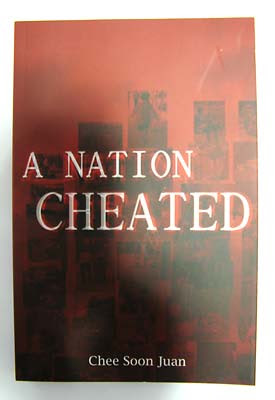
A Nation Cheated starts off with Part I - an account of how Lee
Kuan Yew and the PAP had gotten into power, from his
viewpoint.
It's probably biased - hell, who isn't? - but it casts doubt on the
PAP's (probably biased, too) version of events.
Personally, I didn't really care much for this part. History is
history. We can learn from it, or draw conclusions from it, but we
can't change it anyway.
Part II addresses Singapore's labour and economic policies, looking
at how they might have been successful in the short term, but we're
finally seeing some of their shortcomings in the form of a widening
income gap, a lack of entrepreunership and the poorly-hidden fact
that many of the government's foreign investments have
failed.
While Chee clearly outlines the problems, the possible solutions he
offers aren't convincing, considering that he had managed to
squeeze all of that into a mere 5.5 page-long chapter titled 'The
alternative'.
"What can be done to improve Singapore?" is the question that he
had answered in that chapter. However, what we really want to know
is, "What are our opposition leaders going to do to improve
Singapore?". The book, and possibly Chee's strategy, fails in this
aspect.
==
A Nation Cheated ends off with a speech, and an appendix of
questions and answers.
It's an informative read, provided you understand that books by
political leaders - opposition or otherwise - are inherently
biased.
A pity it doesn't tell us what they can do to improve
Singapore.
Or for that matter, what I can do to build a democratic Singapore
with Chee.
==
A Nation Cheated is available online at SDP's website (email them) or from
Kinokuniya or Select Books in Tanglin.
http://agentsarego.blogspot.com/2008/10/