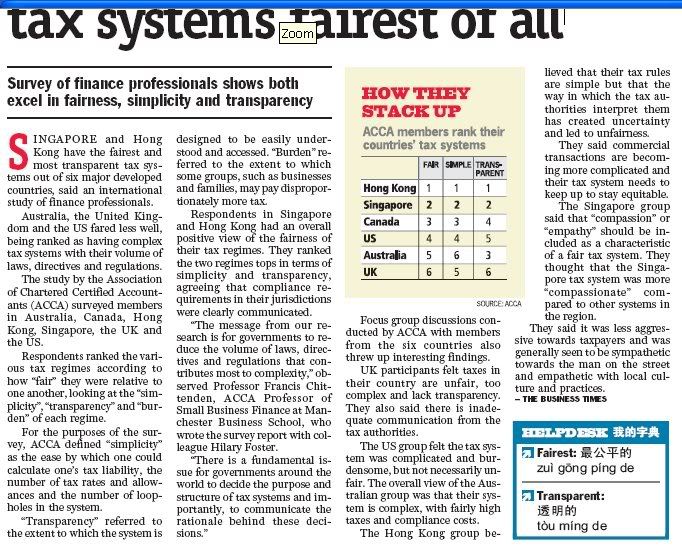
Hong Kong has been the freeest economy in the world for 10
years.
U ask the graduate there.U will know the choice of jobs
less than SG.
Ranking cant put foods on the table.
The reality counts.
Like other rankings,they use their yard stick to measure.
Some SG pple will be happy that they find another good
reason
to leave.Congra!!
45 75 60 39 42 78 53 100 39 58
Cost of Living and economy each allocated max 15%,the rest each
10%.
Cost of Living
45
First world country of course not cheap.But our tax is very
low
in first world,even u take GST into acct.
Leisure &
Culture 75
If u include patrons of 4 D,then it is ok.
Economy 60
Besides,3.3 million of citizens and some 500,000 of PR,SG
still
can feed 900,000 Foreigners working here.And they still give so
low!!
They must forget SWF!!
Environment..39
How much land can
we protect ?we only have 700km2.
But they forget we can collect water in our soil to provide
50%
for our needs.
Freedom 42
They are very generous.Thanks.
Health 78
SG is the lowest in infant mortality rate in the
whole world.
Only half of Aussie!!
Are they mean the higher % in GDP for public health the
better?Rubbish.
Infrastructure 53
If they calculate the passengers and goods throughput
in relationship to population and land areas,they will give us
101 marks.
Risk & Safety..100
But not to some professional and I- want -to save-everyone
blogger.
Climate...39
Ha.How many places in the world without
earthquake nor
tsunami nor
typhoon nor
tornado nor
floodings nor
drought?
and only get 39?
Singapore is one of the few!!
Is the high rainfall/temperature a plus or minus?
Final Score...58--Thanks.Very
generous.
Never mind the figurs.I just want to keep this one as No.1--
SG is the lowest in infant mortality rate in the
whole world.
U can keep all the other 100 marks in the world .Oh Baby.
https://www.cia.gov/library/publications/the-world-factbook/rankorder/2091rank.html
Health 78
Health (10%). In this category, we look at
calorie consumption as a percentage of daily requirements, the
number of people per doctor, the number of hospital beds per 1,000
people, the percentage of the population with access to safe water,
the infant mortality rate, life expectancy, and public health
expenditure as a percentage of a country’s GDP.
SG is the lowest in infant mortality rate in the
whole world.
Only half of Aussie!!
Are they mean the higher % in GDP for public health the
better?Rubbish.
Don't understand what you
meant by your statement "Only half of Aussie!!", as can
be seen from the data, Australia had a score of 91 for health and
Singapore 78, mathematically it's not half.
Alas the scoring system is not
based soley on infant mortality rate, as can be seen from the
explanation of the scoring system, they based it on a number of
criterias, some of these factors are, number of people
per doctor, the number of hospital beds per 1,000 people and public
expenditure as a percentage of a country's GDP.
If you look at doctors per 1,000
population, Singapore is 140 doctors per 100,000 population,
whereas Australia is 247 doctors per 100,000 population. Isn't it
better to have more doctors per population?
http://hdrstats.undp.org/indicators/58.html
As for hospital beds per 1,000
population, Singapore has 2.9 hospital beds per 1,000 population,
whereas Australia has 7.4 hospital beds per 1,000 population. Isn't
it better to have more hospital beds per 1,000
population?
(Data from The Economist
Pocket World in Figures 2007 edition)
For your comment about higher GDP
spending on healthcare being bad, then maybe you should
consider what are the consequences if government has ZERO spending
on healthcare. So essentially, does lower spending on
healthcare means good, or higher spending on healthcare
good?
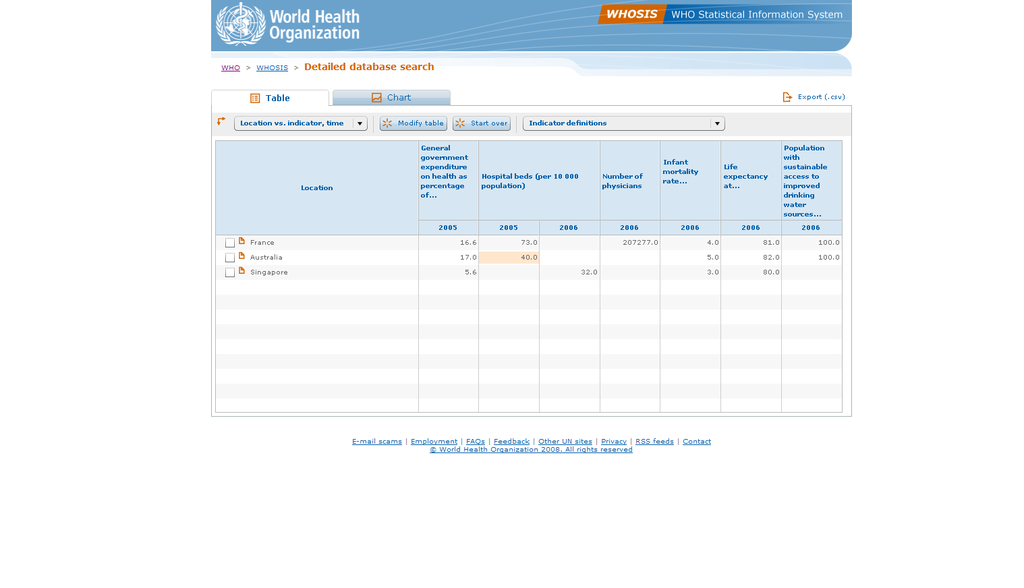
The statistics I posted below are
abit outdated, unfortunately WHO doesn't have public access data
for the current few years. The best I could managed was 2005-2006,
but I guess it could provide some kind of a reference as to the
fairness of their scoring system.
I don't see their system
bias in this aspect of the analysis. Perhaps we should ask
ourselves if we have been the victim(s) of government
propaganda to the point of rejecting concrete data. The
government has an ulterior motive to manipulate data (propaganda)
to it's convenience so as to pacify her citizens, what ulterior
motive has this organisation reporting on the quality of life for
192 countries.