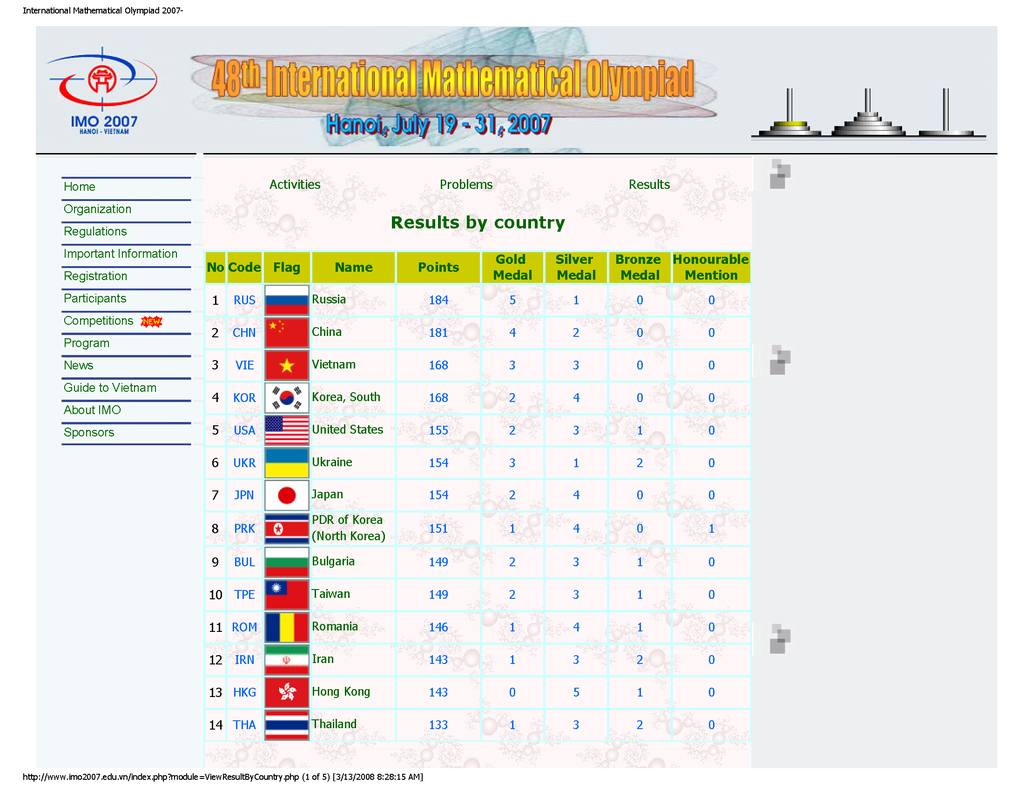
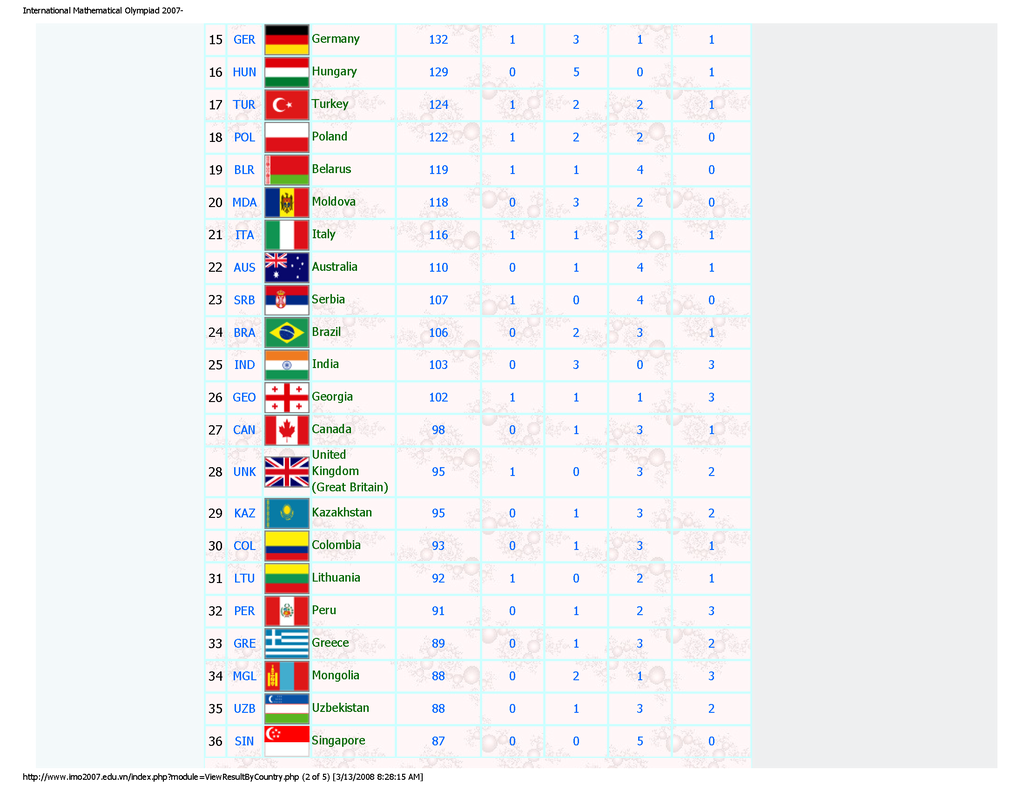
It takes 10 years for Calif to accept this series!!
I must say the principals ,teachers,officials in Calif Educatio
Department and parents have courages and guts to use SG books.
I hope the US defense circles also have this guts,like the
recent oil tank contract awarded to EADS!!
''
<!-- TIMESTAMP END --><!--NEWS RELEASE CONTENT
BEGINS--><!-- HEADLINES BEGIN -->
LAUSD School Uses Singapore Math Textbooks to Help Improve
Scores by 29 Percent; CSUN Education Majors Use Singapore Math to
Help Deconstruct, Teach Elementary Math''
SACRAMENTO, CA and OREGON CITY, OR--(Marketwire - November 14,
2007) - Students in the Golden State will soon be using
state-approved versions of the math textbooks that helped their
counterparts in Singapore crunch numbers better than any children
in the world, according to Jeffery Thomas, president of the
textbooks' North American distributor, SingaporeMath.com Inc.
Elementary school teachers in California will, beginning next
year, be allowed to use state funds to order adaptations of math
textbooks that were developed by Singapore's Ministry of Education
and helped students there earn first-place rankings in three widely
cited studies of student math performance conducted in 1995, 1999
and 2003, Thomas said. The global study -- Trends in International
Mathematics and Science Study (TIMSS) -- is conducted every four
years.
The state-approved adaptations of the Singaporean texts meet the
state's K-5 math standards
and represent a "marked departure" from most math textbooks used in
the U.S., Thomas said. The California State Board of Education
included the adaptations, or "Standards Edition" titles, published
by Singapore-based Marshall Cavendish International in its 2007
Mathematics Primary Adoption on Nov. 8 after receiving a list of
recommended textbooks from the state's Curriculum Commission.
The state's list of adopted math titles is available online at
http://www.cde.ca.gov/ci/ma/im/mathprogramnov2007.asp.
The state released its last mathematics primary adoption in
2001.
The "Standards Edition" textbooks generally replace Singaporean
dollars and cents with U.S. currency, Singaporean proper names and
various British spellings, Thomas said. Teachers in Singapore
deliver classroom instruction in English.
The adopted Singapore math
titles are relatively thin books full of colorful illustrations of
children, shapes and animals designed to support multi-step word
problems that require students to work with numbers in various
forms such as decimals, percentages and fractions.
"The presentation is astonishingly
clear and child-friendly, yet is mathematically sophisticated,"
said Thomas Parker, a professor of mathematics at Michigan State
University. "Students learn through carefully-designed
problem sets. By grade six, the
Singapore texts are one to two years ahead of U.S.
texts, and the students are extremely well-prepared to start
algebra."
Jim Milgram, a professor emeritus
of mathematics at Stanford University, added that,
"Singapore Math is one of the best programs out there --
especially in the lower
grades."
By comparison, in the U.S., elementary school math textbooks
"frequently present mathematics in 'template' form," Parker said.
"The teacher does several examples, then the students do problems that
are identical except for the choice of numbers," said
Parker, the co-author of "Elementary
Mathematics for Teachers," which has been used by
undergraduate education majors at various universities, including
Cal State University, Northridge and the University of Michigan.
"The 'reform' textbooks written in the 1990s go to the opposite
extreme, omitting skill development and instead give problems that
involve much writing and little mathematics."
The Singapore books, he said, "strike a perfect balance."
Undergraduate teaching majors work with editions of "Primary
Mathematics" in conjunction with Parker and Scott Baldridge's
"Elementary Mathematics for Teachers." The teaching book often
calls on undergrads to read a section of "Primary Mathematics," do
problems and study the material from a teacher's perspective.
"Teachers think about what skills are developed, how the
problems are organized, what the prerequisite knowledge is and what
order topics are developed," Parker said. "This becomes a
challenging and effective college course because the emphasis is on
understanding elementary mathematics at the level of 'teacher
knowledge.'"
Earlier editions of the Singapore math titles helped teachers at
Ramona Elementary School in the Los Angeles Unified School District
graduate 29% more fifth graders that met the state's "proficient
and advanced" math standard in 2005-2006 than in 2004-2005,
according to Robin Ramos, a district math coach at Ramona -- a
Title I school in East Hollywood.
"Our scores have jumped considerably," Ramos said. "We need to
learn how to teach math differently from how we were taught -- or
we'll get the same results."
Ramos added that the improvement at Ramona is the byproduct of
committed teaching, using the new textbooks and the training in
Singapore math teachers received from Yoram Sagher, a professor of mathematics at
Florida Atlantic University.
The Singapore math title adopted by California this month for
grades 1-5 is "Primary Mathematics
Standards Edition" -- which is adapted from the title
developed by Singapore's
Ministry of Education, "Primary Mathematics." The Singapore
math title adopted by California this month for kindergarten is
"Earlybird Kindergarten
Mathematics Standards Edition," an adaptation of the
title "Earlybird Preschool Mathematics" used by kindergarten-aged
children in Singapore. Student workbooks and teacher guides are
also available from SingaporeMath.com as companions to the
"Standards Edition" titles.
Students who use Singapore math titles at Ramona Elementary
"love the simplicity of the pictures" and "generally are very
affectionate about them," Ramos said.
"They love the little children giving advice," Ramos said.
"There's joy, and they respond to that -- the book presents math
simply and the students get that."
Richard Askey, Ph.D. -- a
professor emeritus of mathematics at the University of Wisconsin,
Madison -- added that the 2003 TIMSS results reveal that in
elementary school "it is of primary importance to build a firm
foundation of numbers and operations and leaning how to solve
multi-step word problems, and the Singapore method does each of
these."
Askey is acknowledged by Marshall Cavendish International as a
contributor on its state-approved title for grades 1-5.
The distributor of the state-approved texts, SingaporeMath.com,
will work with trainers from Staff Development for Educators and
other Singapore math specialists to help California teachers use
the textbooks, Thomas said.
"We recognize that professional development is an essential part
of the textbooks being successful in the classroom," said Thomas, a
former community college professor. "There's no substitute for good
teaching."
Thomas and his wife, Dawn, a Singaporean, founded
SingaporeMath.com in 1998 after the
couple returned to the U.S. after spending five years in Singapore.
After returning to the U.S., the couple supplemented their
daughter's math coursework with editions of "Primary Mathematics"
from Singapore.
Shane Armstrong, senior group publisher & head of Marshall
Cavendish, said, "The endorsement by
the California Department of Education of 'Primary Mathematics' and
'Earlybird Kindergarten Mathematics' (Standards Edition) for use by
schools in California as a core program is an exciting step
forward, and we will continue to work closely with
SingaporeMath.com Inc. to provide the best math, teaching and
learning support to educators and students in the U.S. --
particularly in California."