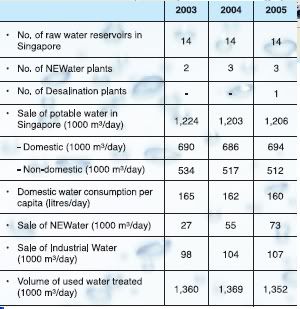
GDP increases some 30 % per m3 per day from 2002 to 2006!
The projection of increases one third in 10 years seem not
valid.
Sales of potable water decreases in a row of 3 years.,
when population increases and GDP also up!!!!
year....................2002......03.........04.......05......06
Water treated..1,315...1,360....1,369.....1352...1399( m3 in
1000/day)
Sale of
potable...1,259...1,224...1,203....1206...1230(m3..in
1000/day)
water
Domestic...............687......690......686.....694..702( m3 in
1000/day)
Non--domestic.......572......534......517.....512...508( m3 in
1000/day)
population(m)......4.17.....4.19.....4.24....4.35...4.48
sale of potable water in liters/capita/ /day
...........................302(2002)....................275(2006)
GDP
162,491million(2002)............ 209,679million(2006)
GDP per m3 /day $353(2002)........$467 per m3/day
click me
Note the huge drop in non--dom water most likely
replaced by NEWater and industral water.
Sale of NEWater..81,000m3/day
Sale of Industrial Water..112,000m3/day
Volume of used water treated....1,399,000 m3/day
Water Demand : Domestic water consumption per capita
162,160,158 liters /capita for 2004,2005,2006
source of water
soldKey ENV data 2007
2.Nano-material
filters could cut cost of cleaning water
SINGAPORE: The cost of filtering and recycling water could be
reduced in a few years' time due to a new material developed by
Nanyang Technological University (NTU) and the Public Utilities
Board (PUB).
This was revealed at an international water conference here, called
the International Water Association Conference and Exhibition on
Water and Wastewater Technologies.
The material that is being engineered by researchers from NTU and
the PUB uses nanotechnology, which controls matter on a scale
smaller than 1 micrometre, and is made up of nano-sized
crystals.
And because the crystals are so tiny, they are able to capture a
large amount of unwanted matter in the water.
That is why the nano-material works better than conventional
cleaning filters or membranes.
Associate Professor Darren Sun, School of Civil and Environmental
Engineering, NTU, said: "Conventional polymer membrane is just a
filter. But this new technology will make the filter double up as a
reactor which will be able to destroy unwanted material."
The nano-material destroys unwanted matter like dissolved salts and
chemical compounds in water by using ultraviolet light and visible
light.
The material then clears its surface to allow more unwanted
material to collect.
The final goal, which will take a few years, is to make a cleaning
filter or membrane out of the nano-material.
The focus now is on testing the material and possibly removing one
stage of the pre-treatment of waste and sea water.
Researchers said another objective of the new filter is to prolong
the lifespan of the membrane and reduce costs.
For now, the results of tests conducted are promising.
To date, the filter can remove at least 20 percent more organic
carbon which is one of the parameters to assess cleaner
water.
The PUB estimates that a pilot plant could be built to test the
nano-material at Chua Chu Kang Waterworks in about two years and
the research project may apply to a scheme called Fast-Tech to
fast-track water projects.
Also announced at the conference is the S$300,000 Lee Kuan Yew
Water Prize, which recognises organisations or individuals who come
up with solutions to water problems.
Nominations will open from the end of June.
The winner will be announced next March and presented in June at
the first Singapore International Water Week.
- CNA/so
05.June .2007