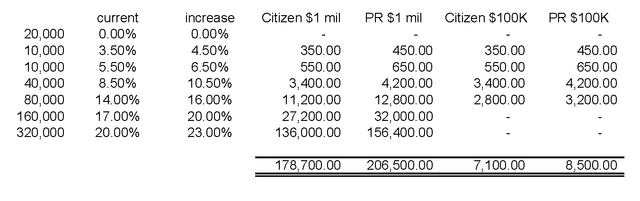
Whether you are PR or citizen, nobody would know, stating it in
cyberspace does not add to it's credibility as your status cannot
be independently verified.
In the world, everything is connected to everything else.
Einstein's search of a Unified Field Theory to link up all
everything in physics. But your association of PRs and female
citizens is remote, because the topic is about PRs and citizens. I
don't think the female citizens are free loaders, but you seem to
associate them in a negative aspect.
My apologies, I misread that statement. You mentioned they
should be receiving more benefits than employment pass holders. Why
should they, can you please explain? Employment pass holders and
PRs are almost the same, they have no intention of staying the
course (retirement) in Singapore. Their only motive is to extract
profits and move back to their home country.
What do you understand from the term GDP (Gross Domestic
Product)?
GDP: The total income earned domestically, including the income
earned by foreign owned factors of production.
Let's have a scenario analysis. Let's say in a household
(Singapore) of 4, their combined income (GDP) is $400,000, they
save their income, which becomes their reserves. After 5 years,
they have a combined savings of $400,000, but 2 of the family
member decides to move to another household. They extract half of
the reserves which is $200,000. Which means the othe 2 household
members will have only half of the reserves available to maintain
house.
Whether they be FTs or PRs, they share a common characteristic,
they have no intention of making Singapore their permanent home.
Having them to pay a higher tax for not becoming citizens will only
bring about higher employment for Singapore citizens. A small
percentage will decide it's not worth their while and decide to
move to another country. This small percentage of jobs will be
taken up by current unemployed Singapore citizens. I do NOT believe
that there will be a mass exodus of PRs just because their income
tax has been raised 1% to 3% (based on the marginal structure of
the tax schedule). Afterall, indirect taxes has gone from 3% to 5%
and will be going to 7% in July, but the influx of FT is still
peaking. Doesn't this statistic prove that taxes has little
influence over the migration patterns of individuals. People based
their migration on environmental factors, tax does not play a major
role. If you have a choice of migration to Ethiopia (say no taxes)
and Tokyo (30% taxes); which would you choose?
Can you please clarify what do you mean by economic liability?
The last I know the government does not provide any unemployment
benefits. So what is your definition of economic liability? The
closest I can envisage is a budget air ticket to your country of
origin.
NS-men relief is an appreciation of those who have served
National Service (NS), as compared to those who are exempted
(medical disability, religious belief and women) from serving NS.
You cannot associate NS-men relief with PRs and employment pass
holders, as they do not have a pre-requisite to fulfil NS
liabilities (they have NO such obligations). e.g. if A from a
country with an education system while B is from a country with no
education system. Can you compare B as if he had an educational
system. I doubt you can, because it was not even in his choice (if
he had one) to pursue an education. If NS-men relief is a
distinction between citizens and PRs, then it should be aptly
called citizens relief and not NS-men relief.
Generating wealth, isn't that the premise of any laissez faire
economic system? I don't think it's only unique to Singapore.
I can't see your logic of associating CPF with PRs. Maybe you can
provide some examples.
Any fallouts with the PR community is unavoidable, but the benefits
reap by Singapore citizens is many times over the loss in PR
fallout. Afterall, Singapore citizens are the ones who has a stake
in the future of Singapore, they decide to make Singapore their
home permanently.
Thank you.