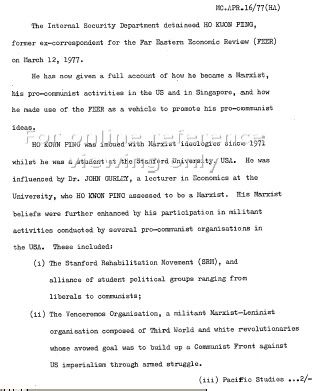
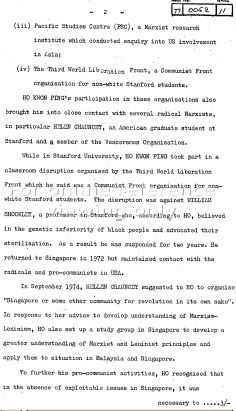
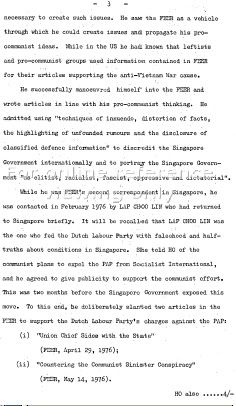
Singapore gazetted FEER as "a declared foreign
newspaper" on Dec 26, 1987 "for interfering in the domestic
politics of Singapore" and later classified it as an offshore
newspaper following an amendment to the NPPA.
In December 2004, FEER changed from a weekly to a monthly
publication and, as a result, it ceased to be an offshore newspaper
and was allowed to circulate in Singapore without having to comply
with the conditions for offshore newspapers.
The magazine, with a circulation cap of 10,000 copies, however
remained "a declared foreign newspaper" but in August, the ministry
said: "It is an anomaly for FEER, which is a declared foreign
newspaper, not to be subjected to the conditions that apply to the
other declared foreign newspapers".
Following that, the government issued notice to FEER to comply with
the conditions under the NPPA by Sept 11.
--/www.bernama.com,September 28, 2006 .By Jackson Sawatan
2.
n December 1987, the Government here cut Feer's
circulation from 9,000 to 500 copies, over an article on arrests
under the Internal Security Act.
The circulation was later gradually restored.
---By Arul John email: [email protected] THIS magazine editor knows
what it's like to get into trouble with governments.
30 November 2003
Getting into trouble with South-east-Asian governments is not
something new for Far Eastern Economic Review editor Michael
Vatikiotis
3.
n 1987, the PAP government detained 22 highly
educated and intelligent young citizens under the Internal Security
Act on the grounds that they were party to a "Marxist" conspiracy.
Some of those arrested were actively working for and supporting the
Party although they were not card-carrying members.
As a condition of their subsequent release, they were all banned
from taking part in any political activity. While the Party does
not subscribe to Marxist philosophy, it believes that some of the
detainees could have been persuaded to join the Party's cause and
helped the Party in its struggle for change within the constitution
and under the law. The effect of barring them from political
activity was to deprive the Party of potential members and
candidates for the 1988 General Election.
4.
Soon the government slashed the circulation of
another Dow Jones publication, the Far Eastern Economic Review,
from 9,000 to 500 copies a week -- a cut that amounted to nearly a
fifth of its total circulation -- for not publishing a
reply to coverage of the arrest of Catholic activists.
When the Review announced that it was pulling out of Singapore as a
result, the government printed a pirate edition of the
magazine.
5.
Lee said that if foreigners "interfered" in Singapore politics
and sold their products there he would "hit them where it hurts, in
their pockets.".....
and the Far Eastern Economic Review famously defended
itself in a libel case brought by Lee over a story about arrests of
Catholic activists. Lee was awarded extra damages by his court on
account of the grilling he received from the Review's counsel, the
well-known London-based human rights lawyer Geoffrey
Robertson......
''The Justice
Game'',
By Geoffrey Robertson,Vintage 1999 ISBN 0099581914----Pages 229 -
240 (part of Chapter 10: Show Trials) are about Singapore. "Never
have I acted for such good people ..." Robertson tells of the 1987
arrests and alleged Marxist conspiracy as well as his
cross-examination of Lee Kuan Yew in the Dow Jones/FEER
case
6.The 1987 Marxist conspiracy
The arrests began in early hours of the 21st May 1987, and within
weeks a total of 22 people were detained, for varying periods of
time.
Most were social workers, dramatists, and Catholic church
welfare workers, detained on the pretence that they were part of a
'Marxist conspiracy' intent on overthrowing the government.
(Emergency Committee for Human Rights in Singapore, 20 July 1987,
p. 7)
While there is little doubt that the 1987 arrests had a big impact
on the lives of the detainees and their families and friends, its
effect went much further than this. Outside of Singapore, a myriad
of individuals, informal groups and NGOs, for the first time, found
themselves united by an issue.
Such overseas attention was particularly strong during the 1987
arrests, much more so than in similar events in the 1960s and
1970s. A mere five weeks after the initial arrests, the then
Foreign Minister Rajaratnam complained that over 200 organisations
from around the world had sent protest letters to the government.
(ECHRS, 31 August 1987, p. 3)
Apart from the very important and active role played by detainee
support groups and several opposition political parties in
Singapore, overseas Singaporeans, small and large international
groups, and even Malaysians (their support predates the Malaysian
governments own detentions several months later) played a
disproportionately large role in highlighting and publicising the
inequities of the PAP government arrests.
So, why did foreign organisations and expatriate Singaporean
communities played such a prominent role while public opinion in
Singapore remained largely muted?
The concept of a 'pacific community' gained popularity by the early
1980s mainly via governmental, business and intellectual circles.
This lingo naturally seeped into community circles soon after and
was taken up in earnest by some NGOs, based in various capital
cities in the region.
Growing regional economic success brought with it greater economic
interdependence between communities, which in turn fueled local
versions of 'regionalism'. NGOs were set up and grew stronger under
this growing climate of regionalism.
In previous times, such organisations would have sufficed to handle
issues delineated by nationalist or domestic concerns. However, by
the 1980s, these concerns began to encompass issues outside
traditional nationalistic boundaries.
It was this up-and-coming NGO movement that helped to highlight the
plight of the Singaporean detainees in 1987.
Singaporean exiles network
Former student leaders of the Singapore University (1974-75), some
of whom were implicated as ring-leaders of the Marxist conspiracy,
were instrumental in drumming up opposition to the Singaporean
government during 1987 arrests.
Mr Tan Wah Piow, based in London, and Mr Tsui Hon Kwong, in Hong
Kong, and several other........