Based on the following report from
CNN Money - 28 July 2006: is Temasek or GIC making any efforts
to buy a stake in the US public listed Oil Companies ?
The Singapore Reserves should be used to earn profits from such
investments, which could be returned to hardpressed Singaporeans -
either by way of lower petroleum retail prices (by reducing
petroleum taxes), or reduce Vehicle Road Tax. This could result in
a positive effect to the Cost of Living and Business Operations in
Singapore.
Exxon Mobil
makes more than $10 billion
No. 1 U.S. oil company earns
$1,318 a second
- topping forecasts - but comes in just
shy of a record.
By Steve
Hargreaves, CNNMoney.com staff writer
July 27 2006: 4:27 PM EDT
NEW YORK (CNNMoney.com) -- Profits at Exxon Mobil surged 36 percent
to a near record $10.4 billion in the second quarter as surging oil
prices helped the world's largest publicly traded company soundly
beat Wall Street forecasts.
The company's profit - which amounts to a cool $1,318 a second - is
the second biggest ever reported by a U.S. company, behind only the
$10.7 billion Exxon itself earned in the fourth quarter of
2005.
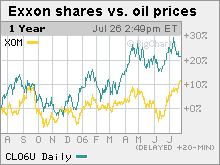
Exxon shares (in yellow) have generally
followed the price of NYMEX crude oil (in blue).
The earnings equaled $1.72 a share,
topping the $1.64 a share analysts had forecast on average,
according to First Call. Total revenue in the quarter was just a
bit more than $99 billion.
Exxon (Charts)
shares rose modestly in afternoon New York Stock Exchange
trading.
The $1,318 a second would buy enough gasoline, even at the current
$3 a gallon national average, to drive a Hummer H3 between Los
Angeles and New York three times.
One analyst said Exxon's record fourth-quarter earnings in 2005
included a $400 million tax charge that analysts were not including
as part of that quarter's profit.
"Apples to apples, this quarter is the highest by any organization
ever," said Fadel Gheit, an energy analyst at Oppenheimer.
Irving, Texas-based Exxon Mobil caught considerable flak from the
general public for its record fourth quarter, which came soon after
gasoline prices hit record highs.
Compounding matters, the company gave its outgoing CEO Lee Raymond
a retirement package worth about $350 million around the same
time.
That combination of events led to a public outcry calling for
restrictions on CEO pay and calls from lawmakers who wanted to
institute a windfall profits tax on the oil industry or even break
up some of the oil giants that merged in the 1990s.
But the industry says that oil prices fluctuate widely over time
and that, in the long run, it's actually less profitable than a
number of other industries.
Officials have also argued against a government-forced breakup,
saying oil companies need to be big to compete in a global market
against foreign state-run firms, some of which are larger than
Exxon Mobil.
Surging oil prices helped Exxon in the second quarter, when crude
prices jumped 31 percent.
Exxon said spending on exploration and production rose 8 percent in
the quarter, to $4.9 billion, while overall output rose 6
percent.
Investors have been concerned that high oil prices would lead the
company to boost spending even further.
But the desire to restrain spending may run counter to consumer's
interests, as more oil on the market would help lower gas
prices.
Gheit said the company sent $7.9 billion back to shareholders in
the second quarter in the form of dividends and stock
buybacks.
He said Exxon's expenditures on exploration and production were
sufficient, as most of the world's oil reserves are by now widely
known. Extracting those reserves, he said, is constrained more by
politics than it is by lack of spending on exploration.
"They can't just go and push [Russian President Vladimir] Putin and
say, 'let us in,'" he said. "They need access to resources, what
can they do?"
Gheit thought the company was striking a good balance with how it
is spending its cash.
When asked about investing in renewable energy technologies, an
Exxon official said that, apart from ethanol, it's generally not
part of the company's plan.
"There are very few that are economical without subsidies," said
Henry Hubble, vice president for investor relations, on a
conference call. "We don't think it makes sense to invest in it at
this point."
The company's mammoth earnings, and its reluctance to get into the
alternative energy market, drew fire from critics.
Shawnee Hoover, director of Exxpose Exxon, a coalition of groups
including Greenpeace and the Sierra Club, said Exxon will continue
to post record profits until consumers have other energy
choices.
"Exxon wants to preserve [its] market by not doing anything about
global warming," Hoover said on a conference call.
Industry experts say that it's becoming increasingly expensive for
oil companies to get easily refinable crude oil out of the
ground.
At the same time, high prices have led to surging demand for
exploration and drilling equipment and workers, causing the price
of such services to jump at least 15 percent a year over the last
several years, industry executives and analysts say.
Then there's the geological fact that new, large, high-quality oil
fields are simply getting harder to find.
Meanwhile, new production hasn't kept pace with surging demand -
not only from the United States but from China, India and other
rapidly growing economies - which has driven prices up nearly
fourfold, from around $20 a barrel in early 2002 to a trading high
of $78.40 earlier this month on the New York Mercantile
Exchange.
Tensions in the Middle East and other parts of the world and
speculative buying by big investment funds have also helped fuel
the run-up.