<!-- /firstHeading --><!-- bodyContent -->
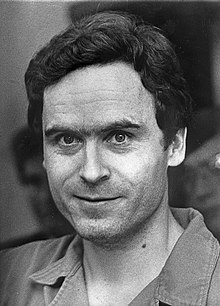
In custody, Florida, July 27, 1978
Theodore Robert "Ted"
Bundy (born Theodore Robert
Cowell; November 24, 1946 – January 24, 1989) was an
American serial killer,
rapist, kidnapper, and necrophile who assaulted and murdered
numerous young women during the 1970s, and possibly earlier. After
more than a decade of denials, he confessed shortly before his
execution to 30 homicides committed in seven states between 1974
and 1978; the true total remains unknown, and could be much
higher.
Bundy was handsome and charismatic, traits he exploited in
winning the confidence of his young, attractive female victims. He
typically approached them in public places and feigned injury or
disability, or impersonated an authority figure, before
overpowering and assaulting them at a more secluded location. He
sometimes revisited his secondary crime scenes for hours at a time,
grooming and performing sexual acts with the decomposing corpses
until putrefaction and destruction by wild animals made further
interaction impossible. He decapitated at least twelve victims and
kept some of the severed heads in his apartment for a period of
time as mementos. On a few occasions he simply broke into dwellings
in the dead of night and bludgeoned victims as they slept.
Initially charged in Utah in 1975 and convicted of aggravated
kidnapping and attempted criminal assault, Bundy became linked to a
progressively longer list of unsolved homicides in multiple states.
Facing murder charges in Colorado, he engineered two dramatic
escapes and committed multiple additional assaults, resulting in at
least three murders, before his ultimate recapture in Florida in
1978. He received three death sentences in two separate trials for
the three known Florida homicides.
Ted Bundy died in the electric chair
at Raiford Prison
in Starke,
Florida, in January 1989. Biographer Ann Rule
described him as "...a sadistic sociopath who took pleasure from
another human's pain and the control he had over his victims, to
the point of death, and even after."[2]
He once called himself "...the most cold-hearted son of a bitch
you'll ever meet."[3][4]
Attorney Polly Nelson, a member of his last
defense team, agreed. "Ted," she wrote, "was the very definition of
heartless evil."[5]
Bundy was born Theodore Robert Cowell at the Elizabeth Lund Home
For Unwed Mothers in Burlington,
Vermont on November 24, 1946. His mother was Eleanor
Louise Cowell (known for most of her life as Louise). The identity
of his father has never been determined with certainty. His
official birth certificate assigns paternity to a salesman and Air
Force veteran named Lloyd Marshall,[6]
but Louise later claimed that she was seduced by "a sailor" whose
name may have been Jack Worthington.[7]
Her family expressed suspicions that the father may actually have
been Louise's own violent, abusive father, Samuel
Cowell.[8]
Bundy's maternal grandparents, Samuel and Eleanor Cowell, raised
him in their Philadelphia home as their son to
avoid the social stigma that accompanied illegitimate birth at the
time. Family, friends, and even young Ted were told that his
grandparents were his parents and that his mother was his older
sister. Eventually he discovered the truth, but how and when is not
clear. He told his girlfriend that a cousin showed him a copy of
his birth certificate after calling him a "bastard",[9]
but he told biographers Stephen Michaud and Hugh
Aynesworth that he found the certificate
himself.[10]
Biographer and true crime writer Ann Rule, who knew
Bundy personally, believes that he did not find unequivocal proof
until he tracked down his original birth record in Vermont in
1969.[11]
Bundy expressed a lifelong resentment toward his mother for lying
about his parentage and leaving him to discover it for
himself.[12]
While Bundy spoke warmly of his grandparents in some
interviews[13]
and told Ann Rule that he "identified with", "respected", and
"clung to" his grandfather,[14]
he and other family members told attorneys in 1987 that Samuel
Cowell was a tyrannical bully and a bigot who hated blacks,
Italians, Catholics, and Jews, beat his wife and the family dog,
and swung neighborhood cats by their tails. He once threw Louise's
younger sister Julia down a flight of stairs for
oversleeping.[15]
He sometimes spoke aloud to unseen presences,[16]
and kept a large collection of pornography which Ted and a cousin
would peruse for hours. At least once he flew into a violent rage
when the question of Ted's paternity was raised.[15]
Bundy described his grandmother as a timid and obedient woman who
periodically underwent electroconvulsive
therapy for depression[16]
and feared leaving their house toward the
end of her life.[17]
Ted occasionally exhibited disturbing behavior, even at that early
age. Julia recalled awakening one day from a nap to find herself
surrounded by knives from the Cowell kitchen; her three-year-old
nephew was standing by the bed, smiling.[18]
In 1950 Louise changed her surname from Cowell to Nelson,
dropped her first name Eleanor,[19]
and at the urging of multiple family members,[20]
left Philadelphia with her son to live with cousins Alan and Jane
Scott in Tacoma,
Washington. In 1951 Louise met Johnny Culpepper Bundy, a
hospital cook, at an adult singles night at Tacoma's First
Methodist Church.[21]
They married later that year and Johnny Bundy formally adopted
Ted.[21]
Johnny and Louise conceived four children of their own, and though
Johnny Bundy tried to include his stepson in camping trips and
other family activities, Ted remained distant from his stepfather.
He later complained to his girlfriend that Johnny wasn't his real
father, "wasn't very bright", and "didn't make much
money."[22]
As a boy Bundy roamed his neighborhood, picking through trash
barrels in search of pictures of naked women.[23]
As an adolescent he browsed bookstores and libraries in search of
detective magazines, crime novels, and true crime documentaries,
favoring stories that involved sexual violence, particularly when
accompanied by pictures of dead or maimed bodies.[24]
Later, he consumed large quantities of alcohol (which he called "a
very important trigger") and "canvass[ed] the community" late at
night in search of undraped windows where he could observe women
undressing, or "whatever [else] could be seen."[25]
Bundy told Michaud and Aynsworth that as an adolescent he "chose
to be alone" because he was unable to understand interpersonal
relationships.[26]
Though he maintained a façade of social activity in school, he
claimed he had no natural sense of how to develop friendships. "I
didn't know what made people want to be friends," he said. "I
didn't know what underlay social interactions."[27]
However, Bundy's friends from Woodrow Wilson High
School told Ann Rule that he was "well known and well
liked" there, "a medium-sized fish in a large pond."[28]
His only significant athletic avocation was snow skiing, which he
pursued enthusiastically using stolen equipment and forged lift
tickets.[10]
During high school he was arrested at least twice on suspicion of
burglary and auto theft. When he reached age 18, the details of the
incidents were expunged from his record, as is customary in
Washington and most other states.[29]
After graduating from high school in 1965 Bundy spent a year at
the University of Puget
Sound (UPS) before transferring to the University of
Washington (UW) in 1966 to study Chinese.[30]
In 1967 he became romantically involved with a UW classmate who is
identified in Bundy biographies by several pseudonyms, most
commonly Stephanie Brooks.[31]
In early 1968 he dropped out of college and worked at a series of
minimum-wage jobs. He also volunteered at the Seattle office of
Nelson
Rockefeller's presidential campaign,[32]
and in August, attended the 1968 Republican National
Convention in Miami as a Rockefeller
delegate.[33]
Shortly thereafter Brooks ended their relationship and returned to
her family home in California, frustrated by what she described as
Bundy's immaturity and lack of ambition. Psychiatrist Dorothy Lewis
would later pinpoint this crisis as "... probably the pivotal time
in his development."[34]
Devastated by Brooks's rejection, Bundy traveled to Colorado and
then further east, visiting relatives in Arkansas and Philadelphia,
and enrolling for one semester at Temple
University.[35]
It was at this time in early 1969, Rule believes, that Bundy
visited the office of birth records in Burlington and confirmed his
true parentage.[35][36]
Back in Washington in the fall of 1969, he met Elizabeth
Kloepfer (identified in Bundy literature as Meg Anders, Beth
Archer, or Liz Kendall), a divorcée from Ogden, Utah who
worked as a secretary at the University of Washington School of
Medicine.[37]
Their stormy relationship would continue well past his initial
incarceration in Utah in 1976. In mid-1970, now focused and goal
oriented, he re-enrolled at UW, this time as a psychology major. He
became an honor student, well-regarded by his
professors.[38]
In 1971 he took a job at Seattle's Suicide Hotline crisis center.
There he met and worked alongside Rule, a former Seattle police
officer and aspiring crime writer who would later write one of the
definitive Bundy biographies, The Stranger Beside
Me. Rule saw nothing disturbing in Bundy's
personality at the time, describing him as "kind, solicitous, and
empathetic".[39]
After graduating from UW in 1972,[40]
Bundy joined Governor Daniel J.
Evans's reelection campaign.[41]
Posing as a college student, he shadowed Evans's opponent, former
governor Albert
Rosellini, and recorded his speeches for analysis by
Evans's team.[42][43]
After Evans's reelection he was hired as an assistant to Ross
Davis, Chairman of the Washington State
Republican Party. Davis thought well of Bundy,
describing him as "smart, aggressive ... and a believer in the
system."[44]
In early 1973, despite mediocre Law School Admission
Test scores, Bundy was accepted into the law schools of
UPS and the University of
Utah on the strength of letters of recommendation from
Evans, Davis, and several UW psychology professors.[45][46]
During a trip to California on Republican Party business in the
summer of 1973 Bundy came back into the life of ex-girlfriend
Brooks, who marveled at his transformation into a serious,
dedicated professional, seemingly on the cusp of a distinguished
legal and political career. He continued to date Kloepfer as well;
neither woman was aware of the other's existence. In the fall of
1973 Bundy matriculated at UPS Law School[47]
and continued courting Brooks, who flew to Seattle several times to
stay with him. They discussed marriage; at one point he introduced
her to Davis as his fiancée.[22]
In January 1974, however, he abruptly broke off all contact; her
phone calls and letters went unreturned. Finally reaching him by
phone a month later, Brooks demanded to know why Bundy had
unilaterally ended their relationship without explanation. In a
flat, calm voice, he replied, "Stephanie, I have no idea what you
mean ..." and hung up. She never heard from him again.[48]
Later he explained, "I just wanted to prove to myself that I could
have married her."[49]
At about the same time Bundy began skipping classes at law school,
and by April he had stopped attending entirely,[50]
as young women began to disappear in the Pacific
Northwest.[51]
There is no definitive consensus on when and where Bundy began
killing women. Bundy told different stories to different people,
and he refused to divulge the specifics of his earliest crimes,
even as he confessed in gruesome detail to dozens of later murders
in the days preceding his execution.[52]
He told attorney Polly Nelson that he attempted his first
kidnapping in 1969 in Ocean City, New
Jersey, but did not kill anyone until sometime in 1971
in Seattle.[53]
He told a psychiatrist that he killed two women in Atlantic City, NJ in
1969 while visiting family in Philadelphia.[54]
In an interview with King County
Detective Robert D.
Keppel he mentioned a homicide in 1972[55]
and another in 1973 involving a hitchhiker near Tumwater,
Washington, but refused to elaborate.[56]
Rule and Keppel believe he may have started killing as a
teenager.[57][58]
Circumstantial evidence suggests that he abducted and killed an
eight-year-old Tacoma girl in 1961 when he was 14 years old, an
allegation he denied repeatedly.[55]
Bundy committed his earliest documented homicides in 1974 when he
was 27. By then he had (by his own admission) mastered the skills
needed—in the era before DNA
profiling—to leave minimal incriminating evidence at a
crime scene.[59]
Shortly after midnight on January 4, 1974—around the same time
he terminated his relationship with Brooks—Bundy entered the
basement bedroom of 18-year-old Joni Lenz (a pseudonym), a dancer
and student at UW. He bludgeoned her with a metal rod from her bed
frame and then sexually assaulted her with a speculum,
causing extensive internal injuries.[60]
She remained unconscious for 10 days but survived the attack with
permanent brain damage.[61][62]
A month later, again late at night, Bundy broke into the room of UW
student Lynda Ann Healy, who broadcast Seattle's radio weather
reports for skiers each morning. He beat her unconscious, dressed
her in bluejeans, a white blouse, and boots, and carried her
away.[63]
Female college students continued disappearing at the rate of
about one per month. In March, Donna Gail Manson, a 19-year-old
student at The Evergreen State
College in Olympia, 60
miles (97 km) southwest of Seattle, left her dormitory on the
way to a jazz concert on campus but never arrived. In April, Susan
Elaine Rancourt disappeared after an evening advisors' meeting on
the campus of Central Washington State College (now Central Washington
University) in Ellensburg, 110
miles (180 km) southeast of Seattle. Two female Central
Washington students later came forward to report encounters—one on
the night of Rancourt's disappearance, the other three nights
earlier—with a man wearing an arm sling, asking for help carrying a
load of books to his brown or tan Volkswagen
Beetle.[64][65]
On May 6, Roberta Kathleen Parks left her dormitory at Oregon State
University in Corvallis, 260
miles (420 km) south of Seattle, to have coffee with friends
at the Student Union
Building. She never arrived.[66]
Detectives from the Crimes Against Persons Unit of the Seattle
Police Department grew increasingly concerned. There was no
significant physical evidence, and the missing women had little in
common, apart from being young, attractive, white college students
with long hair parted in the middle.[67]
On June 1, Brenda Carol Ball, 22, disappeared after leaving the
Flame Tavern in Burien,
Washington near Seattle–Tacoma
International Airport. She was last seen talking in the
parking lot to a brown-haired man with his arm in a
sling.[68]
In the early hours of June 11, UW student Georgeann Hawkins
vanished while walking down the brightly lit alley between her
boyfriend's dormitory residence and her sorority house. The next
morning three Seattle homicide detectives and a criminalist combed
the entire alleyway on their hands and knees, finding
nothing.[69]
After Hawkins's disappearance was publicized, witnesses came
forward to report seeing a man on crutches with a leg cast in the
alley behind a nearby dormitory that night, struggling to carry a
briefcase.[70]
One woman said the man asked her to help him carry the case to his
car, a light-brown Volkswagen Beetle.[71]
During this period Bundy was working at the Washington State
Department of Emergency Services (DES) in Olympia—a government
agency involved in the search for the missing women. There he met
and dated Carole Ann Boone, a twice-divorced mother of two who, six
years later, would play an important role in the final phase of his
life.[72]
Reports of the six missing women and Lenz's brutal beating
appeared prominently in newspapers and on television throughout
Washington and Oregon.[75]
Fear spread among the population; hitchhiking by young women
dropped sharply.[76]
While pressure mounted on law enforcement agencies,[77]
the paucity of physical evidence severely hampered them. Police
could not provide reporters with the little information that was
available for fear of compromising the investigation.[78]
Further similarities between the victims were noted, however: the
disappearances all took place at night, usually near ongoing
construction work, within a week of midterm or final exams; all of
the victims were wearing slacks or blue jeans; and at most crime
scenes there were sightings of a man wearing a cast or a sling and
driving a brown Volkswagen Beetle.[79]
The Pacific Northwest murder string culminated on July 14 with
the broad-daylight abductions of two women from a crowded beach at
Lake Sammamish State
Park in Issaquah, 20
miles (32 km) east of Seattle. Five female witnesses described
a handsome young man wearing a white tennis outfit with his left
arm in a sling, speaking with a light accent, perhaps Canadian,
perhaps British. Introducing himself as "Ted", he asked their help
in unloading a sailboat from his tan- or bronze-colored Volkswagen
Beetle. Four refused; one accompanied him as far as his car, saw
that there was no sailboat, and fled. Three additional witnesses
saw him approach Janice Anne Ott, 23, a probation case worker at
the King County Juvenile Court, with the sailboat story, and
watched her leave the beach in his company.[80]
About four hours later Denise Naslund, an 18-year-old woman who was
studying to become a computer programmer, left a picnic to go to
the restroom and never returned.[81]
Bundy later told Stephen Michaud that Ott was still alive when he
returned with Naslund—and that one was forced to watch as the other
was murdered[82][83]—an
assertion that he would retract on the eve of his
execution.[84]
King County detectives, finally armed with a detailed
description of their suspect as well his car, posted fliers
throughout the Seattle area. A composite sketch was printed in
regional newspapers and broadcast on local television stations.
Elizabeth Kloepfer, Ann Rule, a DES employee, and a UW psychology
professor all recognized the profile, the sketch, and the car, and
reported Ted Bundy as a possible suspect;[85]
but the police, who were receiving up to 200 tips per
day,[86]
initially thought it unlikely that a clean-cut law student with no
adult criminal record could be the perpetrator.[87]
On September 6 two grouse hunters stumbled across the skeletal
remains of Ott and Naslund near a service road in Issaquah, 2 miles
(3.2 km) east of Lake Sammamish State Park.[88]
An extra femur and
several vertebrae found on the
site were later identified by Bundy as belonging to Georgeann
Hawkins.[89]
Six months later the skulls and mandibles of
Healy, Rancourt, Parks, and Ball were found on Taylor Mountain
(where Bundy frequently hiked), just east of Issaquah. All bore
extensive damage from a blunt instrument.[90]
In August 1974 Bun


