Background
What is Falun Gong?
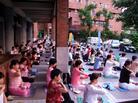
FALUN GONG (also called Falun Dafa) is an ancient form of qigong,
the practice of refining the body and mind through slow-moving
exercises and meditation. Many have come to call qigong, Chinese
Yoga. Like yoga and tai chi, qigong is a vital part of many
peoples lives in Asia; almost every Chinese park is brimming by
the break of dawn with people practicing these arts.
Yet Falun Dafa is different from most other qigong practices in
that it goes beyond the pursuit of health and fitness to the goal
of wisdom and returning to ones original, altruistic nature. At
the heart of the practice are three principles: Truthfulness,
Compassion, and Forbearance. Through a combination of studying the
books of Falun Dafa and performing the exercises, practitioners
strive to become better people by embodying these principles in
everything they do.
The Evolution of Falun Dafa
Falun Dafa was introduced to the public in May of 1992, when Mr. Li
Hongzhi gave his first lecture in Changchun City, China. Soon
afterwards he traveled with several students to the Oriental Health
Expo in Beijing where Falun Dafa earned several awards, prompting
organizers to invite Mr. Li to give several impromptu lectures on
the principles of Falun Dafa.
During the following two and a half years, Mr. Li lectured on
invitation in almost every major Chinese city, giving fifty-four
lecture series in all. All instruction at that time was overseen by
the Chinese governments top qigong organization, the China Qigong
Scientific Research Society.
Although Mr. Li gave his last lecture series at the end of 1994,
the practice continued to grow from 1995 to 1999 at an explosive
rate. During those years, the practice was passed on by word of
mouth and free of charge, and practice sites were organized by
volunteers.
Since 1995, Mr. Li Hongzhi has traveled to countries around the
world to lecture on Falun Dafa and discuss the practice with
students. All lectures have been free and open to the general
public. By the middle of 1999, Falun Dafa was practiced in over 40
countries around the world [1] .
The Persecution of Falun Dafa in China
Many Chinese leaders, including Chinese Premier Zhu Rongji and the
Director of China's Sports Commission, Mr. Wu Shaozu, applauded the
health benefits the practice brought to the nation. [2] Communist
Party head, Jiang Zemin, however, grew fearful of such a large
number of people and believing that the peaceful nature of Falun
Gong made for an easy target banned the practice in 1999. Failing
to eradicate Falun Gong in three months [3] , as Jiang had
proclaimed, Jiang has intensified the propaganda campaign to turn
public opinion against the practice while quietly imprisoning,
torturing and even murdering those who practice it.
China experts point to the systematic campaign Jiang has carried
out against Falun Gong, saying it also demonstrates an ulterior
motive: In a Feb. 9, 2001 article, CNN's Senior China Analyst,
Willy Wo-Lap Lam, quotes a senior Chinese Party member as saying,
"By unleashing a Mao-style movement [against Falun Gong], Jiang is
forcing senior cadres to pledge allegiance to his line...This will
boost Jiang's authority:" By painting Falun Gong as an enemy of the
state, Jiang hopes to mobilize the nation into a struggle with
himself at the helm, and thereby consolidate power.
As of October 14, 2002, the Falun Dafa Information Center has
verified details of 493 deaths [4] since the persecution of Falun
Gong in China began in 1999. In October 2001, government sources
inside China, reported that the actual death toll was well over
1,600. On October 14, 2001, the confirmed death toll was 323. If
the actual death toll shows the same increase as the confirmed
death toll has, then we would expect the true death toll today to
be well over 2,500. Due to extreme difficulty in discovering and
verifying information in China related to wrongful deaths, this
higher figure also likely understates the true death toll. For
instance, in March of this year police from several provinces
poured into the city of Changchun and placed a several weeks long
siege on the city. Residents reported dozens, if not over one
hundred, practitioners were killed. In this chaos, little detailed
information about these deaths could be gathered by the Falun Dafa
Information Center
Intensifying the Campaign Overseas
Soon after Jiang Zemin began persecuting Falun Gong in China,
the
international community reacted, condemning Jiangs actions. On
November 18, 1999, the United States Congress passed joint
resolutions (House and Senate), condemning the persecution. The
Wall Street Journals Ian Johnson began authoring a series of
articles exposing the atrocities committed against people who
practice Falun Gong in China that would later win him the Pulitzer
Prize for International Reporting. U.S. governors, mayors and state
legislators began issuing proclamations of support and
encouragement to people who practice and/or support Falun Gong
throughout the U.S.
This response by the international community put pressure on Jiang
to end his anti-Falun Gong campaign. Jiang, however, responded by
issuing a directive: intensifying the campaign overseas. [5]
Thus, Chinese Embassies and Consulates around the world began
escalating efforts outside China to stamp out support for Falun
Gong, to disrupt Falun Gong activities, and to try to get them
banned.
For the past three years, Chinese Embassy and Consulate officials
have worked to slander and persecute Falun Gong here in the United
States, and in other countries around the world.
Jiang wishes to nullify any criticism of his handling of Falun
Gong. He also wishes to maintain absolute control over what Chinese
citizens hear and see about Falun Gong. Most mainland Chinese only
know what the state-run media report. Nevertheless, the more
positive support Falun Gong receives overseas, the more difficult
it becomes to hide this support from the people of China.
http://www.faluninfo.net/specialreports/freedomunderattack/