http://en.wikipedia.org/wiki/Dioscorea_opposita
Dioscorea opposita
(nagaimo, Chinese yam,
Korean yam) is a type of yam (Dioscorea) that may be eaten raw.
Dioscorea opposita is an exception to the rule that
yams must be cooked before consumption (due to harmful substances
in the raw state). In Japanese cuisine, it is eaten raw and
grated, after only a relatively minimal preparation: the whole
tubers are briefly soaked in a vinegar-water solution,
to neutralize irritant oxalate
crystals found in their skin. The raw vegetable is starchy and
bland, mucilaginous when grated, and may be eaten plain
as a side dish, or added to noodles.
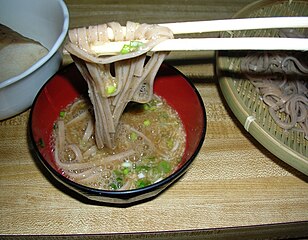
Dioscorea opposita is used in the Japanese noodle dish
tororo udon/soba and as a binding agent in the batter of
okonomiyaki. The grated nagaimo is
known as tororo (in Japanese). In tororo
udon/soba, the tororo is mixed with other ingredients
that typically include tsuyu broth (dashi),
wasabi, and green
onions.
In Chinese it is known as huái shān (淮山), shān yào (山药), or huái shān yào (淮山药).
In Japanese, it is known as nagaimo (lit. 'long yam';
kanji: 長芋; hiragana: ながいも). Furthermore,
nagaimo is classified into ichōimo (lit.
'ginkgo-leaf yam'; kanji: 銀杏芋; hiragana: いちょういも), or yamatoimo (lit.
Yamato yam; kanji: 大和芋; hiragana: やまといも), depending on root
shapes.
In Korea it is called ma (hangul: 마), "sanwu(山芋, 산우)",
seoyeo(薯蕷, 서여), or sanyak(山藥, 산약).
In Vietnam, the yam is called củ mài or khoai
mài. When this yam is processed to become a medicine, the yam
is called hoài sơn or tỳ giải.
The tuber is also used (often in dried form) in traditional Chinese medicine and
Chinese herbology.
Shanyao root, 山藥, Radix Dioscoreae oppositae, falls within the
Chinese herbal medicine category of Tonify Qi materia
medica.[2][3]
Within this category it has specialized and important properties
which make it one of the most important and commonly used materia
medica in the Chinese medicine repertoire. As a tonifying herb
which enters the kidney organ (Zang) and/or channel (Jing), its
role is fundamental, in accordance with the dictum that "the kidney
is the root of Yin and Yang of all the organs (Zang-fu). Shanyao is classified as being of neutral
temperature, an important property which means that, while it
significantly tonifies the Qi, it does not at the same time cause
Heat; in this way it is able to tonify Qi without injuring the Yin,
an important advantage in the treatment of patients with deficient
Yin. In this role of tonifying Qi without injuring the Yin it
appears in such classical formulas as Liu Wei Di Huang Wan, 六味地黃丸, the Six
Flavours Rehmannia Pill, and its many derivative and related
formulas.[4]
Shan Yao is also used in situations where it is necessary to
tonify Qi, but where the Yin is not deficient. In this usage it is
usually used prepared by dry-frying (chao, 炒), which alters its
temperature property to slightly Warm. The slightly Warm property
enables it to Warm the spleen, another organ/channel which it
enters, enabling the spleen to Dry Dampness, but without injuring
Blood, a dimension of the Yin. A typical formula where dry-fried
Shan Yao is used to tonify Spleen Qi is Shen Ling Bai Zhu San,
參苓白術散, Ginseng Poria Atractylodes Powder.[5]
It is also frequently found dry-fried in Chinese herbal
dermatology[6]
in formulas for treating Blood Dryness where it is necessary to
warmly tonify Spleen Qi, to enable it to Transform residual
Dampness, but without drying Blood or Yin.
In combination with bitter melon, Chinese yam has been shown to
contribute to weight loss. Over a period of 23 weeks, those eating
the diet containing Chinese yam lost 7 kilos.