6. Metroline
Our good friend Metroline needs no introduction. Privatised in
1994 and acquired by ComfortDelgro in 2000, Metroline operates 82
routes from 11 garages concentrated mainly in the north and
north-west districts. Metroline's buses can be easily identified
from the blue skirt on their liveries, the colour combination of
which make them a personal favourite for me; however, since June
2009 the blue skirt has been dropped from new bus purchases as well
as repainted vehicles - a pity indeed, as the blue skirt often
provides a good visual respite from the sea of red on the streets.
Of late the ComfortDelgro logo was added to the company name on the
livery, identifying its affiliation to its Singapore owners; at the
same time attracting the attention of many of my Singaporean
student friends puzzled about the familiar name's appearance
here.
Fleet numbers in Metroline are composed of a class prefix and a
running number; however unlike Go-Ahead whose numbers start from 1
from each vehicle class, Metroline's run consecutively from one
order to the next. Therefore the same vehicle class purchased
across different batches (such as the VPL) can occupy discontinuous
range of numbers, interrupted by other vehicle classes in
between.
Amongst the early vehicles of Metroline is this 9.9m Dennis
Trident dating back from 1999. Metroline's class prefix is very
self-explanatory; in this case TA of course means Trident
Alexander...

... while adding an L signifies that this is a longer, 10.5m
version - TAL121

The Tridents came in Plaxton President bodies as well, over
several generations and variants. This is one of the earliest model
with bonded windows, repainted into the new all-red colour
scheme.


...while this is a later version with rubber-mounted windows.

But perhaps the model which Metroline is best known for is
really its Volvo B7TL with Plaxton President bodies, in VP (10.0m)
and VPL (10.6m) classes.
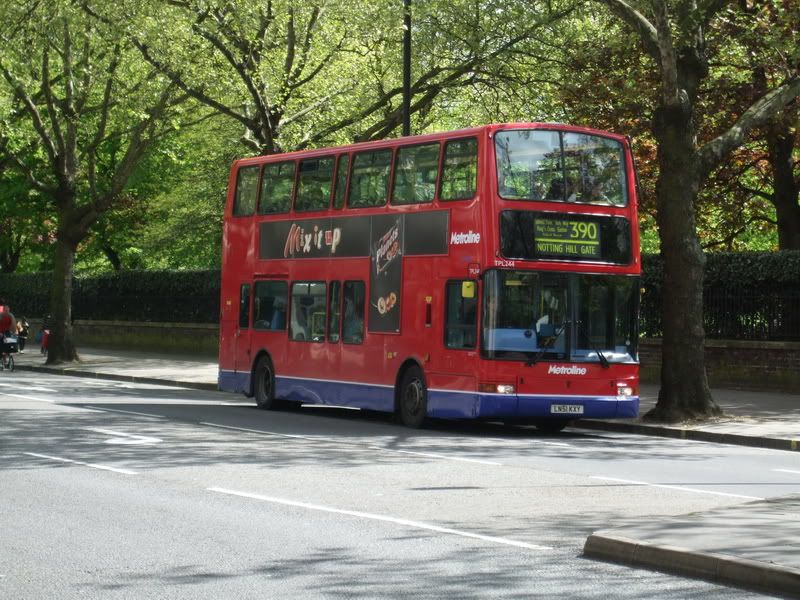
On my home service 390 - much like the Singaporean 390 in the
past, this one is quite an anomaly in service number range amongst
the services plying the heart of Central London.

At Marble Arch, a VP on Service 6 leads a VPL behind. Spot the
difference!

A line of VPs laying over on Service 98 at Holborn. There are
few bus stations around central London, so bus stands (the
equivalent of our roadside terminal, but without any form of
timekeeper or control office) such as these are very common. Buses
do not pick up nor set down passengers from such bus stands; they
have to proceed to/from the first and last stop of the route.

What's a London bus operator without Alexander Dennis Enviro
400? TE681 captured at Euston bus station.

And TE977, from a more recent batch sporting the new livery
style. 
But my personal favourite remains the SELs - Scania N230UD in
very stylish East Lancs Olympus 10.8m bodies. A very small batch of
26 was purchased, almost exclusively deployed on Route 7.

Comfortdelgro's headquarter address in London

Eh did anyone notice the last pic of the bus rims??I jus noticed
after observing the pic clearly tat the axles has the exact same
band tied between the axles which the sbst buses also nw currently
has..So the sbst buses followed tis style from their london
counterparts?? :P