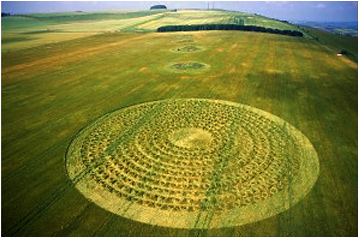
There are a number of observations that have been made over the
years that seem to indicate that there are particular
characteristics that "genuine" (or non-mandmade) formations appear
to exhibit. Some of the observations are listed below:
In what kind of crops do they occur?Crop circles have been reported
in mostly barley and wheat. But, they also appear in corn, oats,
oilseed rape (canola), grass, ricefields, trees, sand, and even
snow.
Where do they appear? They have appeared on almost every continent
and in over 70 countries worldwide -- including the US, Canada,
Australia, Brasil, Russia, India, Germany, and South Africa. There
seems to be a correlation with many forming near ancient
sites.
Physical changes of plants and soil - not only does the physical
appearance of seem to change (it looks dehydrated), but there is
change at the molecular level. Research has been conducted over a
ten year period with samples and thorough laboratory testing
carried out by the biophysicist Dr. Levengood, Nancy Talbott, and
John Burks -- the BLT Research Team, and a small army of volunteers
worldwide. Their findings include enlarged cell walls, expulsion
cavities in the nodes of the plant stalks, significantly extended
node lengths, and changes to the soil composition (ie. vastly
higher level of magnetite concentration) from samples taken within
the crop formations in contrast to the control samples taken from
outside the circles.
Reported increase in crop yield - Some farmers and researchers have
independently reported greater yield in the years following the
appearance of formations in their fields. In 1997, Tim Carson who
farms East Field (where the "DNA" formation appeared in 1996)
reported to researchers that his yield was up 30-40%. The increased
yield that usually only comes with annual rehybridization (done in
labs) remains the same level even in up to 5th generation crops
coming from crop circles, according to researcher Steve
Purkaple.
Swirl in multiple directions - many formations have complex woven
patterns of the swirled crops. Not only do the plants in the
formation swirl clockwise or counter-clockwise, but sometimes
certain sections will swirl one direction and layers on top are
going another direction. They sometimes even have multiple layers
swirled in different directions.
Woven stalks - Other times the stalks are actually woven like a
piece of loose cloth on the floor of the formation. This has been
observed by various researchers in the UK.
Selective swirling - Even though the edges are clearly defined,
sometimes stalks from the outside edge are pulled into the
formation. This doesn't seem to be too unusual, but actually
certain stalks from the middle of a grouping of plants gets pulled
in. The ones closest to the formation do not. And this occurs
around the entire edge of the crop circle. Very meticulous!
Equipment malfunctions - There have been numerous reports of
electronic equipment failing in crop circles and compasses spinning
out of control in & over the crop circles (when flying over in
aircraft). This range of equipment includes watches, mobile phones,
batteries, cameras... fortunately no pacemakers yet! No
explanations for these occurences, other than the indication of a
strong EM field distortions.
Formations "transform" into new patterns - There have been
instances where certain formations take on an entirely different
appearance as they continue to grow in the field. For example, one
formation got a wavy look within the center of the circle that
wasn't there originally.
Unusual bending of plant stalks - It's a widely publicized fact
that plants within a formation actually bend at the naturally
occuring nodes 90 degrees. This can also happen in hoaxed
formations where the plant is pressed to the ground and "bends" to
reach towards the light. This process known as phototropism is more
pronounced in younger stalks, often reaching up towards the light
in 1-2 days. However, what isn't well-known is that there is more
than one possible place for bent nodes. Some formations have had
stalks all bent from the same node (there are up to a half dozen
nodes on one plant). Some formations show bending at the knuckle
closest to the ground, yet in a neighboring section they all bend
two knuckles up and so on. In the line of ~24 circles in Windmill
Hill in 2000, virtually all the stalks were bent 1/4" beneath the
nodes, though at completely different heights (1" to 6" range) from
the ground. This means that each stalk would have to be bent
individually to give that effect.
Occur far from any tramlines - many formations and plain circular
"grapeshots" often occur in the middle of fields far from any
tramlines without any disturbance of the surrounding crop (which is
detectable). Good example is the 1996 formation in Basingstoke,
Hampshire where a circle with a ring was put inside the middle of
an organic oilseed rape field that had no tramlines at all and the
crop was 4-5 feet tall!
Formations occur inside restricted areas - numerous accounts of
crop circles appearing inside military installations that are
fenced off (quite securely!) from the surrounding area. Most
noteably in Wiltshire along the Salisbury Plain. Are Doug and Dave
in the Army?
Geophysical features - One common denominator of many of the crop
formations is that they occur over underground water supplies and
land situated above chalk beds, according to researcher Steve Page.
Water is a good conductor of electrical current, and could possibly
be channeling the electromagnetic currents of the Earth (which is
what dowsers attempt to detect). This observation may have
something to do with how some crop circles are formed.
Sacred geometry - Researchers have discovered layers within layers
of information contained in the crop circles themselves. There are
sacred ratios, such as phi, that governs the growth process of all
organic life. This is an area that requires more attention and
resources, as perhaps this understanding could reveal a message or
at least "higher intelligence" behind these artistic
patterns.
Physical side effects - Many people mention having some sort of
physical reaction (positive or negative) during and after a visit
to a crop formation. Side effects range from nausea, headaches,
dizziness, tingling sensations, pains amd giddiness... to getting
literally knocked off their feet! Sometimes the effects are felt
only after leaving the formation, such as sickness or disruption to
the mentrual cycle, which could be affected by the surge of
energies absorbed from within the formation.
Alignment with natural features of the land - This isn't apparent
from the ground, but aerial photographs have shown that often
formations are imprinted on the earth in alignment with tram lines
or even darkened sections on the earth. This is an impossiblity
without been able to see "the big picture" before permanently
laying out the design.
See what i mean~?