"Your face, my thane, is as a
book where Men may read strange matters."
--William Shakespeare Macbeth
Human beings possess three bodies.
First, there is the physical body, which you can see and is
tangible. It is solid and has a shape, a color and a texture. The
second and third bodies are the mental and the spiritual which are
intangible and merge with the physical body. Our true nature begins
to take on a physical form in our face. It is where our emotions
and our state of health are first revealed. And, as Shakespeare
pointed out in his play Macbeth: Theres no art to find the minds
construction in the face. For the face is truly an opened
book.
For thousands of years, the ancient sages wondered if our facial
features could determine our fate or personality. They began to
compile individual studies, one feature at a time, to see if there
was a direct correlation between facial features and specific
fates. In ancient Greece, Aristotle wrote extensively on
physiognomy categorizing his findings into six chapters that
included physical characteristics of face, body & voice. The
Classical scholars, such as Homer and Hippocrates, wrote of face
reading as an ancient method of practical philosophy. In the Middle
Ages physiognomy was combined with astrology and became part of the
divination arts. By the 18th & 19th century it was used in
Europe as a separate study of criminology where facial features
were used to identify potential criminals. In the 20th century it
was lost to folklore and superstition. But, face reading has
reemerged in the 21st century as a guide in psychoanalysis or, as a
tool for a competitive edge in the executive boardrooms of
corporate America. It is no longer a parlor game. The continuos
interest in face reading has given credence to an art that the
Chinese have always known has been an important guide in human
understanding.
In China, the father of face reading is often credited to the
philosopher Gui-Gu Tze, who lived during the Warring State Period
(481-221 BC). His book Xiang Bian Wei Mang is still in print to
this very day and is studied by serious students of
physiognomy.
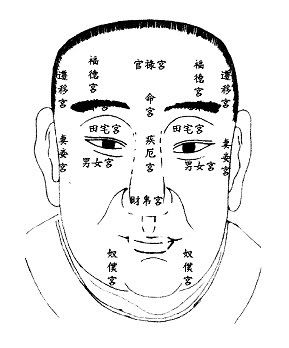
The Chinese art of face reading is a very involved system that
classifies facial features individually by judging the color, shape
and disfigurements of specific areas of the face. Basically, the
face is partitioned into 108 areas. Each area is a specific age
& life situation and by observing the Five Elements of the
productive/destructive cycle and the Taoist theories of yang &
yin, it may be possible to predict events, diagnosis illnesses or
to understand a persons personality.