Originally posted by En':
The Star of Life
A Historical and spiritual history of the Pentagram
by Sharynne NicMacha
Imagine the perfect apple, ripe and bursting with life. Sliced in
half, it reveals a beautiful five-point symmetry-a star formed by
the seeds inside. In fact, each of these five seeds may be seen to
contain a symbolism of its own mirroring the spiritual aspects of
this universal symbol: idea, sustenance, life, secret knowledge and
the hidden mysteries within the earth. Why has this beautiful and
potent emblem, the five-pointed star or pentagram, become such a
misunderstood and stigmatized symbol in these times of re-emerging
enlightenment?
In the tale of Adam and Eve, the apple signified hidden knowledge,
which was forbidden to human kind. Other early cultures encouraged
holy and learned persons in their search for divine wisdom. For
example, the Vedas state that the universe and ourselves are One,
and that by realizing this and tapping into that Universal energy
and state, we achieve wholeness and bliss. These concepts were
known to many ancient civilizations. For most of the western
culture, sacred knowledge was designated as the right of the One
Deity only. It was considered heretical to study the Divine
workings of the Universe. The apple signified that which we should
not attempt to know, and many attempts over the centuries to obtain
knowledge of the Universe (and therefore, ourselves) were
suppressed. The pentagram in its modern guise as the pentacle was
also a target of this subjugation.
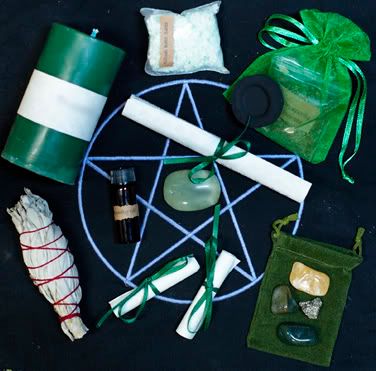
For modern-day Pagans, the Pentacle contains many wonderful layers
of symbolism. The five points symbolize the four directions with
the fifth point as the sanctity of Spirit, within and without. The
circle around the star symbolizes unity and wholeness. It
represents the quest for Divine Knowledge, a concept which is
ancient in origin and universal in scope from the earliest written
ritual texts in Babylonia, to the Celts, to the Native American
traditions. Similar to other figures which are made of a single
unbroken line, this symbol is used to mark off magical enclosures
or ritual areas, especially when used for invocation of deities or
spirit.
The pentagram is one of the most powerful and popular symbols used
by many Neo-Pagans, including those involved in Wicca and
Ceremonial Magic. In working magic, Pagans may draw the shape of
the pentagram in the air with the athame, or sacred blade,
sometimes in the four directions as part of the ritual. A physical
pentacle in the form of a flat disc is often the a main feature of
the altar and is a widely used ritual tool. The symbol is used to
decorate magickal tools or items such as a chalice, cauldron, or
the handle of the athame itself. For some it represents feminine
energy relating to the Goddess and may be used to bind elemental
spirits of the earth as well as to hold consecrated objects such as
herbs, amulets and crystals. The spoken or chanted text of a spell
or invocation may be repeated five times to help insure its
effectiveness. (3, 5, 7, 9 and 13 being some of the most commonly
used repetitions in this context). The pentacle is worn both
ornamentally and symbolically by many Pagans for protectioIn and to
signify that they are involved in the world of magick and divine
wisdom.
It is interesting to note that five-fold symmetries are rarely
found in non-organic life forms but are uniquely inherent to life,
as in the form of the human hand, a starfish, flowers, plants and
many other living things This pattern of five exists even down to a
molecular level. Five, therefore, embodies the form and formation
of life, the very essence of life.
The pentagram is a very widespread sacred symbol used since ancient
times in many areas including Egypt, India, Persia and Greece.
Almost all cultures had a five-fold symbol, which was very
important to their religious and spiritual life. The sacred nature
of five, the important nature of "five-ness" is amply attested to
in Celtic tradition from which much of modern Paganism is derived.
Five appears in numerous Celtic contexts: Ireland had five great
roads, five provinces and five paths of the law. The fairy folk
counted by fives, and the mythological figures wore five fold
cloaks.
In the ancient Irish tale, "Cormac's Cup of Gold", the hero "saw a
royal fortress with four houses in it, and a bright well with nine
ancient hazels growing over it. In the well, were five salmon who
ate the nuts that dropped from the purple hazels, and sent the
husks floating down the five streams that flowed therefrom. The
sound of the streams was the sweetest music...The spring was the
Well of Knowledge, and the five streams the five senses through
which knowledge is obtained. No one will have knowledge who drinks
not a draught out of the well itself or out of the streams. Those
who are skilled in many arts drink from both the well and the
streams."
In another part of the world, around 500 B.C.E. (Before Current
Era) lived Pythagoras, an unparalleled scholar, teacher and leader
renowned for his knowledge of arithmetic, music, government and
sacred geometry. He tapped into the divine mysteries, and, like the
ancient Celts, (and many Neo-Pagans) learned from and existed
comfortably between both worlds.
Pythagoras set up a school where he taught many people, both male
and female, who flocked to him in pursuit of divine knowledge.
Unfortunately, the school was suppressed in a brutal fashion for
political reasons. After this, his followers and the knowledge
itself were forced underground, Pythagoreans considered the
five-pointed star to be a symbol of life and of the divine human.
Therefore, it became the secret sign of the pythagorean followers,
"so that they may know each other."
The Pythagorean schools continued on in secret and from this line
of descent came the Gnostic and Hermetic Mystery Schools (which
contained both men and women and were Christian to varying
degrees), as well as the Masonic Guilds, expert stone-masons
initiated into Mystery Schools learning which included sacred
geometry. Even though the Church considered the Masons to be quite
heretical, they hired them to build the most sacred structures in
Europe- the great cathedrals-many of which contained pentagonal or
five-fold symmetries. Parallel with Masonic culture were the
alchemists of medieval Europe, scientists, philosophers and
magicians, both male and female, who studied the mysteries of the
Universe. These societies held onto this five-fold symbol which
kept its positive, ancient attributes and signified hidden,
luminous knowledge.
This ancient wisdom lived on underground through the mystery
schools and other sources and continued throughout the Middle Ages
up until modern times. However, because this Divine knowledge
threatened the authority and power of the Church, those who pursued
it and the symbols they used were severely persecuted.
The star of life, which had been a symbol of divine illumination,
became stigmatized as a sign of heretical thought and eventually as
something evil. These negative attributes were further reinforced
by the use of the upside down pentagram by some satanic cults who
are probably more "Anti-Christians" than "Pagans". As their beliefs
are not those of most Neo-Pagan groups. Modern media continues to
distort the meaning of the pentagram by showing it in both its
upright and inverted position, yet portraying all who use it as
evil.
In spite of this difficulty history, the symbol has survived, and
continues to be used by those who uphold the search for divine
knowledge. The sacred pentagram maintains its many wonderful and
magickal ancient attributes and is still the symbol of life it has
always been.