The horse-shoe, whether as an
amulet or as a sign of good luck, has nothing to do with the
Christian religion. In either case it is a wholly superstitious
symbol, and savors of paganism; it is in fact an inheritance from
our heathen ancestors, a barbaric token, unworthy even to be named
in connection with the sacred cross. Yet throughout many centuries
it has captivated the popular fancy, and its emblematic use appears
to be as firmly established to-day as ever in many parts of the
world.
It is popularly believed that the chance finding of a horse-shoe
greatly enhances its magical power; and it is claimed, moreover, by
some writers, to be an axiom in folk-lore that talismanic objects
thrust upon one's notice, as it were, are direct gifts from the
goddess Fortune, and hence possessed of a special value for the
finder. Such a notion is as clearly of pagan origin as the custom
of bowing to the new moon, or of fixing representations of horses'
heads upon the gables of houses in order to terrify wandering
spirits of evil.
In "Curiosities of Popular Customs," by William S. Walsh ( p. 665,
1898 ), it is stated that the Northern peoples were wont to offer
sacrifices to Wodan after the harvest, and that the little cakes
still baked on St. Martin's Day, November 11, throughout Germany,
are shaped like a horn or horse-shoe, which was a token of the
pagan god. Although not susceptible of proof, it seems highly
probable that we have here another relic of idolatry. It is a point
worthy of note, moreover, that Wodan was not only an all-powerful
deity, corresponding to the Greek Zeus and Roman Jupiter, but that
he was also a great magician, and hence quite naturally the
horse-shoe, as one of his symbols, inherits magical
attributes.
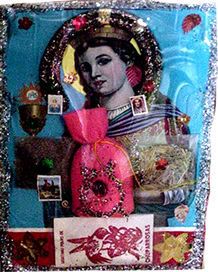
In Tuscany a horse-shoe when found is placed in a small red bag
with some hay, which the Tuscans consider also a luck-bringing
article, and the twofold charm is kept in its owner's bed.
Dr. Robert James, an English physician of the eighteenth century,
and the inventor of a well-known feverpowder, ascribed his success
in acquiring a fortune to his good luck in having once found a
horse-shoe on Westminster Bridge. The sincerity of his faith was
attested by the adoption of the horse-shoe as his family
crest.
Brand quotes from John Bell's MS. " Discourse on Witchcraft" (1705)
as follows:--
Guard against devilish charms for Men or Beasts. There are many
sorceries practiced in our day, against which I would on this
occasion bear my testimony, and do therefore seriously ask you,
what is it you mean by your observation of Times and Seasons as
lucky or unlucky? What mean you by your many Spells, Verses, Words,
so often repeated, said fasting or going backward? How mean you to
have success by carrying about with you certain Herbs, Plants, and
branches of Trees? Why is it that, fearing certain events, you do
use such superstitious means to prevent them, by laying bits of
Timber at Doors, carrying a Bible merely for a Charm, without any
farther use of it? What intend ye by opposing Witchcraft to
Witchcraft, in such sort that, when ye suppose one to be bewitched,
ye endeavour his Relief by Burnings, Bottles, Horse-shoes, and such
like magical ceremonies?
In some Roman Catholic countries the priests are wont to brand cows
and pigs on the forehead with the mark of a horse-shoe, to insure
them against disease. It was, moreover, an old Scotch superstition,
or freet, to pass a horse-shoe thrice beneath the belly and over
the back of a cow that was considered elf-shot.
Among the Wendish inhabitants of the Spreewald, in North Germany,
the lucky finder of a horse-shoe is careful not to tell any
neighbor of his good fortune, but proceeds at once to fasten the
shoe over the door of his house, or on the threshold, with three
nails, and by three blows of a hammer, so that evil spirits may not
enter.
We have seen that a horse-shoe picked up on the road is often
prized as no mean acquisition by the finder thereof. It may not be
out of place to give here a literal translation of a spell for the
protection of a horse's hoof when a shoe has been lost. The
original appeared in Mone's "Anzeiger" in 1834, and is written in
the dialect known as "Middle High German," which was in vogue from
the twelfth to the sixteenth centuries:--
When a horse has lost one of its iron shoes, take a breadknife and
incise the hoof at the edge from one heel to the other, and lay the
knife crosswise on the sole and say: "I command thee, hoof and
horn, that thou breakest as little as God the Lord broke his Word,
when he created heaven and earth." And thou shalt say these words
three hours in succession, and five Paternosters and five Ave
Marias to the praise of the Virgin. Then the horse will not walk
lame until thou happenest to reach a smithy.
The Germans have a saying in regard to a young girl who has been
led astray,-- "She has lost a horseshoe." This saying has been
associated with the shoe as a symbol of marriage, an idea found
both in the northern and Indian mythologies. But the phrase has
been also thought to refer to the horse-shoe shaped gloria which
crowns the head of the Virgin, the horse-shoe thus becoming the
symbol of maidenly chastity. Again, it has been suggested, in
reference to the same phrase, that the horse-shoe is a symbol of
the V (or first letter of the word Virgo), which is used in church
records to designate the unmarried state, just as the word
"spinster" is used in legal documents.
The ancient Irish were wont to hang up in their houses the feet and
legs of their deceased steeds, setting an especial value upon the
hoofs; and with the Chinese of to-day a horse's hoof hung up
indoors is supposed to have the same protective influence over a
dwelling that a horse-shoe has elsewhere. In southwestern Germany
it is still a common practice to nail a hoof over the stable-door;
and in the Netherlands a horse's foot placed in a stable is thought
to keep the horses from being bewitched.
Burton, in his "Anatomy of Melancholy," admits a belief in the
virtues of a ring made from the hoof of the right foot of an ass,
when carried about as an amulet.
Occasionally, though rarely, the horse-shoe is thought to have been
employed by the witches themselves in furtherance of their
mischievous designs.
In the "Revue des traditions populaires," vol. ii. 1887, an
anecdote is related of a veteran Polish cavalryman who had served
under Napoleon I. While bivouacking with a detachment of lancers in
a village of eastern Prussia, he and several others lodged in the
house of an old peasant woman, and their horses were accommodated
in her barn. It was shortly noticed that the animals appeared
depressed and refused the hay and grain provided for them,
whereupon the soldiers concluded that they were under some spell
and began a search for the cause. They soon found an old horseshoe
with three nails remaining in it, and one of these was quickly
driven out with a hammer. Instantly the horses began to snort and
exhibited signs of restlessness. On the removal of the second nail
they held up their I-leads proudly, and when the third nail was
hammered out they fell upon their provender and devoured it
voraciously. The cavalrymen were now convinced that their horses
had been the victims of some deviltry at the hands of their
hostess, whom they believed to be a sorceress. Before their
departure, therefore, they gave her a good beating with their sabre
scabbards to teach her not to practice her nefarious arts upon the
horses of honest people.