Goddess worship dates back to
Paleolithic times. Many anthropologists speculate the first "God "
or gods of the peoples were feminine. This coincides with ancient
creation myths and beliefs that creation was achieved through
self-fertilization. Within the concept of creation the
participation of the male principle was not known or recognized
yet. The Goddess was believed to have created the universe by
herself alone.
From this belief came the agricultural religions. It was thought
that the gods only prospered by the beneficence and wisdom which
the Goddess showered on them. Evidence appears to indicate most
ancient tribes and cultures were matriarchal.
Although this maybe true, there seems to be little evidence that
the feminine portions of these societies held themselves superior
over their male counterparts. Generally Goddess worship had been
balanced by the honoring of both the male and female Deities. This
is illustrated by the belief in and the observance of the sacred
marriage of the Sky God and Earth Mother in many global
societies.
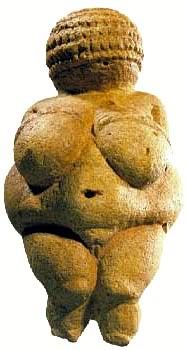
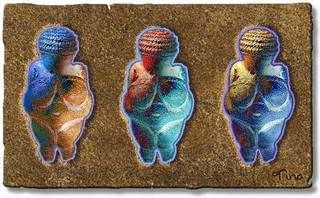
Among the first human images discovered are the "Venus figures,"
nude female figures having exaggerated sexual parts that date back
to the Cro-Magnons of the Upper Paleolithic period between 35,000
and 10,000 BC.
In southern France is the Venus of Laussel which is carved in
basrelief in a rock shelter. This appears once to have been a
hunting shrine which dates to around 19,000 BC. In this carving the
woman is painted red, perhaps to suggest blood, and holds a bison
horn in one hand.
Also in Cro-Magnon cave paintings women are depicted giving birth.
"A naked Goddess appears to have been the patroness of the hunt to
mammoth hunters in the Pyrenees and was also protectress of the
hearth and lady of the wild things."
Other female figurines were discovered dating back to the
proto-Neolithic period of ca, 9000 - 7000 BC, the Middle Neolithic
period of ca. 6000 - 5000 BC, and the Higher Neolithic period of
ca. 4500 - 3500 BC. Some of these figurines were decorated as if
they had been objects of worship. In black Africa were discovered
cave images of the Horned Goddess (later Isis, ca. 7000 - 6000 BC).
The Black Goddess images appeared to represent a bisexual,
self-fertilizing woman.
During the predynastic Egyptian period, prior to 3110 BC, the
Goddess was known as Ta-Urt (Great One) and was portrayed as a
pregnant hippopotamus stand on her hind legs.
The Halaf culture around the Tigris River, ca. 5000 - 4000 BC, had
Goddess figurines associated with the cow, serpent, humped ox,
sheep, goat, pig, bull, dove and double ax. These things were known
to the people and became symbols representing the Goddess.
In the Sumerian civilization, ca. 4000 BC, the princesses or queens
of cities were associated with the Goddess. A king was associated
with God.
Throughout the eons of history the Goddess assumed many aspects.
She was seen as the creatress, virgin, mother, destroyer, warrior,
huntress, homemaker, wife, artist, jurist, healer and sorcerer. Her
roles or abilities increased with the advancement of the cultures
which worshipped her.
She could represent a queen with a consort, or lover. She might
bear a son who died young or was sacrificed only to rise again
representing the annual birth-death-rebirth cycle of the
seasons.
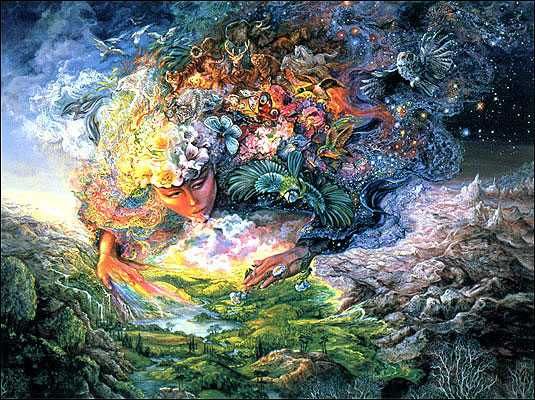
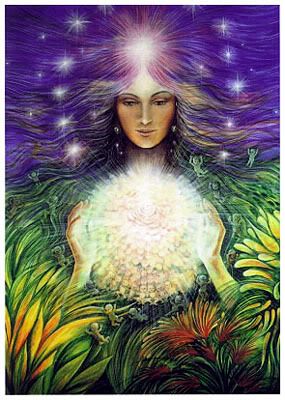
Throughout the centuries the Goddess has acquired a thousand names
and a thousand faces but most always she has represented nature,
she is associated with both the sun and moon, the earth and the
shy. The Goddess religion, usually in all forms, is a nature
religion. Those worshipping the Goddess worship or care for nature
too.
Concerning the thousand names of the Goddess. The first is that
"Every female divinity in the present Encyclopedia may be correctly
regarded as only another aspect of the core concept of a female
Supreme Being." "If such a system had been applied to the usual
concept of God, (giving him the different names and titles which
people throughout the centuries have attributed to him), there
would now be a multitude of separate 'gods' with names like
Almighty, Yahweh, Lord, Holy Ghost, Sun of Righteousness, Christ,
Creator, Lawgiver, Jehovah, Providence, Allah, Savior, Redeemer,
Paraclete, Heavenly Father, and so on, ad infinitum, each one
assigned to a particular function in the world
pantheon."