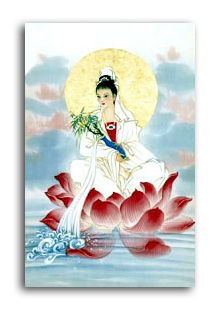
~*~Legendary Flowers Blooming on Buddha Statue
~*~
By Cho Sang-hee
Senior Writer
October 20, 2000
UIWANG, Kyonggi-do, South Korea--
They have not seen a miracle yet, such as the healing effects of
Lourdes. But for monks and people visiting Chonggye-sa Temple in
this suburb of Seoul, it is an unprecedented mystery on the shining
gilded statue of the Buddhist deity, often compared to the Madonna
in Christianity.
The enigma is that more than a score of tiny white flowers are
blooming on the forehead of Kuanyin Bodhisattva, enshrined in this
age-old temple perched on Mt. Chonggye in South Korea.
According to Buddhist literature, the legendary flower called
"`Udambara'' (Udumbara-pupsa in Sanskrit) blooms once in 3,000
years, as told by the Lotus Sutra. Religious Indians believe the
blooming takes place when the Sage King of Future comes to the
world.
"It is a sheer delight that gives you a feeling beyond
description,'' said the Rev. Chongsang, chief abbot of
Chongye-sa.
He added, "I hope this joyful experience of `hwanhisim' be shared
by most people, including those who have suffered.''
"This an auspicious sign and a wake up call for us to undertake our
responsibility of turning this country into a pure land,'' said the
senior Chogye Order priest, who is also managing Sokkuram Grotto
and serves as deputy chief of the Silla temple Pulguk-sa, a
Unesco-registered World Heritage Site.
The discovery on the tip of the eyebrow of the Buddha-to-be
"Kwanseum-bosal'' was made on Oct. 6 by a laywoman believer, Lee
Kyong-sun, 40 while praying at the main Buddha hall.
According to monks, it now grows in upright arrays of 21
thread-like twigs that each are one centimeter in length, with a
tiny white flower no bigger than the tip of a ball-point pen.
People say it is up to each individual to interpret its true
meaning.
Some even try to make its association with President Kim Dae-jung's
winning of the Nobel Peace Prize last week. Couldn't it also be a
good omen for the success of of Seoul's ASEM summit? Ranging from
political prospects for such issues as national unification to
personal wishes, people seem to be very hopeful before the statute
with its extraordinary appearance.
Does the image have any healing power? So far, nobody has made that
kind of claim, yet many hope for exactly that kind of
occurrence.
The Rev. Chongsang said, "You may feel a difference between here
and other places of meditation, as you sit before the Kuanyin
statue.'' He explained that he himself feels ki, or energy, in his
body, as well as more depth and concentration in his mind.
Does this make it possible to make a comparison to the Grotto of
Massabielle, in Lourdes of Southern France, where a poor
14-year-old girl, Bernadette Soubirous, met the Virgin Mary during
the 18 apparitions that began in 1858.
More than five million people, many of whom are sick and
handicapped, come to Lourdes from every country of the world. They
go there for several reasons, such as due to curiosity, a desire to
be physically cured, a passion to express their faith, or to
provide service to those who suffer. Lourdes today is called a town
of friendship, world center of pilgrimage and a special place of
meeting, with God and people.
What is the popular reaction to the Chonggye-sa apparition?
According to monks at the temple, some 7,000 pilgrims are visiting
the temple on the hill of Mt. Chonggye daily, as the word spreads
via the media and Buddhist community members. Due to the traffic
jams on the access road, some people park their cars and walk to
the temple. The 3-kilometer entrance will be expanded and paved
next year, with construction work already underway.
Many lay visitors and priests have made the pilgrimage from far
away. Former president Chun Doo-hwan, who had spent the days after
his resignation at Mt. Sorak's Paekdam-sa Temple, visited the
temple on Wednesday.
The temple (phone:031-426-2348, fax:031-426-3666, address:#San 11,
Chonggye-dong, Uiwang City) is accessible from Uiwang via Kwachon
and Pangyo, the southern portal cities of Seoul. The temple belongs
to the Chogye diocese supervised by Yongju-sa Temple in
Suwon.
It is on the southern slope of Mt. Chonggye, a 618-meter-hill whose
eastern side faces the Seoul-Pusan Expressway, and the northwestern
foothills are the location of the National Contemporary Art Museum,
Seoul Grand park and the horseracing track.
Chonggye-sa Temple was founded in the Silla period, but its reached
its greatest expansion in 1284, during the reign of Koryo King
Chungnyol by Cho In-gyu, a rich layman. At that time, more than 100
monks resided while it was developed under the patronage of Cho. In
1407, during the early Choson peri d, the dynasty's government
designated it as a "very fortunate temple.'' During the rule of
Yonsan-gun, when the king banned temples in the walled capital, the
temple came to assume the role of Zen monastery, instead of
Pongun-sa at the south of the Han River.
"Its tradition as a Zen monastery has continued at Chongye-sa until
modern times,'' said the Rev. Chongsang, citing such great Buddhist
masters as Vens. Kyongho, Mangong and Kumo.
For example, Ven. Kyongho, of the early last century, is legendary
for his extraordinary life and teaching as a Zen master.
Many of their disciples are leading figures in the monks' Chogye
Order, the nation's largest Buddhist sect.
"I believe the phenomenon of our temple's statue has a connection
to the great teachers of the past,'' said the chief abbot.
The temple is going to hold a series of masters' sermon meetings,
with high-ranking monks invited. The number of teachers, 21,
corresponds with the number of the flowers in bloom. It will last
for more than 100 days, with weekly shifts of the sermon
speakers.
They believe that 21 flowers will bloom on each of the 21 twigs.
The chief monk said, "We will wait and see.''
In an act of acknowledging the mysterious occurrence, Ven.
Chongdae, chief executive of the Chogye Order, attended the
ceremony Wednesday to initiate the 108-day Buddhist meeting and
sighting of the flowers. It will last until Feb. 1 of next year.
Already some 20 persons have kept vigils at the the Buddha
Hall.
The temple and the municipality of Uiwang look forward to the
increase of visitors, including Buddhist pilgrims from across the
country and possibly from abroad.
Gov. Kim Chang-yuel of Kyonggi-do Province reminds people that
Korean Buddhism has kept the tradition of national safeguarding in
times of moral chaos, economic difficulty and foreign invasion,
according to history.
"The appearance of Udambara is auspicious sign by the Buddhist
tradition and it is a happy incident to all nation as President Kim
Dae-jung's winning of the Nobel Peace Prize is so to all 70 million
Korean people,'' said Lim in a speech to congratulate the
apparition at Choggye-sa Temple.
It is the first time that as many as 21 flowers of Udambara appear
though the similar kind of phenomenon took place twice recently at
temples in Korea recently, at at a temple in Kwangju, Kyonggi-do,
in 1997 and at Kwangsu-sa in Taejon in July this year.
The Rev. Chongsang, maintained it is almost unthinkable that the
500 year-old Buddhist statute, which might have been gilded every
two to three years over the woodwork, could produce the flower-like
growing things.
Botanically the flower may be in category of Ficus (glomerata), or
fig. However, botanists regard the appearance at Chogye-sa can be
hardly related with the fruitful plant.
In India it is believed as a divine plant along with the bo
tree.
Buddhist daily Popbo Sinmun editor Lee Hak-jong said the floral
appearance is associated with the sage king in India and the best
model of such leader is King Ashoka, the great ancient patron of
Buddhism.
The Lotus Sutra decribed the sighting of the udambara flower is
like seeing the the birth of Buddha and the audience of
Him.
* The above Excerpts
are taken from the Internet without any edits mainly for
informational purposes only. ~*~ LIGHT OF ATLANTIS ~*~ will not be
responsible for any of its contents, misuses or abuses using the
information presented.