Sex in
Ancient Civilizations
Sumeria: Ihe Earliest Records
MYTH, RITUAL AND SEXUALITY were almost inseparable in ancient
Mesopotamia. The earliest deity, the creator-goddess Nammu, meaning
"the sea," was believed to have been responsible for creation by
giving birth to both heaven and earth. In a later era, the myth
changed. Nammu was supplanted by the hero god Marduk who, having
killed her, cut her down the middle and used half of her body to
make the sky. The more familiar, and historically far more
widespread, myth of a masculine god as the supreme creator of the
world was now in place. Although it is impossible to account
definitively for this development, it was probably the result of
invasions of hostile tribes whose values were predominantly
masculine into the areas populated by the early, settled,
goddess-worshipping people.
Such was the importance of the gods in early Sumerian times that
what was considered morally right was for the people almost wholly
identified with what was ritually correct. For instance, it seems
that the gods were quite indifferent to the fact that widows and
orphans fared very badly and suffered oppression. Yet they were in
the habit of becoming very angry if their worshippers ate ritually
impure food. The entire Sumerian culture which dates back to about
5000 BC, was largely underpinned by ritual, much of it explicitly
sexual in nature.
The Sumerians were the first literate people, and their written
remains provide a glimpse into their world view. Some of the clay
tablets, fragments and seals which they inscribed exist to this
day, to tell fascinating stories, including the fragmentary story
of Inanna. Of all the deities, most of whom were personifications
of various aspects of nature, Inanna was the most revered for a
long period. Hers was the realm of love and procreation, in which
she was a forerunner of Anath of Canaan, Isis of Egypt, and the
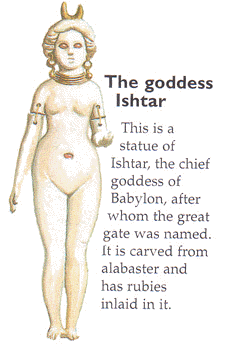
Babylonian goddess, Ishtar, with whom she is sometimes identified.
Inanna herself, it is clear, rejoiced in her sexuality. The story
tells how, "When she leaned back against the apple tree, her vulva
was wondrous to behold." She herself speaks of making love with her
consort, the shepherd Dumuzi, in rhapsodic terms:
"He shaped my loins with his fair hands,
The shepherd Dumuzi filled my lap with cream and milk,
He stroked my pubic hair,
He watered my womb.
He laid his hands on my holy vulva.
He caressed me on the bed."
She addresses him tenderly as "dear to my heart" and "honeysweet"
and is explicit in her desire:
"Bridegroom, let me caress you,
My precious caress is more savory than honey,
In the bedchamber, honey filled,
Let us enjoy your goodly beauty,
Lion, let me caress you,
My precious caress is more savory than honey"
Some experts believe that the references to "honey" may well be the
origin of our "honeymoon" or "honey month."

The sexual union of Inanna and Dumuzi was the prototype of the
Sumerian custom of the "sacred marriage." which was ritually
performed at the New Year festival. This rite later became
widespread in other societies, notably Babylon and Greece. In its
Sumerian form, the high priestess, known as the "Entu," in order to
ensure the renewal of fertility throughout the land, would
ceremonially mate with the high priest or king, who personified the
life force of the earth. In fact, as far as we can tell, the kings
of Sumeria may literally have been sons, fathers and consorts of
the high priestesses. As the representative of the goddess the
priestess would, through sexual union with the king, bestow her
divine power upon him, thereby making him fit to rule. In the
ceremony itself, it fell to the priestess to take the initiative
and grant her heavenly favors, thereby furthering life. For his
part the god-king had to bring her offerings and await her
pleasure: ultimate power was in her keeping. Any child born of such
a union was considered to be half-human and half-divine.
Further fragments of the Inanna story emphasize the importance to
the people of this ceremony. It was the successful performance of
the sacred marriage that guaranteed the renewed growth of all
human, animal and plant life:
"The people of Sumer assemble in the palace,
The house which guides the land.
In order to care for the life of all the lands,
Ihe exact first day of the month is closely examined...
So that the New Yearís Day, the day of rites,
May be properly determined,
And a sleeping place be set up for Inanna."
Inanna is often depicted resting her foot on the back of a lion,
offering the king the symbolic objects indicating his ruling power.
Lions, when associated with feminine deities, represent the
undomesticated, fierce, aggressive aspect of the female. Often such
goddesses incorporate a dual nature, the other side of their
character manifesting compassion and, gentleness. The Buddhist
deity Tara is another example. Although primarily benevolent and
merciful she is often represented as a fierce, warlike goddess. But
it is precisely because of her lion-like power that she is able to
confront dangerous forces and this gives her the ability to protect
her followers from suffering.

* The above Excerpts
are taken from the Internet without any edits mainly for
informational purposes only. ~*~ LIGHT OF ATLANTIS ~*~ will not be
responsible for any of its contents, misuses or abuses using the
information presented.