There are many words and phrases peculiar to the belief in
Voodoo. Here are but a few of the more significant ones.
Gran Met, Olorun, or
Grand Master.
These are terms for the highest god in the religion of the West
African tribe Yoruba. This belief in Gran Met continued in Saint
Domingue (Haiti), where Voodoo was transformed and spread to New
Orleans. There are lesser spirit gods in Haitian Voodoo as well,
called Obatala and Oduduwa. Obatala formed the earth and created
humans, and fought with Oduduwa, who also sought to create worlds.
Obatala lost the struggle, but was eventually asked to rule over
the earth with his former adversary. The Yoruba celebrated the
peaceful settlement between the two gods. Additionally, there are
lesser spirits called "orisa" who were once human but became holy
and immortal spirits upon death; they are the counterpart to saints
in Christianity. Ogun is the most powerful of the orisas; he is the
spirit of iron and war. He is also invoked to aid in hunting. A
"loa" is also a spirit in Voodoo; loas can carry messages from
humans to the gods, it is said.
Bokor, Houngan and
Mambo.
In Haitian Voodoo, the bokor is a Voodoo priest who performs magic
for pay. The houngan (a male priest) and the mambo (a female
priest) are skilled in Voodoo magic as well, but accept no pay. In
New Orleans Voodoo, the female Voodoo queen accepted pay and was
more powerful than her male counterpart, the Voodoo doctor, who was
also paid.
Mojo and
Juju.
In New Orleans Voodoo, mojo was a negative and juju was a positive
form of spell or hex. This was similar to the difference between
Black and White Magic. Gris-Gris, meaning "grey" in French, could
be either mojo or juju.
Zombie or
Zombi.
These were the living dead, soulless beings brought back to life by
the Voodoo priest in Haitian Voodoo. Or perhaps they were persons
under the influence of a natural herb narcotic who were subjected
first to a simulated death, then to more natural drugs which turned
them into semi-conscious beings, hence zombies. Primarily the
zombie was known in Haitian Voodoo.
Li Grand Zombi, Maison
Blanche, Bayou St. John, St. John's Eve.
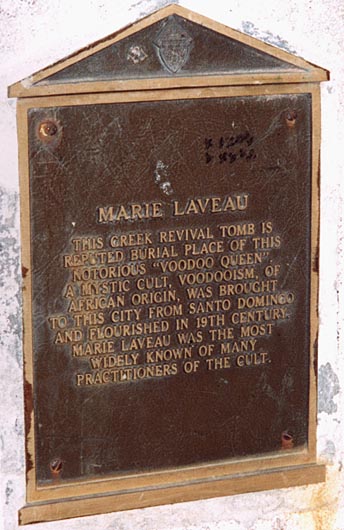
Li Grand Zombi was the name of Marie Laveau's snake who was
worshipped at Voodoo rituals. Maison Blanche was the name of
Laveau's cottage near Lake Pontchartrain. Bayou St. John was the
site of the natural waterway in New Orleans where Marie held her
spectacular Voodoo rituals. St. John's Eve, June 23, was the day
the biggest Voodoo gatherings were held where even members of
"polite society" were invited including reporters, prominent
citizens, and the police. It is also the day that some believers
claim the ghost of Marie Laveau rises from the dead.
Dambala.
This was the loa or spirit god of the snake, popular in New Orleans
Voodoo.
Voudou, Vodu,
Vodun.
The magic that Marie Laveau performed was based on an ancient
religion from a distant land. What we today call Voodoo and think
of as mere superstition was actually an animist religion called
Vodu or Voudou, originating in West Africa with the Yoruba tribe
and on the Caribbean island Saint Domingue. It had arrived in New
Orleans during the French colonial period with the slave trade. In
1718, Nouvelle Orleans was founded by the Quebecois explorer
Bienville, and from those early days this belief in spirits and the
power of nature had been the strength of the enslaved. Eventually,
even the Europeans and the Creoles in New Orleans (natives of
European origin, French and Spanish) came to fear Voodoo. The
leaders in Voodoo were the male doctors (like Dr. John) and the
female queens who eventually reigned supreme in New Orleans.
All Voodoo is said to have roots in the West African spirit-based,
snake-worshiping, animist faith called "Vodu" (possibly from the
Dahomey tribe); Vodu was a term which meant "the gods." Animism was
a belief in spirits who lived in nature and resided in natural
objects, such as in trees.
Santeria.
This is a form of Voodoo which incorporates elements of Catholicism
and comes from Cuba. Other Caribbean islands have developed their
own form of beliefs. Obeah is Voodoo from Jamaica, while Shango is
Voodoo from Trinidad.
Charm, chicken bones,
coffin.
A Voodoo charm is possessed by a spirit and has special powers;
such a charm can be positive or negative. Chicken bones were used
in Black Magic to summon forth evil spirits. A small replica of a
coffin or casket could also be used to summon evil spirits.
Souls.
In Voodoo a person has two souls, the gros bon ange and the ti bon
ange. The first soul, gros, is the energy or force which gives life
to a person, implanted at birth, withdrawing at death; it is
universal in all humans. It seems to function as in reincarnation
for it returns to the Gran Met at death to a soul reservoir from
which newly born humans obtain fresh souls.
The latter soul, ti, operates during a person's life, sometimes
leaving the body during sleep. The ti bon ange relates to the
concept of personality and is specific to that individual. It seems
to have the ability to perform "out-of-body experiences" (OBE).
Such OBE's can supposedly occur during Voodoo rituals.
Perhaps a belief in these souls relates to the concept of the
subconscious and the collective subconscious -- this is, however,
merely speculation.

* The above
Excerpts are taken from the Internet without any edits mainly for
informational purposes only. ~*~ LIGHT OF ATLANTIS ~*~ will not be
responsible for any of its contents, misuses or abuses using the
information presented.