Scholars believe that the Buddhist
monk and translator Kumarajiva was the first to refer to the female
form of Kuan Yin in his Chinese translation of the Lotus Sutra in
406 A.D. Of the thirty-three appearances of the bodhisattva
referred to in his translation, seven are female. (Devoted Chinese
and Japanese Buddhists have since come to associate the number
thirty-three with Kuan Yin.)
Although Kuan Yin was still being portrayed as a male as late as
the tenth century, with the introduction of Tantric Buddhism into
China in the eighth century during the T'ang dynasty, the image of
the celestial bodhisattva as a beautiful white-robed goddess was
predominant and the devotional cult surrounding her became
increasingly popular. By the ninth century there was a statue of
Kuan Yin in every Buddhist monastery in China.
Despite the controversy over the origins of Kuan Yin as a feminine
being, the depiction of a bodhisattva as both 'god' and 'goddess'
is not inconsistent with Buddhist doctrine. The scriptures explain
that a bodhisattva has the power to embody in any form--male,
female, child, even animal depending on the type of being he is
seeking to save. As the Lotus Sutra relates, the bodhisattva Kuan
Shih Yin, "by resort to a variety of shapes, travels in the world,
conveying the beings to salvation."
The twelfth-century legend of the Buddhist saint Miao Shan, the
Chinese princess who lived in about 700 B.C. and is widely believed
to have been Kuan Yin, reinforced the image of the bodhisattva as a
female. During the twelfth century Buddhist monks settled on
P'u-t'o Shan--the sacred island-mountain in the Chusan Archipelago
off the coast of Chekiang where Miao Shan is said to have lived for
nine years, healing and saving sailors from shipwreck--and devotion
to Kuan Yin spread throughout northern China.
This picturesque island became the chief center of worship of the
compassionate Saviouress; crowds of pilgrims would journey from the
remotest places in China and even from Manchuria, Mongolia and
Tibet to attend stately services there. At one time there were more
than a hundred temples on the island and over one thousand monks.
The lore surrounding P'u-t'o island recounts numerous appearances
and miracles performed by Kuan Yin, who, it is believed, reveals
herself to the faithful in a certain cave on the island.
In the Pure Land sect of Buddhism, Kuan Yin forms part of a ruling
triad that is often depicted in temples and is a popular theme in
Buddhist art. In the center is the Buddha of Boundless Light,
Amitabha (Chinese, A-mi-t'o Fo; Japanese, Amida). To his right is
the bodhisattva of strength or power, Mahasthamaprapta, and to his
left is Kuan Yin, personifying his endless mercy.
n Buddhist theology Kuan Yin is sometimes depicted as the captain
of the "Bark of Salvation," guiding souls to Amitabha's Western
Paradise, or Pure Land--the land of bliss where souls may be reborn
to receive continued instruction toward the goal of enlightenment
and perfection. The journey to Pure Land is frequently represented
in woodcuts showing boats full of Amitabha's followers under Kuan
Yin's captainship.
Amitabha, a beloved figure in the eyes of Buddhists desiring to be
reborn in his Western Paradise and to obtain freedom from the wheel
of rebirth, is said to be, in a mystical or spiritual sense, the
father of Kuan Yin. Legends of the Mahayana School recount that
Avalokitesvara was 'born' from a ray of white light which Amitabha
emitted from his right eye as he was lost in ecstasy.
Thus Avalokitesvara, or Kuan Yin, is regarded as the "reflex" of
Amitabhaóa further emanation or embodiment of "maha karuna (great
compassion), the quality which Amitabha himself embodies in the
highest sense. Many figures of Kuan Yin can be identified by the
presence of a small image of Amitabha in her crown. It is believed
that as the merciful redemptress Kuan Yin expresses Amitabha's
compassion in a more direct and personal way and prayers to her are
answered more quickly.
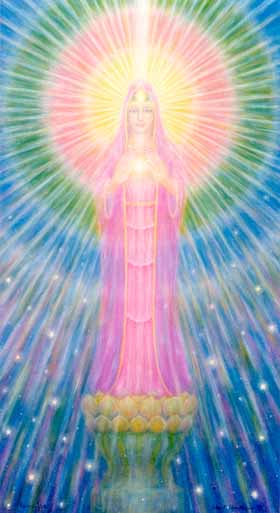
The iconography of Kuan Yin depicts her in many forms, each one
revealing a unique aspect of her merciful presence. As the sublime
Goddess of Mercy whose beauty, grace and compassion have come to
represent the ideal of womanhood in the East, she is frequently
portrayed as a slender woman in flowing white robes who carries in
her left hand a white lotus, symbol of purity. Ornaments may adorn
her form, symbolizing her attainment as a bodhisattva, or she may
be pictured without them as a sign of her great virtue.
Kuan Yin's presence is widespread through her images as the
"bestower of children" which are found in homes and temples. A
great white veil covers her entire form and she may be seated on a
lotus. She is often portrayed with a child in her arms, near her
feet, or on her knees, or with several children about her. In this
role, she is also referred to as the "white-robed honored one."
Sometimes to her right and left are her two attendants, Shan-tsíai
Tung-tsi, the "young man of excellent capacities," and Lung-wang
Nu, the "daughter of the Dragon-king."
Kuan Yin is also known as patron bodhisattva of P'u-t'o Shan,
mistress of the Southern Sea and patroness of fishermen. As such
she is shown crossing the sea seated or standing on a lotus or with
her feet on the head of a dragon.
Like Avalokitesvara she is also depicted with a thousand arms and
varying numbers of eyes, hands and heads, sometimes with an eye in
the palm of each hand, and is commonly called "the thousand-arms,
thousand-eyes" bodhisattva. In this form she represents the
omnipresent mother, looking in all directions simultaneously,
sensing the afflictions of humanity and extending her many arms to
alleviate them with infinite expressions of her mercy.
Symbols characteristically associated with Kuan Yin are a willow
branch, with which she sprinkles the divine nectar of life; a
precious vase symbolizing the nectar of compassion and wisdom, the
hallmarks of a bodhisattva; a dove, representing fecundity; a book
or scroll of prayers which she holds in her hand, representing the
dharma (teaching) of the Buddha or the sutra (Buddhist text) which
Miao Shan is said to have constantly recited; and a rosary adorning
her neck with which she calls upon the Buddha¹s for succor.
Images of Avalokitesvara often show him holding a rosary;
descriptions of his birth say he was born with a white crystal
rosary in his right hand and a white lotus in his left. It is
taught that the beads represent all living beings and the turning
of the beads symbolizes that Avalokitesvara is leading them out of
their state of misery and repeated rounds of rebirth into
nirvana.
Today Kuan Yin is worshipped by Taoists as well as Mahayana
Buddhists--especially in Taiwan, Japan, Korea and once again in her
homeland of China, where the practice of Buddhism had been
suppressed by the Communists during the Cultural Revolution
(1966-69). She is the protectress of women, sailors, merchants,
craftsmen, and those under criminal prosecution, and is invoked
particularly by those desiring progeny. Beloved as a mother figure
and divine mediatrix who is very close to the daily affairs of her
devotees, Kuan Yin's role as Buddhist Madonna has been compared to
that of Mary the mother of Jesus in the West.
It is in truth the same soul.

* The above Excerpts
are taken from the Internet without any edits mainly for
informational purposes only. ~*~ LIGHT OF ATLANTIS ~*~ will not be
responsible for any of its contents, misuses or abuses using the
information presented.