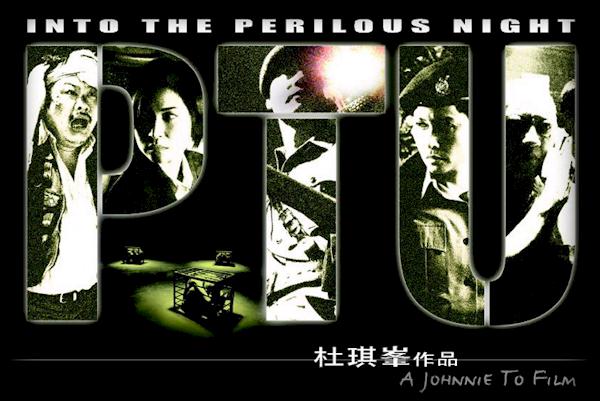
Year: 2003
Director: Johnnie To Kei-Fung
Cast: Simon Yam Tat-Wah, Lam Suet, Maggie Siu Mei-Kei, Ruby Wong
Cheuk-Ling, Raymond Wong Ho-Yin, Eddy Ko Hung, Wong Tin-Lam, Lo
Hoi-Pang
The Skinny: Johnnie To's long-awaited crime film comes stuffed with
Milky Way-type style and cinematic contemplation. The end result is
less satisfying than some of his more celebrated works (i.e. The
Mission), but it's still head and shoulders above most anything
you'll find out of Hong Kong. Nowadays, anyway.
Review
by Kozo: It took a year to make thanks to numerous starts and
stops, but Johnnie To's long-awaited PTU is finally upon us. This
return to the crime genre is long overdue for To. Since The Mission
in 1999, his filmography has consisted almost exclusively of
comedies, the only two exceptions being Fulltime Killer and Running
Out of Time 2, though the latter could have been considered a
comedy too. PTU promises a return to the films that made Milky Way
productions: tough crime flicks mired in and critical of their
chosen genres. For awhile there, it seemed that Johnnie To's Milky
Way crime films were the only thing worth seeing out of Hong
Kong.
Simon Yam is Mike, the leader of a Police Tactical Unit (or PTU,
duh) that patrols the streets of Hong Kong. One night, he and his
squad (including Maggie Siu and Milky Way regular Raymond Wong)
happen across Officer Lo (Lam Suet), an anti-crime detective who's
been beaten by a group of young triad regulars. Lo's gun is
missing, which should be reported, but Lo is fearful that the
oversight will have heavy consequences for him. Without hesitation,
Mike offers to help Lo find the gun, with the coming dawn as their
deadline for success.
Unfortunately, the circumstances are more convoluted than they
first appear. Lo was beaten by men belonging to gangster Ponytail,
but Ponytail has just been assassinated by another party. The
obvious culprit would be rival gangster Eyeball, but the accusation
is denied. Still, Ponytail's father Bald Head wants revenge, and
will use Lo's missing gun to get his way. Meanwhile, Mike and his
team conduct their own investigation into the missing gun, but
Mike's motives are questioned by various parties, including fellow
PTU member Maggie Siu and the obligatory rookie cop. The local
members of CID (led by Ruby Wong) begin investigating Ponytail's
murder, and soon begin to question Lo's involvement. Plus, a series
of broken car windows and some guy at a telephone booth add
intrigue to the evening. All these seemingly separate plot threads
circle each other before coming together in grand cinematic style.
Shots are fired, lives saved or lost, and heroism attained in the
most unlikely of ways. Were it not a Milky Way film, this could be
the blueprint for your atypical noir potboiler.
But this is a Milky Way film, which means things are never quite
what they seem. Johnnie To explores a variety of genre
themescamaraderie, righteousness, and the nature of heroismbut
stops short of being definite on anything. Like his most sublime
crime film, The Mission, To uses a minimum of dialogue and a
maximum of cinematic staging to explore the subjects of PTU.
Actions speak more loudly than words, and the criminal world is
home to both a stunning ridiculousness (there's actually a
hierarchy for seating at hot pot restaurants) and a sudden danger
(death, and even life, could be hidden just out of reach). At the
same time, the just and the pathetic can exchange places in a
matter of minutes, and heroism can be found by sheer luck. Without
dialogue or even an overly dominant theme, all of this seems
blissfully random, but there is a geniunely enthralling edge to
this noir tilt-a-whirl of a movie. Johnnie To keeps things moving
with a steadyand deceptively stillpace, and even when the film
seems to go nowhere, nuggets of satisfaction are easily
gleamed.
Which isn't to say that the film is perfect because it really
isn't. Perhaps it's unfair to do so, but when comparing PTU to The
Mission, it becomes all to easy to recognize one as superior to the
other. The Mission found genuine character and drama in the
underplayed relationship between five guys, and the amount that was
unsaid in that film carried remarkable emotional weight. On the
other hand, PTU takes a few compelling characters (Lam Suet's
Officer Lo) and some not-so-compelling ones (Ruby Wong's CID
officer, and pretty much every PTU officer not played by Simon Yam)
and creates little that is more than superficially interesting.
Some questions are raised, but more often than not, the absurdities
and amusing minutiae provide only momentary chuckles. Rarely do we
discover more about the characters through their quietest moments,
and some sequences (like when Mike and his PTU team explore a dark
building) are only interesting as minor gags.
Still, PTU works tremendously as an iron-handed exercise in cinema
style, and Johnnie To and company should be commended for their
exquisitely realized production. To (and cinematographer Cheng
Siu-Keung) create an almost alternate reality for PTU, a nighttime
Hong Kong so quiet and empty that seemingly almost anything could
happen. The Hong Kong streets one normally associates with bustling
crowds are rendered as clean, dark spaces with fixed intervals of
stark brightness. It's the perfect setting for the nominal
characters of PTU to run around in, and their simple existence in
this empty world seems to impart great thematic significance. What
that significance is (Right? Wrong? Heroism? Dumb luck?) can be
debated endlessly, but it's worth celebrating that a Hong Kong film
gives us anything even remotely substantial to chew on. PTU
succeeds as an entertainingly minor noir, and though it may not
amount to much more than that, the ultimate ride is well worth the
trip. (Kozo 2003)
Awards: 23rd Annual Hong Kong Film Awards
Nomination - Best Picture
Nomination - Best Director (Johnnie To Kei-Fung)
Nomination - Best Actor (Simon Yam Tat-Wah)
Nomination - Best Supporting Actress (Maggie Siu Mei-Kei)
Nomination - Best Screenplay (Yau Nai-Hoi, Au Kin-Yee)
Nomination - Best Cinematography (Cheung Siu-Keung)
Nomination - Best Editing (Law Wing-Cheong)
Nomination - Best Original Score (Chung Chi-Wing)
Nomination - Best Sound Effects (Cheuk Bo-Yi)
Nomination - Best Visual Effects (Ma Man-Yin)
40th Annual Golden Horse Awards
Winner - Best Original Screenplay (Yau Nai-Hoi, Au Kin-Yee)
Nomination - Best Picture
Nomination - Best Director (Johnnie To Kei-Fung)
Nomination - Best Actor (Simon Yam Tat-Wah)
Nomination - Best Supporting Actor (Lam Suet)
Nomination - Best Editing (Law Wing-Cheong)
Nomination - Best Cinematography (Cheng Siu-Keung)
Nomination - Best Make-Up and Costume Design (Suki Yip
Suk-Wa)
Nomination - Best Original Film Score (Chung Chi-Wing)
Nomination - Best Visual Effects (Stephen Ma Man-Yin)
Nomination - Best Sound Effects (Martin Chappel)
10th Annual Hong Kong Film Critics Society Awards
Best Director (Johnnie To Kei-Fung)
Recommended Film
Availability: DVD (Hong Kong)
Region 0 NTSC
Mei Ah Laser
16x9 Anamorphic Widescreen
Cantonese and Mandarin Language Tracks
Dolby Digital 5.1 / DTS 5.1
Removable English and Chinese Subtitles