Method of Operation
Surprisingly, a full understanding of the Ripper's modus operandi
was not established until several years ago. The Whitechapel
murderer and his victim stood facing each other. When she lifted
her skirts, the victim's hands were occupied and was then
defenseless. The Ripper seized the women by their throats and
strangled them until they were unconscious if not dead. The
autopsies constantly revealed clear indications that the victims
had been strangled. In the past some writers believed that the
Ripper struck from behind when the victims were bent forward, their
skirts hiked up their backsides while waiting to engage in anal
sex. This is a very awkward arrangement and the risk that they may
scream or elude his clutch's make this unacceptable. The Ripper
then lowered his victims to the ground, their heads to his left.
This has been proven by the position of the bodies in relation to
walls and fences that show that there was virtually no room for the
murderer to attack the body from the left side. No bruising on the
back of the heads shows that he lowered the bodies to the ground
rather than throwing or letting them fall. Given the inclement
weather and filth in the streets it is unacceptable that the
prostitutes or their client would have attempted intercourse on the
ground. He cut the throats when the women were on the ground.
Splatter stains show that the blood pooled beside or under the neck
and head of the victim rather than the front which is where the
blood would flow if they had been standing up. In one case blood
was found on the fence some 14 inches or so from the ground and
opposite the neck wound and this shows that the blood spurted from
the body while in the prone position on the ground. This method
also prevented the killer from being unduly blood stained. By
reaching over from the victim's right side to cut the left side of
her throat, the blood flow would have been directed away from him,
which would have reduced the amount of blood in which he would have
been exposed. If the victim was already dead before their throats
were cut, then the blood spilt would have not been very much. With
the heart no longer beating the blood would not have been
"pressurized," so only the blood in the immediate area of the wound
would have evacuated gently from the cuts. The Ripper then made his
other mutilations, still from the victim's right side, or possibly
while straddling over the body at or near the feet. In several
cases the legs had been pushed up which would have shortened the
distance between the abdomen and the feet. No sign of intercourse
was ever detected nor did the Ripper masturbate over the bodies.
Usually he took a piece of the victim's viscera. The taking of a
"trophy" is a common practice by modern sexual serial killers. In
the opinion of most of the surgeons who examined the bodies, most
believed that the killer had to have some degree of anatomical
knowledge to do what he did. In one case he removed a kidney from
the front rather than from the side, and did not damage any of the
surrounding organs while doing so. In another case he removed the
sexual organs with one clean stroke of the knife. Given the time
circumstances of the crimes (outside, often in near total darkness,
keeping one eye out for the approach of others, and under extremely
tight time constraints), the Ripper almost certainly would have had
some experience in using his knife.
The Ripper Letters
It is commonly accepted by the experts on the case that none of the
letters purported to have been written by the Ripper were in fact
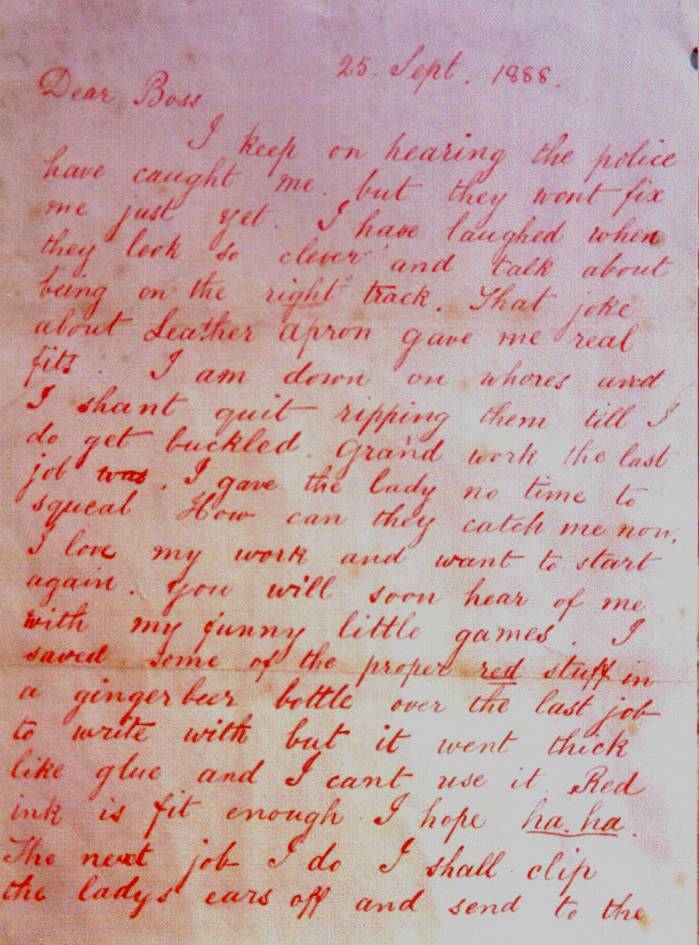
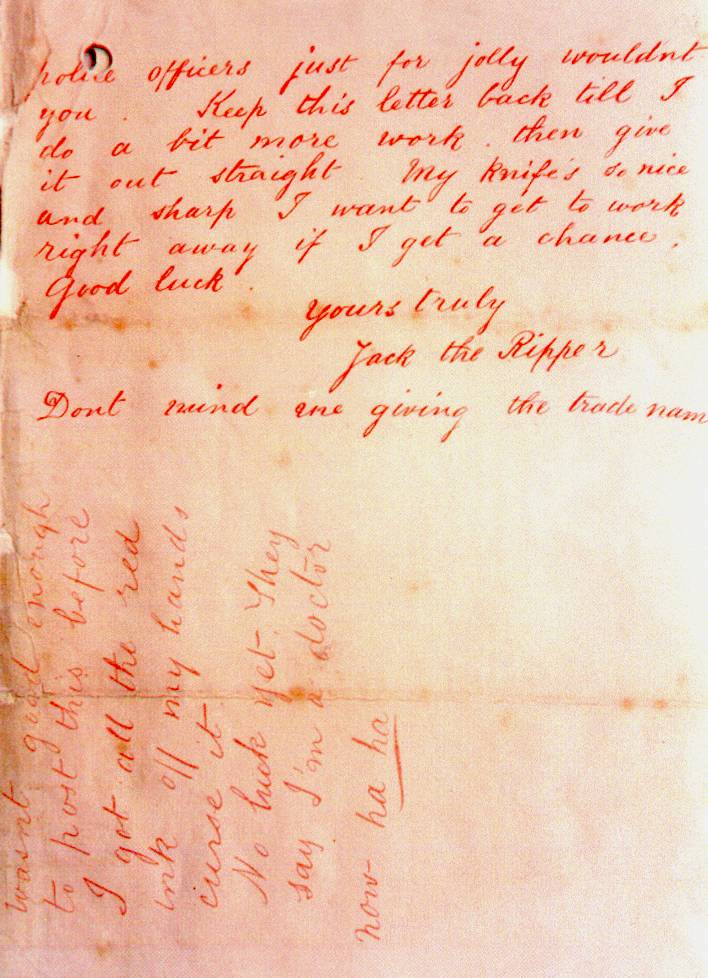
written by him. A letter dated September 25 and received on the
twenty-seventh by the Central News agency was the first to be
signed "Jack the Ripper". A postcard post marked October 1
followed. Because it referred to a "double event" the police
thought it might be from the killer since it was posted the day
after the Ripper killed two women. The post card also referred to
the letter and must have come from the same source as the letter
had not been released to the public yet. If the post card had been
sent on September 30, the day of the "double event", instead of
October 1, the likelihood that it was really written by the
murderer would be significantly greater. The Whitechapel Murderer
may have written the letter/post card but there is no evidence to
suppose that he did and the police seem convinced that they were
the work of a journalist. A recently discovered document states
that a journalist from the Central News agency, Tom Bulling, was
the writer.
One other letter may have been written by the killer. In
mid-October a small parcel was sent to George Lusk, who was head of
a vigilance committee in Whitechapel. Inside was half a human
kidney and a letter from someone claiming to be the killer, and
that it was part of the kidney he removed from the victim Eddowes.
It is impossible to know for sure if the Ripper really did send it.
Most of the arguments in favor of it being from Jack have been
based on inaccurate information and the myths rather than the facts
surrounding the case. However, Eddowes did suffer from Bright's
disease and the description of the kidney does match what a
Bright's disease kidney would look like.
Evidence
In a time before forensic science and even finger printing, the
only way to prove someone committed a murder was to catch either
him or her in the act, or get the suspect to confess. The
Whitechapel Murders unhappily fall into this period of time. One
interesting feature of this case is that not one, but two police
forces carried out investigations. The Metropolitan Police, known
as Scotland Yard, was responsible for crimes committed in all the
boroughs of London except the City of London proper. The single
square mile in the heart of London known as the City of London had
their own police force. When Eddowes was killed, it was in their
territory and this brought them into the Ripper case. It is
believed that the rank and file of the two forces got along and
worked well together, but there is evidence that the seniors in
each force did not. To what degree, if any, their failure to
cooperate fully had on solving the case is not known. Most sources
do not fault either police force for failing to solve the Jack the
Ripper mystery, rightly pointing out that catching serial killers
is still a hard task even by today's science and technology. Other
than autopsies and taking statements from everybody who might know
something there was little else that the Metropolitan police force
did. The attitude of the people at the time was that the police
were incompetent and that the Commissioner, Sir Charles Warren, was
only good for policing crowds and keeping order rather than
detective work. He was especially criticized for not offering a
reward in the hope that a confederate or accomplice would come
forth and inform against the Ripper. In fact, Warren had no
objections for a reward being offered and it was his superior,
Henry Matthews, the Home Secretary who refused the sanction of a
reward. The City of London Police seems to have done a better job
although they did not apprehend the killer either. City police
officers made crime scene drawings, took many photographs of the
victim Eddowes, and even though she was not in their jurisdiction,
they took photographs of the Kelly victim. She is the only victim
who was photographed at the crime scene. One of the splits between
the leadership of the two forces was over graffito found in
Goulston Street on the night of the "double event". A piece of
Eddowes' apron, which the Ripper used to wipe off his knife, was
found by a constable near a doorway that had a chalked message over
the door. This message, "The Juwes are the men That Will not be
blamed for nothing", may have been written by the Ripper and the
City police officers wanted to photograph it. Warren felt that
leaving it until it was light enough to be photographed might cause
riots against the Jews living in Whitechapel whom the bigoted
English residents already believed were responsible for the
murders. Warren did not even compromise by willing to erase or
cover up the word "Juwes" only. In the end the police never charged
any suspect with the murders committed by the Ripper which shows
they did not have a sufficient amount of evidence that would gain a
verdict of guilty in criminal court.