From http://www.csicop.org/si/9811/i-files.html.
For article's reference, pls go to website.
Helix to Heaven
The Staircase Stands but the Myth Falls
Joe Nickell
--------------------------------------------------------------------------------
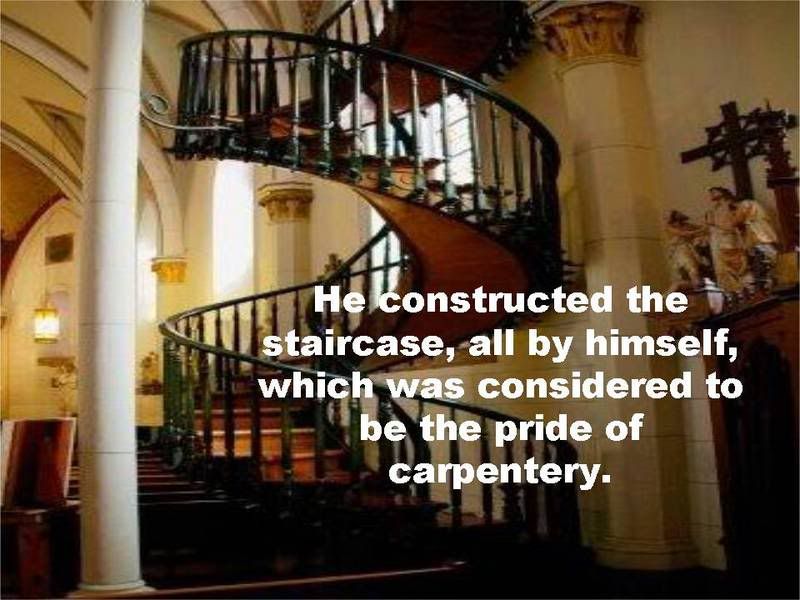
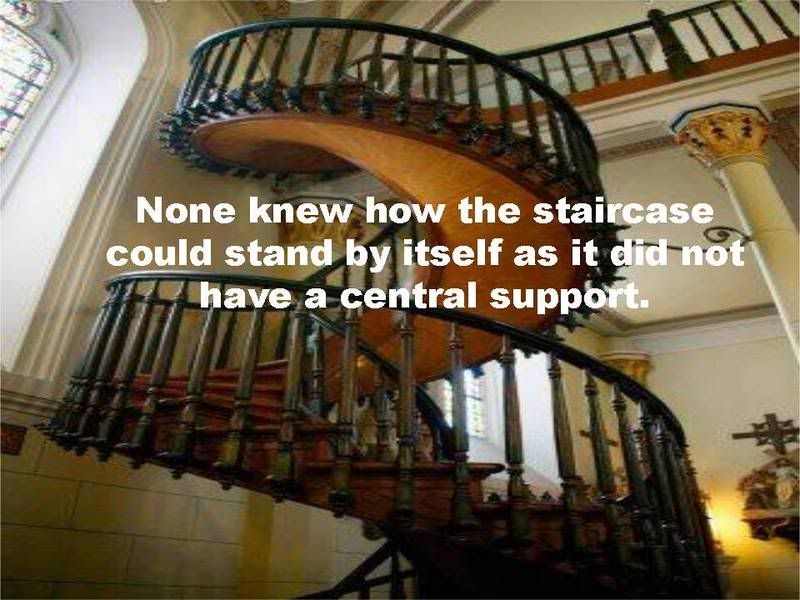
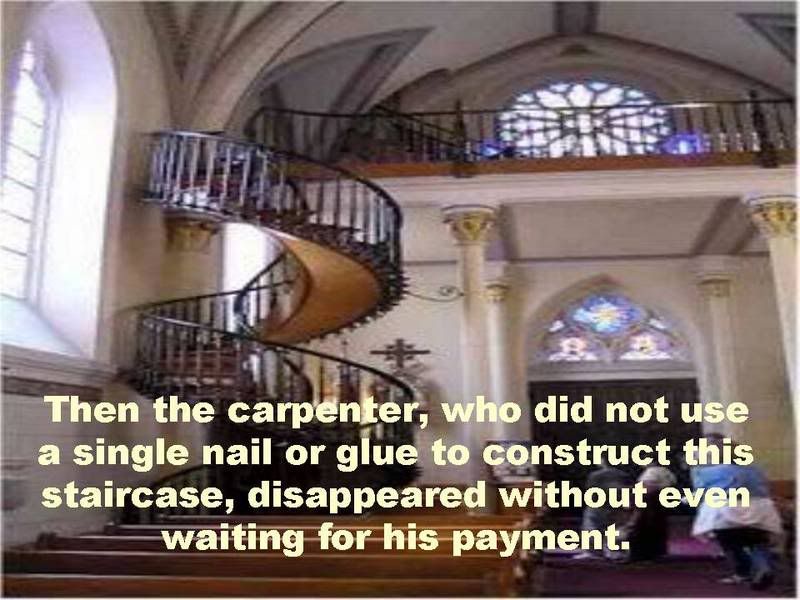
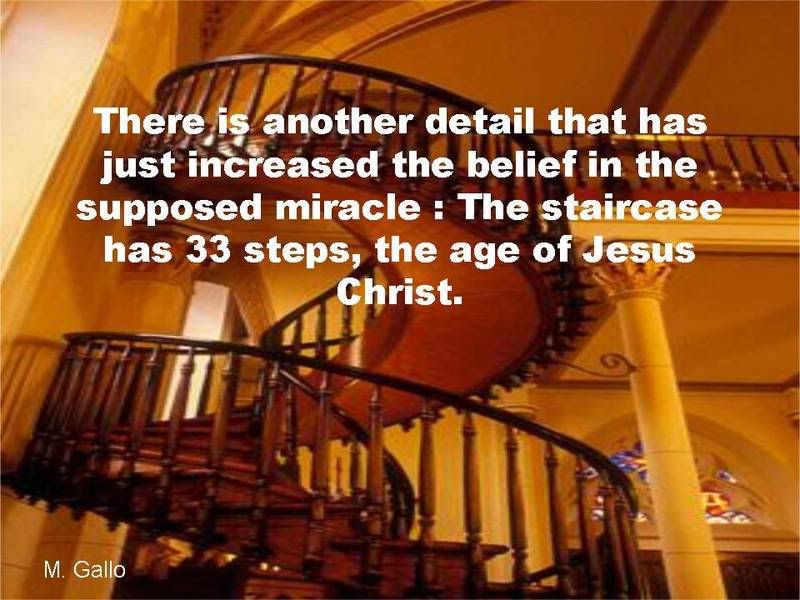
Figure 1. The spiral stairway at Loretto Chapel in Santa Fe, New
Mexico, is an alleged miracle of construction.
The CBS television movie "The Staircase" (April 12, 199 , told how "a dying nun's wish to complete her order's
chapel is fulfilled by a mysterious stranger" (Bobbin 199. Starring Barbara Hershey as the terminally ill mother
superior and William Peterson as the enigmatic carpenter, the movie
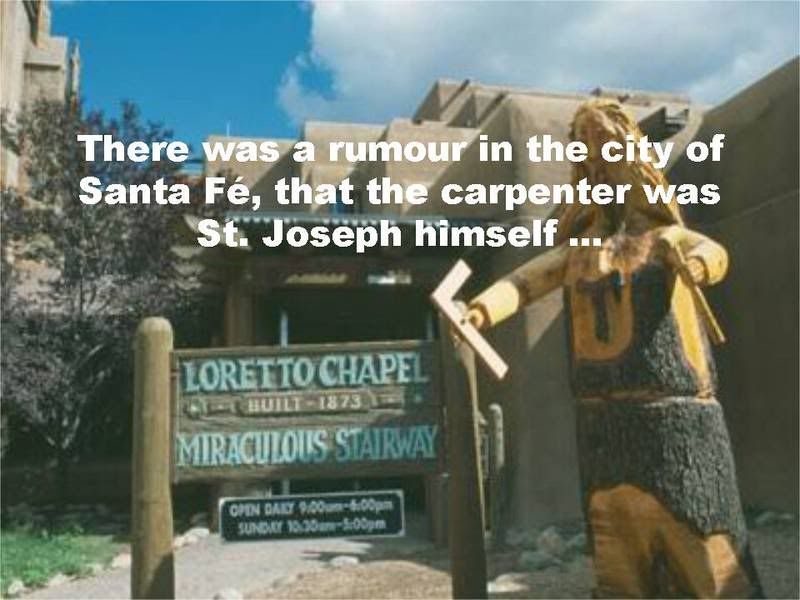
is an embellishment of the legend of the "miraculous stairway" at
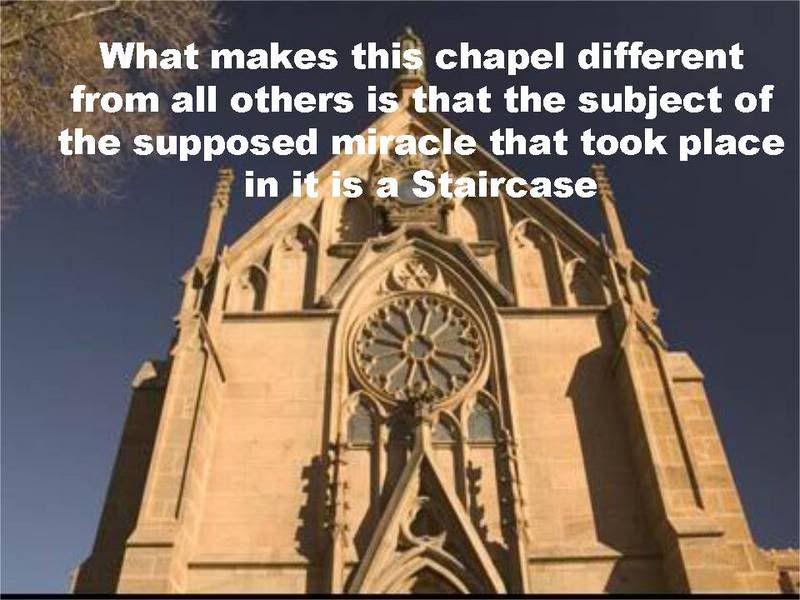
the Sisters of Loretto Chapel in Santa Fe, New Mexico. The wooden,
spiral stair is thought to be unique, and some claim its very
existence is inexplicable.
The Loretto legend begins with the founding of a school for females
in Santa Fe in 1852. A combined day and boarding school, the
Loretto Academy was established by the local Sisters of Loretto at
the behest of Bishop John Lamy. In 1873 work began on a chapel.
Unfortunately some earthly, even earthy events reportedly marred
the work: The wife of Bishop Lamy's nephew caught the architect's
eye and he was killed for his interest -- shot by the nephew who
was distraught over his destroyed marriage.
At this time work on the chapel was nearing completion and,
although the choir loft was finished, the architect's plans
provided no means of access. It was felt that installing an
"ordinary stair" would be objectionable on aesthetic grounds and
because it would limit seating (Bullock 1978, 6, . "Carpenters and builders were called in," according to
one source, "only to shake their heads in despair." Then, "When all
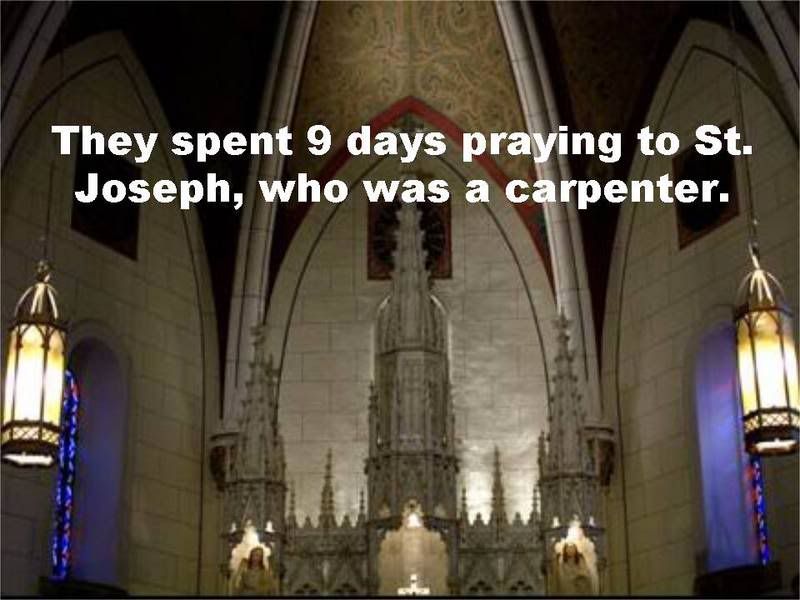
else had failed, the Sisters determined to pray a novena to the
Master Carpenter himself, St. Joseph" (the father of Jesus)
(Bullock 1978, .
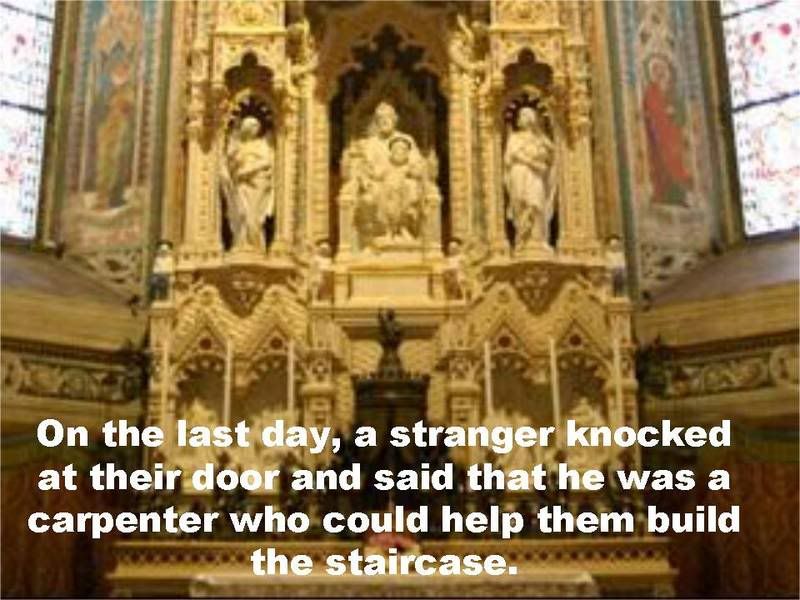
"On the ninth day," reportedly, their prayers were answered. A
humble workman appeared outside, leading a burro laden with
carpentry tools. He announced he could provide a suitable means of
access to the loft, requiring only permission and a couple of water
tubs. Soon, he was at work:
Sisters, going in to the Chapel to pray, saw the tubs with wood
soaking in them, but the Man always withdrew while they said their
prayers, returning to his work when the Chapel was free. Some there
are who say the circular stair which stands there today was built
very quickly. Others say no, it took quite a little time. But the
stair did grow, rising solidly in a double helix without support of
any kind and without nail or screw. The floor space used was
minimal and the stair adds to, rather than detracts from, the
beauty of the Chapel.
As the tale continues:
The Sisters were overjoyed and planned a fine dinner to honor the
Carpenter. Only he could not be found. No one seemed to know him,
where he lived, nothing. Lumberyards were checked, but they had no
bill for the Sisters of Loretto. They had not sold him the wood.
Knowledgeable men went in and inspected the stair and none knew
what kind of wood had been used, certainly nothing indigenous to
this area. Advertisements for the Carpenter were run in the New
Mexican and brought no response.
"Surely," said the devout, "it was St. Joseph himself who built the
stair" (Bullock 1978, 8, 10).
No doubt the legend has improved over the intervening century, like
good wine. As we shall see, there is more to the story. But Barbara
Hershey concedes, "Those who want to believe it's a miracle can,
and those who want to believe this man was just an ingenious
carpenter can" (Bobbin 199. Evidence for the latter is considerable, but first we
must digress a bit to understand spiral stairs.
Spiral and other winding staircases reached a high point in
development in sixteenth-century England and France, with several
"remarkable" examples ("Stair" 1960; "Interior" 1960). To
appreciate the architectural and other problems such stairs present
we must recognize that builders use turns in staircases to save
space or to adapt to a particular floor plan. The simplest is the
landing turn which is formed of straight flights joined at the
requisite angle by a platform. A variation is the split landing
which is divided on a diagonal into two steps.
Instead of a landing, the turn may be accomplished by a series of
steps having tapered treads. Such staircases are called winders and
include certain ornamental types, like that which takes the shape
of a partial circle (known as circular stair) or an ellipse. An
extreme form of winding staircase is a continuous winder in the
form of a helix (a line that rises as it twists, like a screw
thread). This is the popularly termed "spiral staircase" like the
example at Loretto Chapel (Locke 1992, 135-36; Dietz 1991,
340-42).
Helixes -- unlike, say, pyramids -- are not inherently stable
weight-supporting structures. They require some kind of
strengthening or support. Therefore, in addition to being secured
at top and bottom, the spiral staircase is usually also braced by
attachment along its height to a central pole or an adjacent wall
(Dietz 1991, 342; "Stair" 1960).
Unfortunately, spiral and other winding staircases are not only
problematic in design but are also fundamentally unsafe. Explains
one authority, "For safety, any departure from a straight staircase
requires careful attention to detail in design and construction."
Especially, "Because people tend to travel the shortest path around
a corner, where a winder's treads are narrowest, the traveler must
decide at each step where each foot falls. This may be an
intellectual and physical exercise best practiced elsewhere. In
short, winders are pretty but inherently unsafe" (Locke 1992, 135,
136). Other experts agree. According to Albert G. H. Dietz,
Professor Emeritus of Building Engineering at MIT, Winders "should
be avoided if at all possible. No adequate foothold is afforded at
the angle [due to the tapering] and there is an almost vertical
drop of several feet if a number of risers converge on the same
point. The construction is dangerous and may easily lead to bad
accidents" (Dietz 1991, 341). As a consequence, winders are
frequently prohibited by building codes. That is especially true of
the spiral stair, which "contains all the bad features of the
winder multiplied several times" (Dietz 1991, 342).
Such problems seem to have beset the staircase at Loretto,
suggesting that, at most, the "miracle" was a partial one. Safety
appears to have been a concern at the outset, since there was
originally no railing. At the time the staircase was completed, one
thirteen-year-old sister who was among the first to ascend to the
loft, told how she and her friends were so frightened -- absent a
railing -- that they came down on hands and knees (Albach 1965).
Nevertheless, despite the very real hazard, it was not until 1887
-- ten years after the staircase was completed -- that an artisan
named Phillip August Hesch added the railing (Loretto n.d.). No one
claims it was a miracle, yet it is described as "itself a work of
art" (Albach 1965; see Figure 1).
Over time, other problems arose relating to the double helix form.
The helix, after all, is the shape of the common wire spring.
Therefore, it is not surprising that people who trod the stairs
reported "a small amount of vertical movement" or "a certain amount
of springiness" (Albach 1965) and again "a very slight vibration as
one ascends and descends rather as though the stair were a living,
breathing thing" (Bullock 1978, 14).
Some people have thought the free-standing structure should have
collapsed long ago, we are told, and builders and architects
supposedly "never fail to marvel how it manages to stay in place,"
considering that it is "without a center support" (Albach 1965). In
fact, though, as one wood technologist observes, "the staircase
does have a central support." He observes that of the two wood
stringers (or spiral structural members) the inner one is of such
small radius that it "functions as an almost solid pole" (Easley
1997).
There is also another support -- one that goes unmentioned, but
which I observed when I visited the now-privately owned chapel in
1993. This is an iron brace or bracket that stabilizes the
staircase by rigidly connecting the outer stringer to one of the
columns that support the loft (see Figure 2).
Figure 2. Iron support bracket (unmentioned in published accounts)
reveals the "miracle" is a partial one. (Photos by Joe
Nickell)
There is reason to suspect that the staircase may be more unstable
and, potentially, unsafe than some realize. It has been closed to
public travel since at least the mid-1970s (when the reason was
given as lack of other egress from the loft in case of fire). When
I visited in 1993 my understanding was that it was suffering from
the constant traffic. Barbara Hershey implied the same when she
stated, "It still functions, though people aren't allowed to go up
it very often" (Bobbin 199. It would thus appear that the Loretto staircase is
subject to the laws of physics like any other.
The other mysteries that are emphasized in relation to the stair
are the identity of the carpenter and the type of wood used. It
seems merely mystery mongering to suggest that there is anything
strange -- least of all evidence of the supernatural -- in the
failure to record the name of an obviously itinerant workman.
As to the wood, that it has not been identified precisely means
little. The piece given to a forester for possible identification
was exceedingly small (only about 3/4-inch square by 1/8-inch
thick) whereas much larger (six-inch) pieces are preferred by the
U.S. Forest Service's Center for Wood Anatomy (which has made many
famous identifications, including artifacts taken from King Tut's
tomb and the ladder involved in the Lindbergh kidnapping) (Knight
1997). The wood has reportedly been identified as to family,
Pinaceae, and genus, Picea -- i.e., spruce (Easley 1997), a type of
"light, strong, elastic wood" often used in construction ("Spruce"
1960). But there are no fewer than thirty-nine species -- ten in
North America -- so that comparison of the Loretto sample with only
two varieties (Easley 1997) can scarcely be definitive.
In the final analysis the "mysteries" of the spiral staircase at
the Loretto Chapel are evidence, not of its miraculous production
but instead of its human -- quite fallibly human --
manufacture.