
During the final stages of World War II in 1945, the United
States conducted two atomic bombings against the cities of
Hiroshima and Nagasaki in Japan, the first on August 6,
1945 and the second on August 9, 1945. These two events are the
only use of nuclear
weapons in war to date.[2]
For six months before the atomic bombings, the United States
intensely fire-bombed
67 Japanese cities. Together
with the United Kingdom and the Republic of China, the United
States called for a surrender of Japan in the Potsdam
Declaration on July 26, 1945. The Japanese
government ignored this ultimatum. By
executive order of President
Harry
S. Truman, the U.S. dropped the nuclear
weapon "Little
Boy" on the city of Hiroshima on Monday, August 6,
1945,[3][4]
followed by the detonation of "Fat
Man" over Nagasaki on August 9.
Within the first two to four months of the bombings,
the acute effects killed
90,000–166,000 people in Hiroshima and 60,000–80,000 in
Nagasaki,[1]
with roughly half of the deaths in each city occurring on the first
day. The Hiroshima prefectural health department estimates that, of
the people who died on the day of the explosion, 60% died from
flash or flame burns, 30% from falling debris and 10% from other
causes. During the following months, large numbers died from the
effect of burns, radiation sickness, and other
injuries, compounded by illness. In a US estimate of the total
immediate and short term cause of death, 15–20% died from radiation
sickness, 20–30% from
flash burns, and
50–60% from other injuries, compounded by illness.[5]
In both cities, most of the dead were civilians.[6][7][8]
Six days after the detonation over Nagasaki, on August 15, Japan
announced its
surrender to the Allied
Powers, signing the Instrument of Surrender on
September 2, officially ending the Pacific
War and therefore World War II. Germany had signed its Instrument of Surrender on May
7, ending the war in
Europe. The bombings led, in part, to post-war Japan's adopting
Three
Non-Nuclear Principles, forbidding the nation
from nuclear armament.[9]
The role of the bombings in Japan's surrender and the U.S.'s
ethical justification for them,
as well as their strategic importance, is
still
debated.[10][11]
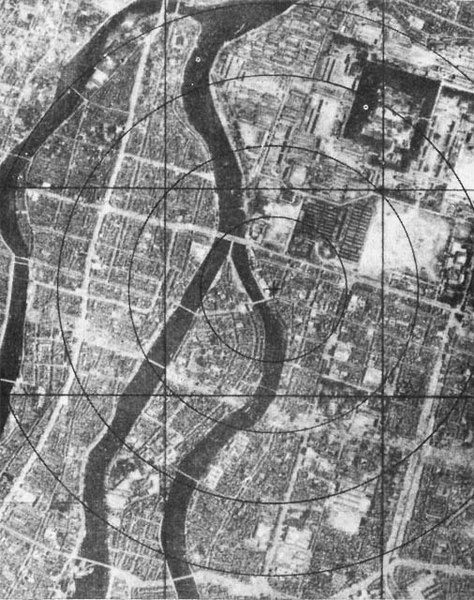

Hiroshima Before and After bombing .
Your
view please .