What
burning ‘paper money’ really meant
During a funeral ceremony in ancient China, paper-made models of
houses, sedan chairs, treasure chests, clothes, daily utensils, and
even effigies of servants, were burnt as the cortege was leaving
home for burial in the cemetery.
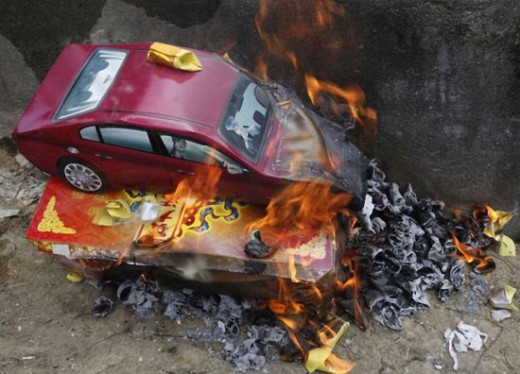 The ORIGINAL meaning of such an
act is to show everyone present that all former possessions of the
deceased cannot be brought along to the next life. At one’s
death, everything one had ever owned has to be left behind. The
burning only emphasizes this message, as it is the most graphical,
symbolic, and dramatic way of showing total loss!
There is a Chinese saying that ‘no possessions can be brought
along to the next existence; the only thing that follows one is his
deeds, or ‘karma’ ‘ ( 万般带不去,唯有业随身 ). Furthermore, his
relatives and friends only follow the deceased up to the grave, but
soon turn to go home, leaving the dead alone in his tomb!
Thus, the burning of cheaply-produced paper models and effigies
served as an effective educational tool. Witnessing how fire
consumes every ‘former possession’ of the deceased, even an
illiterate peasant or young child was able to understand this sense
of total relinquishment at death.
A seller holds up a 'paper car' meant as offerings to
the dead.
Today, this practice is completely misunderstood by the majority
of Chinese. Instead of the original meaning, paper-made
models have been turned into “paper offerings” – with the mistaken
thought that whatever one burns, his departed relatives will obtain
in the netherworld!
Hence people nowadays burn paper models of the latest i-Pads,
smartphones, LED screens, and “paper money” in inflated sums in
order to please the dead. All these will not help the
departed ones at all. In fact, this misunderstanding will
only harm the living by maintaining their ignorance and
delusions.
Many people assume that whatever is fancied in life is
also fancied in the netherworld.
Instead of burning “paper offerings”, one can perform
‘Dedication of Merits’ (Pāli, ‘Pattidāna ’) to help
their departed relatives. The explanation on this Buddhist
practice was posted on this website on 31 March. Scroll down
and have a good read!