he is the chief villain isnt he
He was a disaster in ruling China but he succeeded in one thing
that Sun Yat Sen and Chiang Kai Shek could not - unify China.
China is a big country with a huge population, you want to unify
this country and bring it under centralised control is not easy,
only Mao Zedong could do it. You must concede this point to
him.
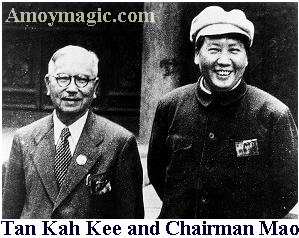
Tan Kah Kee also supported Mao.
COMMUNITY LEADERS
As prominent businessmen, Tan Kah Kee and Lee Kong Chian not
only assumed positions of social authority, they also used their
influence to build institutions and networks both locally and
abroad, from the huay kuan to institutions of higher learning, that
would further their respective causes.


 1
Rallying the People [ View Details ]
A key figure in the Singapore Chinese
Chamber of Commerce, Singapore Hokkien Huay Kuan, Ee Hoe Hean Club
and various business associations, Tan Kah Kee encouraged these
organisations to modernise, just as China needed to modernise. He
often called for greater unity among the different Chinese dialect
groups, and took the lead in rallying the Chinese in Southeast Asia
to support China’s war effort against the Japanese.

 Tan believed that for China to be strong, the different
dialect groups or bang needed to work together. Even though his
Hokkien community outnumbered the others and enjoyed more influence
in the Singapore Chinese Chamber of Commerce, he felt that all
Chamber members should be treated equally. He said, “The Chamber of
Commerce is an organisation to rally all Singapore businessmen, and
there seems to be no necessity to draw a line between their bang
affiliation.”
Tan could not convince the Chamber to adopt a more democratic
approach during his lifetime, but his ability to rally others to
his causes helped him to build the Singapore Hokkien Huay Kuan into
a body that solidly supported education and promoted social
development. Similarly, he encouraged Chinese towkays from other
dialect groups to join the Ee Hoe Hean Club, a businessmen’s social
club dominated by the Hokkien. With Tan as its chairman from 1923,
the Club became a platform for raising political awareness of the
Japanese invasion of China and the headquarters for Tan’s various
Relief Fund efforts.
[ Close ]
2
Supporting the Motherland [ View Details ]
 Despite the many years he spent in Singapore, Tan Kah Kee
had a strong attachment to China. Besides
building schools, he was instrumental in leading the Singapore
Chinese community to support many relief efforts for China from the
late 1920s. In 1938, Tan was elected to chair the South Seas China
Relief Fund Union, which gathered not only financial resources but
also sent volunteer drivers and mechanics to transport military and
medical supplies on the Burma Road to
China.
Tan’s early anti-Japanese war efforts were launched after the 1928
Jinan Incident, when Japanese and Chinese military clashes led to
many civilian casualties. Believing that the Overseas Chinese had a
responsibility to support their homeland when it was under threat,
Tan led the Shandong Relief effort, which raised $1 million
(Chinese currency) within a month.
Tan went on to lead other relief fund
efforts, culminating in the Singapore China Relief Fund Committee
and South Seas China Relief Fund Union. Under his able leadership,
the latter consolidated the efforts of Chinese communities across
Southeast Asia and contributed a total of about $5,500 million
(Chinese currency) to the Chinese war effort between 1937 and
1942. Tan was
greatly respected by the Chinese political leadership; during a
1940 mission to China, he met Chiang Kai Shek, Mao Zedong, Zhou
Enlai, Zhu De and other key members of the Kuomintang and Chinese
Communist Party.

http://www.thelegacy.nl.sg/exh_community.html
The year was 1940, and China’s luck was at its lowest point.
Much of the
eastern states were occupied by the Japanese, and the Nationalist
Party under Chiang Kai-shek, still fighting a rear-guard action
from the safe haven of wartime capital Chongqing, was hopelessly
corrupt.
As a de facto leader of the overseas Chinese, Tan Kah Kee has just
embarked on an 8-month trip to China, dubbed the Comfort Mission,
to bring aid and moral support to those suffering from the
onslaught of the invaders. After being feted by Chiang, he visited
Mao Zedong, then living in the caves of Yenan with a few thousand
of his forces.
Tan Kah Kee had heard of how the Communist Party – which was
considered an enemy of the Nationalists, had conducted their
affairs with much fairness and high principles of governance,
earning the admiration and respect of those they came into contact
with.
At the end of his
8-day visit to this humble abode, Tan Kah Kee observed that Mao and
his men ruled this region of a few thousand followers and the
surrounding peasants with a firm hand tempered with fairness,
frugality and much egalitarianism, implementing a system of thrift
and reward matched with hard work, a viable education system for
the children, and had somehow made his people economically
self-supporting with what little they
had.
Tan Kah Kee
- who had up to then despaired over the lack of a viable
leadership to pull the country up from its ruinous depths -
was suddenly filled with a glowing sense of
hope.
Here was a group of high-principled and incorruptible people,
widely read in socialist theories, leaders who didn’t stand on
ceremonies and practised what they preach – here is the light at
the end of the tunnel, and that the path towards salvation would be
clear. Upon his return to Singapore, TKK wasted no time in
announcing to his huaqiao compatriots that they should from then on
change their allegiance to the Communist Party.
The record 6-hour speech – which eventually gave rise to one of the
most famous sayings in modern China – ‘The future of China lies in
Yenan’ — not only angered Chiang but gave the Communist Party the
seal of approval to continue their battle against the ruling
faction, and confidence in their final march towards Beijing after
the Japanese were finally driven from China’s
shores.
http://poeygee.wordpress.com/2009/08/13/hello-world/