The Spread of Buddhism Among the
Chinese
During
the third century B.C., Emperor Asoka sent missionaries to the
northwest of India, that is, present-day Pakistan and Afghanistan.
The mission achieved great success as the region soon became a
centre of Buddhist learning with many distinguish monks and
scholars. When the merchants of Central Asia came into this region
for trade, they learnt about Buddhism and accepted it as their
religion. By the second century B.C., some central Asian cities
like Kotan, has already become important centres for Buddhism. The
Chinese people had their first contact with Buddhism through
Central Asians who were already Buddhists.
When
the Han Dynasty of China extended its power to Central Asia in the
first century B.C., trade and cultural ties between China and
Central Asia also increased. In this way, the Chinese people learnt
about Buddhism so that by the middle of the first century C.E., a
community of Chinese Buddhists was already in
existence. As
interest in Buddhism grew, there was a great demand for Buddhist
texts to be translated from Indian languages into Chinese. This led
to the arrival of translators from Central Asia and India. The
first notable one was Anshigao from Central Asia who came to China
in the middle of the second century. With a growing collection of
Chinese translations of Buddhist texts, Buddhism became more widely
known and a Chinese monastic order was also formed. The first known
Chinese monk was said to be Anshigao's disciple.
The
early translators had some difficulty in finding the exact words to
explain Buddhist concepts in Chinese, so they often used Taoist
terms in their translations. As a result, people began to relate
Buddhism with the existing Taoist tradition. It was only later on
that the Chinese came to fully understand the teachings of the
Buddha.
After
the fall of the Han Dynasty in the early part of the third century,
China faced a period of political disunity. Despise the war and
unrest, the translations of the Buddhist texts continued. During
this time, both foreign and Chinese monks were actively involved in
establishing monasteries and lecturing on the Buddhist
teachings.
Among
the Chinese monks, Dao-an who lived in the fourth century, was the
most outstanding. Though he had to move from place to place because
of the political strife, he not only wrote and lectured
extensively, but prepared the first catalogues of them. He invited
the famous translator, Kumarajiva, from Kucha. With the help of of
Do-an's disciples, Kumarjiva translated a large number of important
texts and revised the earlier Chinese translations. His fine
translations are still in use to this day. Because of political
unrest, Kumarkiva's disciple were later dispersed and this helped
to spread Buddhism to other parts of China.
The Establishment of Buddhism in
China: From
the beginning of the fifth century to around the end of the sixth
century, northern and southern China came under separate rule. The
south remained under native dynasties while the north was
controlled by non-Chinese rulers. The Buddhist in southern China
continued to translate Buddhist texts and to lecture and write
commentaries on the major texts. Their rulers were devout Buddhists
who saw to the construction of numerous temples, participated in
Buddhist ceremonies and organised public talks on
Buddhism.
In
northern China, except for two short periods of persecution,
Buddhism flourished under the lavish royal patronage of rulers who
favoured the religion. By the latter half of the sixth century,
monks were employed in government posts. During this period,
Buddhist art flourished, especially in the caves at Dun-huang,
Yun-gang and Long-men. In the thousand caves at Dun-huang, Buddhist
paintings covered the walls and there were thousands of Buddha
statues in these caves. At Yun-gan and Long-men, many Buddha images
of varying sizes were carved out of the rocks. All these activities
were a sign of the firm establishment of Buddhism in China by the
end of this period.
The Development of Chinese Schools of
Buddhism: With
the rise of the Tang Dynasty at the beginning of the seventh
century, Buddhism reached out to more and more people. It soon
became an important part of Chinese culture and had great influence
on Chinese Art, Literature, Sculpture, Architecture and the
Philosophy of that time.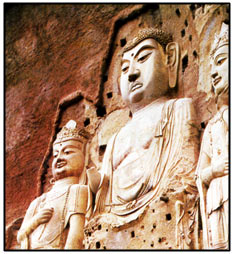
By
then the number of Chinese translations of Buddhist texts had
increased tremendously. The Buddhist were now faced with the
problem of how to put their teachings into practice. As a result, a
number of schools of Buddhism arose, with each school concentrating
on certain texts for their study and practice. The Tian-tai school,
for instance, developed a system of teaching and practice based on
the Lotus Sutra. It also arranged all the Buddhist
texts into graded categories to suit the varying aptitude of the
followers.
Other
schools arose which focused on different areas of the Buddha's
teachings. The two most prominent schools were the Ch'an and the
Pure Land schools. The Ch'an school emphasized the practice of
meditation as the direct way of gaining insight and experiencing
Enlightenment in this very life. (see link)

The
Pure Land school centres its practices on the recitation of the
name of Amitabha Buddha. The practice is based on the sermon which
teaches that people could be reborn in the Western Paradise (Pure
Land) of Amitabha Buddha if they recite his name and have sincere
faith in him. Once in the Pure Land, the devotees are said to be
able to achieve Enlightenment more easily. Because of the
simplicity of its practice, this school became popular especially
among the masses throughout China.
Further Development of Buddhism in
China:
In the middle of the ninth century, Buddhism faced persecution by a
Taoist emperor. He decreed the demolition of monasteries,
confiscation of temple land, return of monks and nuns to secular
life and the destruction of Buddha images. Although the persecution
lasted only a short time, it marked the end of an era for Buddhism
in China. Following the demolition of monasteries and the dispersal
of scholarly monks, a number of Chinese schools of Buddhism ceased
to exist as separate movements. They were absorbed into the Ch'an
and Pure Land schools which survived. The eventual result was the
emergence of a new form of Chinese Buddhist practice in the
monastery. Besides practicing Ch'an meditation, Buddhist also
recited the name of Amitabha Buddha and studied Buddhist texts. It
is this form of Buddhism which survives to the present
time.
Just
as all the Buddhist teachings and practices were combined under the
one roof in the monasteries, Buddhist lay followers also began to
practice Buddhism, Taoism and Confucianism simultaneously.
Gradually, however, Confucian teachings became dominant in the
court and among the officials who were not in favour of
Buddhism.
Buddhism
generally, continues to be a major influence in Chinese religious
life. In the early twentieth century, there was an attempt to
modernize and reform the tradition in order to attract wider
support. One of the most well-known reformist was Tai-xu, a monk
noted for his scholarship. Besides introducing many reforms in the
monastic community, he also introduced Western-style education
which included the study of secular subjects and foreign languages
for Buddhist.
In
the nineteen-sixites, under the People's Republic, Buddhism was
suppressed. Many monasteries were closed and monks and nuns
returned to lay life. In recent years, a more liberal policy
regarding religion has led to a growth of interest in the practice
of Buddhism.
http://www.buddhanet.net/e-learning/buddhistworld/china-txt.htm
Chinese Buddhist Links:


