Life’s most awesome event is death, and death comes to all
without regard to wealth, beauty, intelligence or fame.
Death is inevitable, but how you die
terrified and confused,
or with confidence and spiritual mastery
is within your control.
Phowa, or ‘transference of consciousness at the time of death’ is
the simplest and most direct method to attain enlightenment. One of
the six Yogas of Naropa, it is taught by all Tibetan Buddhist
traditions; the Drikung Kagyu Lineage, however, holds the special
power to transfer one’s consciousness to the Pureland of Buddha
Amitabha. In Tibet, the famous Drikung Phowa was given every twelve
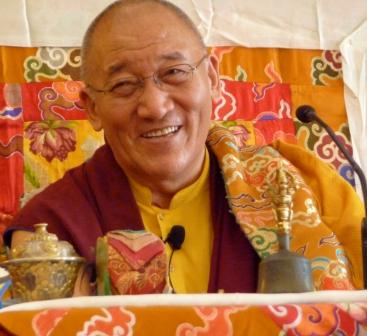
years by the two Head Lamas of the Drikung Lineage. HE Choeje Ayang
Rinpoche first started to teach Phowa in India in 1963 and the west
in 1975 following the instructions from his root master HH the 16th
Gyalwang Karmapa Rangjung Rigpe Dorje.
It is also one of the methods to enable one to reach Buddha
Amitabha’s pure land. Through a combination of breath, mantra and
visualization techniques applied at the time of death, the
consciousness is ejected from the crest aperture, circumventing the
Bardos and avoiding rebirth in the six realms of cyclic existence.
From this gate one’s consciousness can be transferred directly to
the domain of Amitabha Buddha (Dewachen, the western Buddha field).
Naropa said, “There are nine gates (ordinary aperture called buga)
which are of the world, but there is only one which is the gate of
Mahamudra (nirvana). If you shut the nine gates then you will get
the path of liberation without any doubt.”
In the words of the Marpa the translator, “If you study Phowa,
then at the time when death is approaching, you will know no
despair. If beforehand you have become accustomed to the path of
phowa, then at the time of death you will be full of cheerful
confidence.” It is taught that one does not return to the samsaric
realms after entering Dewachen, and that one can quickly and easily
achieve enlightenment from that realm. Thus, Phowa is alike an
insurance that this attainment will follow death.
This practice is especially relevant in the present day, when
most of us lack the luxury of lengthy solitary meditative practice.
Because of this lack, as well as the overwhelming path that is
simple and direct, and which enables us to transform the stresses
of modern life into a vital force that cuts through attachment to
illusory objects and awakens in us the realization of our own
Buddha nature. Life is very short and can end suddenly without
warning. When death comes we have no escape, neither our
accumulated wealth nor our dear ones can help us … Nothing can,
except the precious teaching.
Read more at :
http://ayangrinpoche.org/an-introduction-to-phowa/