This was posted by another forumer years back... but the topic
is expired and couldn't bump it back up, thought it would be
interesting for those interested in practicing Pureland.
The Parable of the White Path
with commentary by
Shan-tao written in the 7th century, China
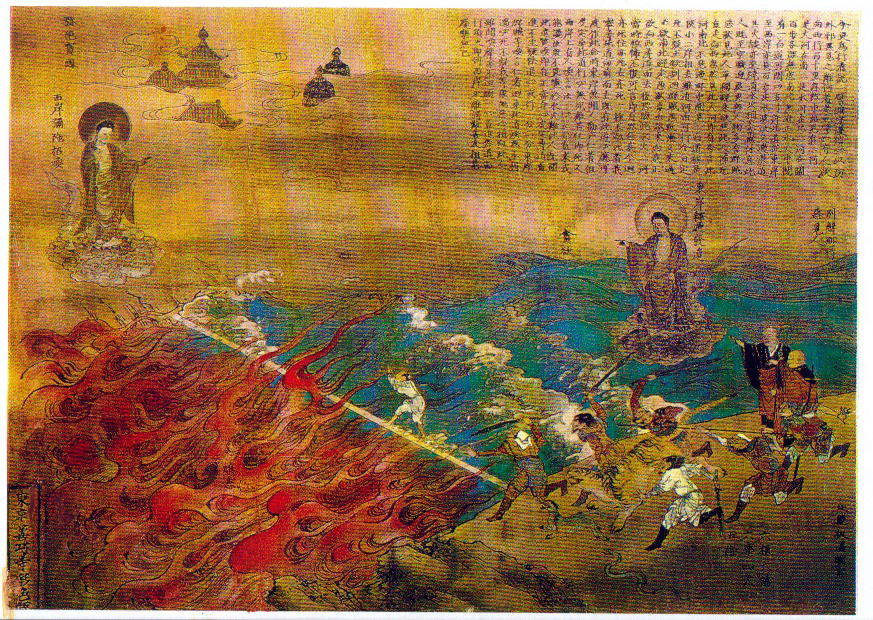
I wish to say to all aspirants for spiritual rebirth: I will now
present a parable for the practicers in order to protect their
faith and to guard it against attacks by those who have wrong and
unauthentic views. What is the parable?
Suppose a man is traveling a hundred thousand miles toward the
west. On the way, he suddenly comes upon two rivers: one is a river
of fire that extends southward, and the other is a river of water
that extends northward. The two rivers are each a hundred paces
wide and unfathomably deep, extending endlessly to the north and
south. Where they meet, there is a white path, four or five inches
wide. This path is a hundred paces long from the east bank to the
west. The waves of the water splash and the flames of the fire burn
the path; the waves and flames alternate without ceasing.
This traveler has already journeyed far into the open plain where
there is no one to be found. Suddenly, there appear many bandits
and vicious beasts. Seeing him alone, they approach, competing with
each other to kill him. Afraid of death, he at once runs to the
west. When he suddenly sees this great river, he says to himself,
"This river extends endlessly to the south and to the north. I see
a white path in the middle, but it is extremely narrow. Although
the two banks are close to each other, how can I get across?
Undoubtedly, I shall die this day. When I turn round to return, I
see bandits and vicious beasts coming closer and closer. If I try
to run toward the south or north, I see vicious beasts and
poisonous insects vie with each other to attack me. If I seek the
path to the west, I will certainly fall into one of the two rivers
of water and fire.
His horror at this moment is beyond expression. So he thinks to
himself, "If I turn back now, I shall die; if I stay, I shall die;
if I go forward, I shall die, too. Since I cannot escape death in
any way, I would rather follow this path. Because there is a path,
it must be possible to cross the rivers."
When this thought occurs to him, he suddenly hears a voice from the
eastern bank urging him, "Take this path with firm resolution.
There is no danger of death. If you stay there, you will die."
Again, he hears another voice from the western bank calling to him,
"Come at once single-heartedly with right mindfulness. I will
protect you. Do not fear that you may fall into the calamities of
water or fire." Since the traveler hears this voice urging him from
the bank and the calling from the other, he resolutely, body and
soul, takes the path and proceeds at once without doubt or
apprehension.
As he takes a step or two, he hears the voices of the bandits on
the eastern bank, "Come back! That path is treacherous. You cannot
cross it. Undoubtedly, you are sure to die. We have no evil
intentions in pursuing you." Though hearing the calling voices,
this person does not even look back. As he proceeds straight on
this path with singleness of heart, he, in no time, reaches the
western bank and is now free from all danger. There he meets his
good friend, and his joy knows no end. This is the parable.
Commentary
The meaning of the parable is as follows. 'The eastern bank' is the
burning house of this mundane world. 'The western bank' represents
the Pure Land or Nirvana. The 'Bandits and vicious beasts calling
with feigned friendship' refer to sentient beings' six sense-organs
and the five aggregates by which we engage the life experience.
'The open plain where there is no one to be found' refers to always
associating with evil friends without having a chance to meet a
true good teacher. 'The two rivers of water and fire' describes
sentient beings' greed and lust which are like water and their
anger and hatred which are like fire. 'The white path, ‘four or
five inches wide,' between the raging rivers symbolizes the Middle
Way, which also demonstrates that the hope for spiritual rebirth
and renewal arises from within sentient beings blind passions of
greed and anger. Since greed and anger are intense, they are
compared to the water and fire. Since the wholesome mind is subtle,
it is compared to a white path. Further, 'waves always splash the
path' describes that greed always arises and taints one's wholesome
mind. 'Flames always burn the path' describes our foolish nature,
that anger and hatred even burn those who travel the spiritual
path.
'This man at once takes the path westward' shows that he, in one
thought moment, proceeds westward by simply letting go of his
self-power attitude and practices. 'Hearing a voice from the
eastern bank urging him to proceed, he immediately takes the path
to the west' shows that even though Shakyamuni (the historical
Buddha) is already dead and people cannot see him, his teaching
(dharma) still exists, which can be followed; the teaching is
compared to the voice. 'As he takes a step or two, bandits call him
to return' shows that people of different understandings, different
practices and wrong views confuse him with their false views,
saying, "You will commit evil karma and fall back from the Path."
'There is a man on the western bank calling to him' refers to the
living reality of Amida Buddha and the Primal Vow.
"In no time he reaches the western bank and rejoices at seeing his
good friend" shows that the sentient beings who have long been
sinking in the state of suffering and being deluded and bound by
their own negative karma, from which they cannot set themselves
free, are now urged by Shakyamuni to proceed to the west and also
summoned by Amida's compassion and love; faithfully heeding the
calls of wisdom and compassion from the earthly sage (Shakyamuni)
and the living reality of compassion (Amida), they take the path of
the Primal Vow with constant mindfulness while unafraid of the two
rivers of water and fire; after their physical death, they will be
spiritually reborn in the Pure Land, where they will see and
experience reality-as-it-is with boundless joy.