Why do we need scientific evidence or explanation for everything
to prove that it exists? Can scientists explain the soul and mind
that exist in all living things? If there is no evidence or not
enough evidence to prove that certain things exist, it doesn't mean
they don't exist.
Actually, Buddhism does not teach that there is a soul, but that
there are Streams of Consciousness. There is a huge difference.
Realising Anatta or the truth of no-self is what liberates.
Please see this article for an introduction to the core
teachings of Buddhism, http://www.kktanhp.com/Theravada%20Buddhism.htm
Excerpt:
Anatta
Doctrine
This is the most unique feature of Buddhism. It
is not found in any other religion in the world. Buddha formulated
this doctrine and gave ample reasons to support it. In all the
other religions there exists a Soul or a Self or Atman in humans.
This is a permanent, unchanging, everlasting essence or entity in
man. In some religions, this soul will end up in heaven or hell
eternally after death. In Hinduism the Atman after many life times
of purification will finally unite with God or Brahman. This Self
or soul is the thinker of thoughts, feeler of sensations and
receiver of rewards and punishments. Buddhism reckons that this
soul is the cause of all evils and misdeeds because of the
selfishness of ‘me’ and ‘mine’. Selfishness leads to all other
defilements like hatred, ill will, conceit and
pride.
Buddha explained that each individual is
composed of five constituents: body, feeling, perception, mental
factors (habitual tendencies) and consciousness. At birth these
five constituents propel the karmic forces to form an individual in
this life. At death, the five constituents break up to leave the
forces in the spirit world during which no individual is in
existence. In a subsequent birth these five separate constituents
will reform another individual according to the karma accrued by
that individual in his past life. So the theory goes: in life these
five constituents are inconstant, forever changing and are
impermanent. When impermanent the individual composing of the five
constituents is consistently suffering. These five constituents
being ever changing have no organizing principle or soul or
permanent essence apart from the constituents. This is the
rationale of the anatta doctrine.
Buddha said that man psychologically invented
the idea of God and Soul for self-protection and self-preservation.
God is supposed to protect man for safety and security. For
self-preservation, man conceives of a Soul or Atman, which will
live eternally. All other religions cling on to these entities of
God and Soul due to selfish motives. Buddha argued that these
ideas are false and deep-rooted conjured in the minds of the
Brahmins. After his enlightenment he postulated two theories to
counter the concept of God and Atman. These are the Five
Aggregates and the Conditioned
Genesis.
Man is composed of the Five
Aggregates, which are 1) the body, 2) feelings, 3)
perception 4) mental tendencies and 5) consciousness. Try as hard
as one may, one can find no essence or a Self or an Atman in any of
these constituents. He also emphasized that there is no other
essence or substance outside these five constituents. These
conditioned and ever changing constituents are subjected to
suffering---dukkha.
The Conditioned Genesis
(Paticca-samuppada) is relative and
interdependent.
The principle of this doctrine is given in these
four lines:
When this is, that is
This arising, that arises
When this is not, that is not
This ceasing, that ceases.
This doctrine is encapsulated by twelve
links:
1.
Through ignorance are conditioned volitional actions or
kamma-formations.
2.
Through volitional actions is conditioned
consciousness.
3.
Through consciousness are conditioned mental and physical
phenomena.
4.
Through mental and physical and mental phenomena are conditioned
six faculties.
5.
Through the six faculties is conditioned (sensorial and mental)
contact.
6.
Through (sensorial and mental) contact is conditioned
sensation.
7.
Through sensation is conditioned desire.
8.
Through desire is conditioned clinging.
9.
Through clinging is conditioned the process of
becoming.
10.
Through the process of becoming is conditioned
birth.
11.
Through birth are conditioned dukkha, illness, old age,
lamentation, pain and
12.
Decay and Death.
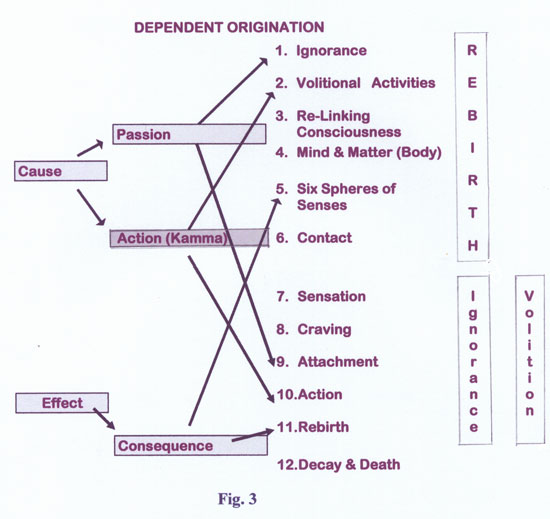
Looking at the above 12 links, the crucial point
is to stop at the point where contact gives rise to sensation or
feeling. Even if sensation or feelings have arisen, one should
prevent the feelings from concocting craving and clinging. It is at
this point of craving that kamma is generated. So without craving,
clinging and being, no dukkha is generated as no kamma has been
earned.
One can see that all the factors in this circle
of links of the Conditioned Genesis (Dependent Origination) are
conditioned and conditioning. They are relative, interdependent and
interconnected. Nothing is independent and absolute and there is no
first cause. If the five aggregates and all the other things are
conditioned and interdependent, there should also be no free will.
With this Conditioned Genesis together with the analysis of the
Five Aggregates, one finds that there is also no immortal abiding
essence in man. Whether this essence is called Atman or soul it
does not matter. This is the Buddhist doctrine of Anatta, No-Soul
or No-Self. In conventional truth or daily conversation we use the
word “I” merely to signify an individual separate from other
individuals. However in ultimate truth there is no essence or
abiding substance behind this individual. ‘A person should be
mentioned as existing only in designation (conventionally an
individual), but not in reality.’
The verses 277, 278, 279 of chapter XX of
The Dhammapada say:
277 All created things are
transitory;
Those who realize this are freed from
suffering.
This is the path that leads to
wisdom.
278
All created things are involved in
sorrow;
Those who realize this are freed from
suffering.
This is the path that leads to pure
wisdom.
279
All states are without self;
Those who realize this are freed from
suffering.
This is the path that leads to pure
wisdom.
Verses 277 and 278 say that all created things
are impermanent and therefore involved in dukkha, sorrow and
suffering. But verse 279 emphasized that ‘All
states’ are without self (anatta). The
word used to denote ‘all states’ is dhamma. The word dhamma
includes both conditioned and unconditioned things and states, the
Absolute and Nibbana. That means there is no Self or Atman in the
Five Aggregates or outside the Five Aggregates. Furthermore, there
is also no Self or Atman in the unconditioned --- the Absolute and
Nibbana.
For those who take the self as consciousness,
Buddha replied that it is better to take the body as self, because
the body is more solid. Also the mind or consciousness changes much
faster than the body. The vague feeling of ‘I Am’ gives the false
impression that there is a self in us. To cure this spiritual
disease is to see objectively that the Five Aggregates
work interdependently in a constant flux within the law of cause
and effect, and that there is no eternal, unchanging, and permanent
essence in all conditioned and unconditioned things and
states.

