This topic is for read-only.
Singapore -- I read with
interest a report in Temasek Review that some Singaporeans have
called for Ming Yi, the former CEO of Ren Ci hospital to disrobe
after he was convicted on charges of fraud and lying to the
Commissioner of Charities.
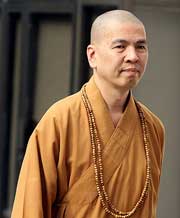 << Ven. Ming Yi - Should he be disrobed
for his financial miendeavour at Ren Ci Hospital?
It is indeed sad and disappointing that the once famous and
inspiring Buddhist monk in Singapore has broken his precepts and
break the hearts of his faithful lay disciples and supporters.
Ming Yi has already been punished for his mistakes. Should he
still dorn the saffron robes of a Buddhist monk or should he
renounce monkhood to prevent bringing the religion into
disrepute?
Though regretful, Ming Yi’s actions have not tarnished the name
of Buddhism in anyway. The Buddha taught human beings a method to
achieve real and eternal happiness. The dhamma, or the teachings of
the Buddha, is simply a path leading to the eventual goal.
I am not well versed in the Mahayana school to comment on
whether Ming Yi should disrobe. In the Theravade school of
Buddhism, to which I belong to, the monks are restrained under the
Patimokkha, or a code of conduct comprising of 227 precepts
formulated during the Buddha’s time more than 2,500 years ago.
According to the Patimokkha, there are four parajikas (defeat)
or rules entailing explusion from the Buddhist order or Sangha if
they are broken by a monk: – engaging in sexual intercourse with a
female, stealing, murder and “boasting of a superior human state
without direct knowledge.”
As long Ming Yi did not commit any of the above offences, he
does not need to disrobe at least according to the Theravada
school.
Buddhism does not discriminate against individuals who have
broken the laws of their lands. The Buddha taught that ignorance is
the root of all sources of human suffering. Unless one attains
Enlightenment or Nibbana, he/she will still make mistakes due to
delusion, greed and hatred.
In the Pali Canon, there is a story of a highway murderer named
Angulimala who became a Buddhist monk and attained Nibbana which is
seen as an example of the redemptive power of the Buddha’s teaching
and the universal human potential for spiritual progress.
Angulimala’s original name was Ahimsaka and he was a talented
and favourite student of a Brahmin during the Buddha’s time.
However, the other students grew jealous of his speedy progress and
sought to turn his master against him.
To that end, they made it seem as though Ahimsaka had seduced
the master’s wife and boasted that he was wiser than the guru.
Unwilling or unable to attack him directly, the teacher said that
Ahimsaka’s training was complete, but that he must provide the
traditional final gift offered to a guru before the teacher would
grant his approval.
As his payment, the teacher demanded 1,000 fingers, each taken
from a different victim, thinking that he would be killed in the
course of seeking this grisly prize.
Ahimsaka became a highwayman, killing travelers who passed
through the forest. When the people of the kingdom began to avoid
the roads, he entered the villages and dragged people from their
homes. He never took clothes or jewels from his victims, only
fingers.
To keep count of the number of victims that he had taken, he
strung them on a thread and hung them on a tree. However because
birds began to eat the flesh from the fingers, he started to wear
them around his neck as a garland. Thus he came to be known as
Angulimala (”garland (or necklace) of fingers”).
Villagers petitioned the king to hunt down Angulimala. Fearing
for her son’s life, Angulimala’s mother set out to find him and
warn him of the king’s intent. The Buddha perceived with his
“divine eye” that Angulimala had slain 999 victims, and was
desperately seeking a thousandth.
If the Buddha encountered Angulimala that day, he would become a
monk and subsequently attain Nirvana. If Angulimala encountered his
mother instead, he would slay her as his thousandth victim and fall
into hell for millennia.
The Buddha set off to intercept Angulimala, despite being warned
by the people of the village in which he was staying. On the road
through the forest of Kosala, Angulimala first saw his mother who
came to warn him of the impending arrival of the kings’ army.
Angulimala, after some deliberation, decided to make her his
1000th victim. But then when Buddha also arrived, he chose to kill
him instead. He drew his sword, and started running towards the
Buddha. But although Angulimala was running as fast as he could, he
couldn’t catch up with the Buddha who was walking calmly.
This bewildered Angulimala so much that he called to the Buddha
to stop. The Buddha said that he himself had already stopped, and
that it was Angulimala who should stop.
Angulimala asked for further explanation, after which the Buddha
said that he had stopped harming living beings, and that Angulimala
was still harming and hurting living beings.
After hearing this, Angulimala changed his ways, vowed to cease
his life as a brigand and joined the Buddhist order. Angulimala
eventually attained Nibbana and became an Arahant, the highest
stage of sainthood in Buddhism.
Angulimala’s story serves as an example that even the worst of
people can undo the faults in their beings and return to the right
path.
If Ming Yi has realized his mistakes and truly repent, we should
forgive and embrace him with an open heart. Being fellow wayfarers
in the endless rounds of Samsara, we have no right to judge
him.
Ming Yi has already been punished for his offences. He should
not be punished twice by being stripped of his saffron robe. If his
heart is still with the Buddha, he should be permitted to continue
his practice and who knows, he may be able to attain Nibbana in
this very lifetime too, like Angulimala.